There are two kinds of AI search visibility — and most brands are only measuring one of them.
The first is recognition. When a consumer asks an AI assistant a broad, category-level question — best sustainable athletic wear, top grocery loyalty programs, leading home improvement retailers — most established brands show up. Years of category investment, owned content, and earned media have given the major LLMs enough material to recognize who the players are.
The second is preference. When the same consumer asks a more specific question — one tied to a real need, a use case, a feature, or a buyer segment — the picture changes. The AI is no longer producing a list of who's known in the category. It is producing a recommendation. And the brand it picks is not necessarily the most famous one. It is the one whose value to that specific buyer the AI can explain most confidently.
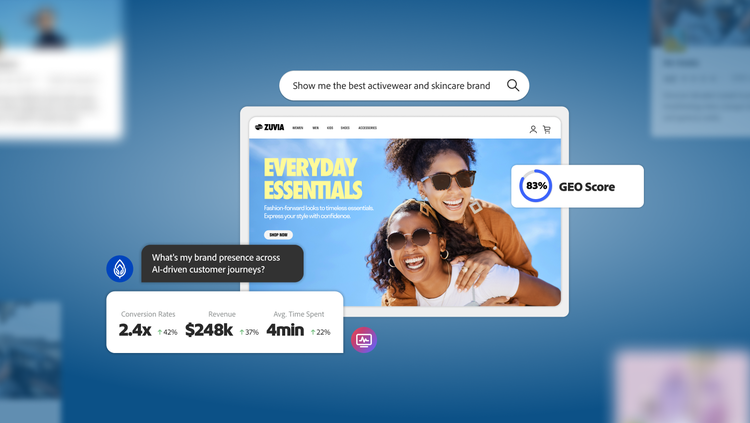
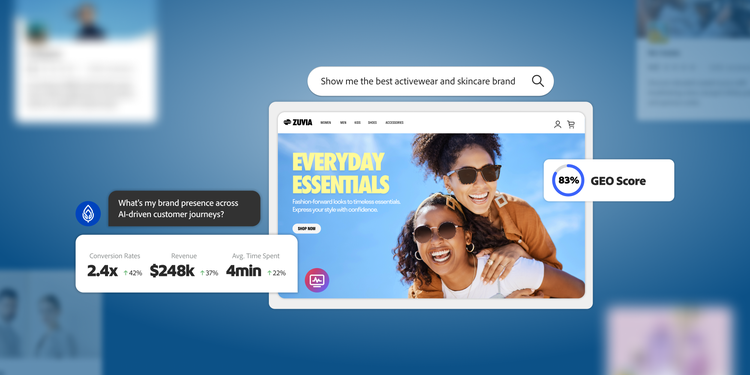
This is the gap most current AI search measurement is missing. And it matters more now than it did even six months ago. AI-referred traffic to US retail sites grew 393% year over year in the first quarter of 2026, according to Adobe Digital Insights. Shoppers arriving through that channel now convert 42% better than non-AI traffic, browse 13% more pages per visit, spend 48% longer on site, and generate 37% higher revenue per visit — a complete reversal from twelve months earlier, when AI traffic converted 38% worse than non-AI sources. The AI is no longer a top-of-funnel curiosity. It is one of the highest-quality discovery surfaces in digital commerce. Losing out on the queries that shape its recommendations is not a soft loss. It is losing the customer at the moment of choice.
What a real GEO assessment actually looks at.
Generative engine optimization (GEO) is the discipline that has developed around this new reality — measuring, and improving, how brands show up across AI assistants like ChatGPT, Gemini, Claude, and Perplexity. A real GEO assessment looks past whether your brand appears, and assesses what is actually happening on three layers — each one diagnosing a different way a brand can be visible and still lose the recommendation.
Layer 1: Whether the AI can read your content at all.
This is the most concrete problem and the most overlooked.
A brand can have a compelling story — strong products, distinctive positioning, real proof points — and still be largely invisible to AI crawlers because the pages that express all of that are built in ways the model cannot parse cleanly. The page that wins over a human visitor can render as near-blank to an AI engine due to JavaScript-heavy frameworks, dynamic rendering, fragmented site structures. Having ample brand equity is futile if there’s nothing the AI can actually cite.
Adobe Digital Insights' analysis of major US retail sites found that the average product page — the page closest to a transaction — scores just 66% on citation readability. A third of the most commercially important content on a retail site does not exist in the AI's view of the world. And the gap between leaders and laggards is wider than most brands assume: The best-performing retailers score 82.5% on homepage readability while the lowest performers score 54.2% — a 28-percentage-point gap between the top and bottom of the market.
Foundation is fixable. Adobe's AI Content Visibility Checker scores any page in seconds. But foundation is also table stakes. A perfectly readable site that gives the AI nothing distinctive to say about the brand is still losing.
Layer 2: Where you appear, on which queries, and what the AI actually says.
This is the layer where most of the strategic work sits. And it is best diagnosed across three distinct questions:
- Are you appearing in the top positions, or further down the list? Visibility and position are not the same thing. A brand can appear in a high share of relevant AI responses and still see limited business impact if it consistently shows up further down the list while a competitor holds the top position. AI responses are curated recommendations, not lists of ten links where every result has an equal shot. Brands appearing higher are generally more likely to carry weight with the reader. Measuring share of mention without measuring average position is one of the most common gaps in current AI search dashboards.
- Are you appearing on the right queries, or only the ones where the AI already knows you? This is where the recognition-versus-preference gap shows up most clearly. Brands that perform well on broad, category-level queries often disappear on the more specific queries that reflect actual buyer intent — queries that name a feature, a use case, a buyer segment, or a real-world need. The first kind of query tests whether the AI has heard of you. The second tests whether the AI knows what makes you specifically right for a specific buyer. On a broad query, the AI lists. On a specific one, the AI chooses.
- When the AI does include you, what is it actually saying? The same brand is often described in very different ways across ChatGPT, Gemini, Claude, and Perplexity. One engine cites recent product launches; another leans on older positioning language; another reduces the brand to a generic category descriptor. This inconsistency reflects the information ecosystem each model draws from. AirOps' 2026 State of AI Search, which analyzed 21,311 brand mentions across ChatGPT, Claude, and Perplexity, found that 85% of brand mentions came from external domains while only 13.2% came directly from the brand's domain — analyst coverage, press articles, customer reviews, and forum discussions doing the heavy lifting. That means GEO is not only a website optimization problem. It extends into the broader ecosystem of earned coverage, third-party validation, and review content that LLMs draw from when they synthesize a recommendation.
Layer 3: Whether any of this is translating to revenue.
This is the layer that turns measurement into a business case.
AI-referred shoppers behave fundamentally differently from visitors arriving through traditional channels. In March 2026, Adobe Digital Insights measured AI-referred traffic converting 42% better than non-AI traffic, generating 37% higher revenue per visit, spending 48% longer on site, and browsing 13% more pages. They are not simply browsing. They have already completed the research and comparison phase inside the AI conversation and arrive closer to a decision.
But there is a second dynamic here that almost no one is measuring properly — and it carries more strategic weight than the conversion lift.
AI search is not growing alongside organic search. It is replacing it.
The query volume that once flowed through Google is migrating to AI assistants, gradually and almost invisibly. Bain & Company found in February 2025 that 60% of searches now terminate without the user clicking through to another website. Organic impressions on many category terms are rising even as click-through rates fall — because AI-generated summaries are satisfying the query before the shopper ever clicks. A brand that sees organic traffic decline 15% while AI referral grows 8% is not breaking even. It is contracting. And a brand not tracking AI referral at all — still common — is contracting without knowing it.
Organic search and AI referral are no longer separate channels competing for separate budgets. They are competing for the same intent, on the same buyer, often inside the same session. The brands that build a unified measurement view will see the shift early enough to manage it. The ones that keep tracking them as separate line items will keep reporting that each channel looks fine, until the combined erosion shows up in revenue they cannot explain.
What this changes about how you compete.
The brands that look at AI search through this full lens rarely find the problem they expected. The foundation is usually in a better state than feared. The content is broadly readable. What is consistently missing is the connective tissue: the specific proof points structured in ways AI can retrieve, the earned coverage that reinforces a current and consistent brand story, and the value propositions made explicit enough that the AI can defend the brand on the queries that decide the recommendation.
Those are not technical gaps. They are strategic ones. And the brands that close them first do not just improve their AI visibility — they actively shift the position the AI gives to one brand and not another.
Three moves separate the brands that win this shift from the ones that don't:
- Measure preference, not just recognition. Stratify your prompt set by query specificity. Track position and share-of-mention separately on broad category queries versus the use-case, feature, and buyer-segment queries that decide purchases.
- Treat earned and owned as one surface. Audit the third-party pages — review sites, analyst coverage, community forums — that LLMs are actually citing for your brand alongside your own pages. With 85% of AI brand mentions coming from external domains, optimizing only your owned content means optimizing the wrong surface.
- Unify organic and AI-referral measurement. Report them in the same view. The brands that catch the substitution effect early are the ones whose dashboards already make the trade-off visible.
Recognition and preference are not the same thing in AI search. A brand can be widely recognized — appearing across broad, category-level responses — and still lose the recommendation when the question narrows to something specific: a use case, a feature, a buyer segment, a real-world need.
Those more specific queries are where intent shows up. They are where the AI stops listing and starts choosing. And they are where the competition for the AI's recommendation is most directly decided.
Measuring visibility on broad queries — and stopping there — is measuring the wrong half of the picture. The brands that win AI search will be the ones whose visibility holds up when the question gets specific, whose positions hold up against direct competitors, and whose value proposition is clear enough that the AI can defend the recommendation.
Explore Adobe Brand Visibility to measure, optimize, and act on AI visibility across every page and every engine — or scan any page in seconds with the free AI Content Visibility Checker.
Sneha Hatwar is a Senior Manager in Adobe's Digital Strategy Group (DSG), where she leads a global practice driving AI-led diagnostics, executive narratives, and scalable assessment frameworks for enterprise customers across the Americas, EMEA, and JAPAC. She recently incubated a generative engine optimization (GEO) diagnostic, an offering that evaluates how brands appear, rank, and get represented across ChatGPT, Gemini, Perplexity, and other generative AI engines — and translates those insights into content, authority, and positioning strategies. Sneha completed ISB's Leadership with AI executive program and brings over 12 years of experience across digital strategy, customer experience, and business analytics.