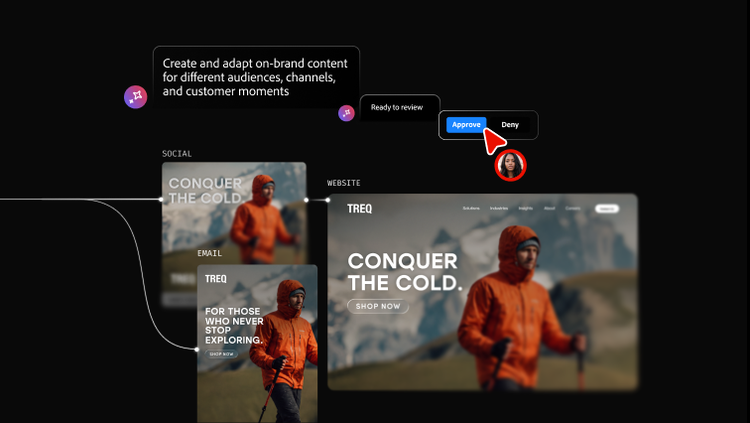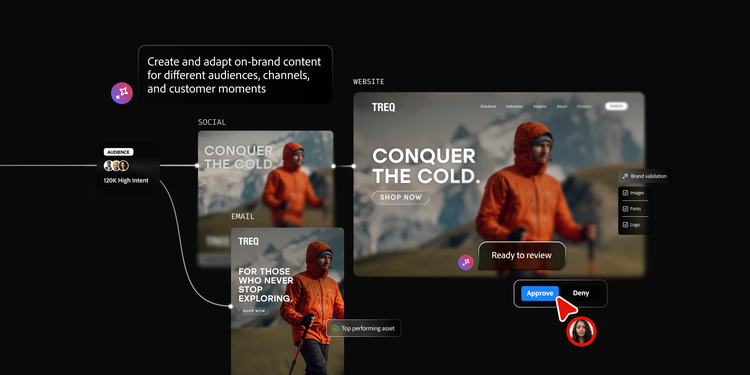
AI is redefining everything from how we work, how we make decisions, to how entire industries operate. It has fundamentally reshaped customer expectations practically overnight. Customers are now looking for hyper-personalization, conversational discovery, and always-on relevance from the brands they engage with. But the gap between what customers expect and what brands can deliver is widening fast.
This shift in customer engagement is actively reshaping how customer experiences are created and delivered while exposing the limitations of traditional content supply chains that were never designed to operate with this level of speed, adaptability, or personalization. They’re rapidly breaking down due to:
- Disconnected tools and teams, leading to slow workflows and fractured context
- Manual handoffs and approvals that become bottlenecks in the process
- Static metadata limiting asset discovery and reuse
- Limited visibility into performance signals preventing feedback looping back into creation
- Governance breaking down when you try to scale across audiences and regions
This gap is a core reason marketing and creative leaders feel overwhelmed today. The pressure isn't just about creating more content - it's about producing and delivering content for fundamentally different customer experiences, which takes a fundamentally different content supply chain. This moment represents more than a shift in tools. It’s a structural inflection point not just for AI adoption, but for rethinking the content supply chain itself. As AI transforms customer behavior, the systems behind your content must transform with it. Shifting from linear operations and AI-powered creation alone to an agentic content supply chain brings humans and agents together from ideation through delivery.
This blog is the first in a series exploring agentic readiness and the future of the content supply chain. First, we’ll look at the market forces that are redefining customer experiences, then we’ll explore why the future demands a new operational foundation that infuses agents into every step of the process.
The shift in customer expectations.
Customers no longer experience brands through campaigns — they experience them in meaningful moments shaped by intent signals, context, and conversations. Conversational AI interfaces are increasingly becoming primary gateways to brand interaction.
Recent research from Gartner shows that 73% of buyers avoid brands that send irrelevant content. In this environment, brand exposures can’t be repetitive or feel generic. They must be fresh, personalized, and interactive. That means marketing teams must orchestrate dozens of messaging combinations, imagery variations, formats, languages, and regional adaptations across channels, all with unique specifications and at every touchpoint. Differentiation today doesn’t come from content volume alone. It comes from continual, always-on relevance at scale.
What this means for your content supply chain.
By combining human creativity and strategic oversight with intelligent agents that automate execution, adapt to real-time signals, and continually optimize outcomes, organizations can deliver personalized experiences at the speed and scale customers expect.
Conversational AI changes the nature of content.
At the same time as content demand is exploding, AI is transforming how customers interact with brands. The rise of conversational interfaces — virtual assistants, AI concierges, and LLM-powered search — shifts content from static assets to dynamic, intent-driven responses. In a conversational world, content is no longer something customers consume — it’s how they interact with your brand.
Customers increasingly expect:
- Immediate, relevant answers
- Context-aware recommendations
- Seamless transactions
- Interactions that understand people’s intent mid-conversation
The shift turns content from a static asset into a dynamic interface that responds in real time, adapts to context, and continually learns from conversational engagement. A static, linear content process can’t keep up.
Content built once and shipped can’t hold up to an interface that’s expected to converse. Instead of continuing to produce static content, organizations need a connected, intelligent system that can drive meaningful conversations and optimize for intent and outcomes.
This means your content supply chain must be built for ongoing orchestration where intelligent agents keep content moving — accelerating production, maintaining governance, and optimizing for evolving customer engagement. Only then can brands deliver relevant, on-brand content at the speed of conversation.
Building an agentic content supply chain.
Transformation isn’t simply about keeping up, it’s about unlocking growth. AI is reshaping the content supply chain into an always-on, agent-powered system where intelligent services generate, route, and optimize content based on real-time performance and intent signals.
In this model, AI doesn’t replace creativity — it amplifies it. Leading organizations approach content supply chain transformation as a growth enabler rather than a response to pressure. They see AI as connective intelligence woven throughout workflows, where humans and AI collaborate in orchestrated sequences to produce, deliver, and optimize content together. This is how teams deliver high-quality content faster while protecting what makes their brand distinctive.
With humans orchestrating intelligent agents, brands can empower teams to create more relevant experiences and turn content into a durable engine for business growth.
What comes next.
As the first in a series that explores AI trends in the content supply chain, this article has focused on the external forces reshaping marketing — shifting customer behavior, exponential content demand, and the rise of conversational engagement.
In the upcoming articles, we’ll explore:
- Building an enterprise context foundation to power your agentic content supply chain
- Why a brand intelligence layer is essential for content creation in the AI world
- Building out your agentic ecosystem
- Orchestrating human-agent collaboration across your workflows
As AI reshapes every stage of the content supply chain, it’s no longer enough to optimize isolated workflows or layer automation onto legacy processes. The AI era calls for systems that are intelligent by default, connected end to end, and built to learn and adapt over time. It also calls for treating content as dynamic, data-informed experiences that not only meet rising expectations, but ultimately shape what customers expect next.
Leading organizations are moving toward an intelligent content supply chain that is connected, adaptive, and powered by agents at every stage. Learn more about how Adobe is building the future of the agentic content supply chain.