Workfront AI Collaborators: Now Generally Available

Adobe Workfront AI Collaborators is now generally available.

Many marketing teams already have AI agents scattered across their team. But often, most of that work happens in an isolated fashion (in someone’s individual chat window, for instance), making it invisible to the rest of the team and disconnected from the organizational flow of work.

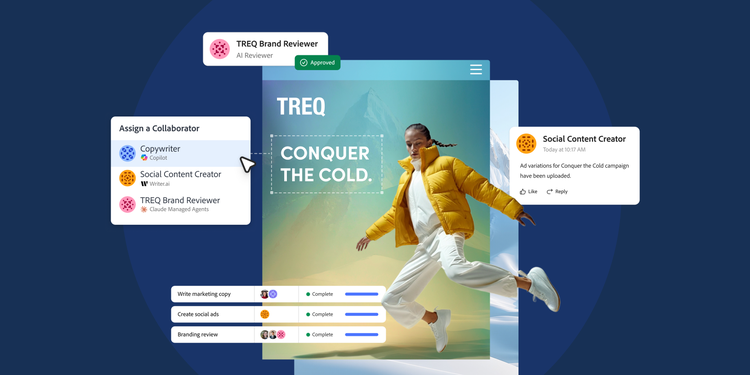
AI collaborators in Adobe Workfront aims to change that. This capability brings those same agents directly into a space where the work they do is visible, connected, repeatable, and reviewed like any other task. When fully integrated into governed workflows, AI Collaborators transform agents from side-channel experiments into a new engine for your marketing organization—unlocking faster, higher-capacity, and fully accountable work.

How you put agents to work, under control

An AI Collaborator is a permissioned user in Workfront that pulls the context an agent needs from your projects, putting them to work and returning the finished result into Workfront for review. It gives teams a governed way to delegate work to AI — with the right permissions, context, and an auditable trail of activity.

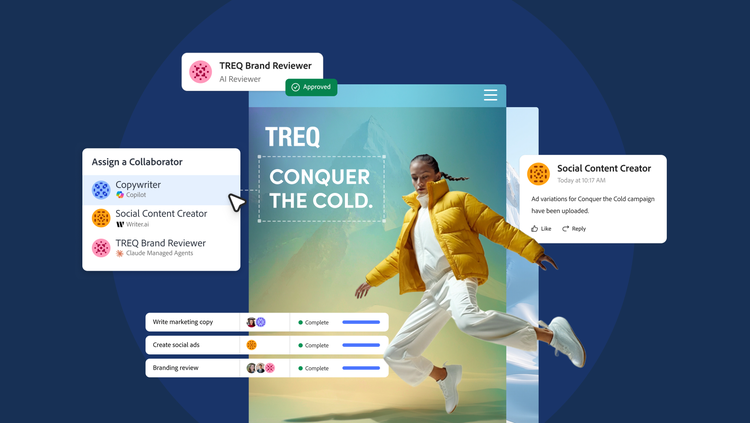
To get started, an AI Collaborator can be assigned work in the same way you’d assign it to a person. You can do this with any AI agent your team has built. Workfront automatically packages and hands the agent everything it needs, such as the task description, campaign brief, messaging rules, brand voice, and competitive analysis.

That is the difference that matters. The system supplies the context, so that the agent is more capable, and a quality response doesn’t ride on an individual knowing how to write a quality prompt. The output returns to Workfront, posted right to the task where it can be reviewed and approved. Nothing ships unseen, and every step is in the record. Permissions, audit trails, and human-in-the-loop approvals are built in from day one, so enterprises can operationalize and scale agentic work while staying in control.

That structure is what turns scattered agents across your organization into compounding value for your whole team.

  • Permissioned: The agent operates with access tied to its role, nothing more.
  • Visible: Results post to Workfront instead of disappearing into a chat thread.
  • Repeatable: The same context and instructions apply every time, so your best strategist's approach becomes the whole team's approach.
  • Auditable: Every step is logged, and a human always signs off before anything ships.

What this looks like in real work.

The clearest way to understand AI Collaborators is to watch where they automate work before a person ever gets involved. Here are use cases being built by AI Collaborator beta customers.

On-brand copy creation. A stakeholder requests new marketing copy for a landing page. An AI Collaborator connected to the team's copywriting agent — built in Microsoft Copilot Studio — creates an on-brand draft, pulling the brief, brand guidelines, and messaging pillars straight from the project, along with the custom details supplied in the request. The copywriter now starts from a strong draft and spends their time on craft and judgment, not setup.

Localization at volume. An approved piece of content gets localized across markets automatically with a regional reviewer checking each version for nuance, brand fit, and compliance — then signs off. The AI Collaborator handles the volume, and the human owns the judgment call. The entire path — from source content to every approved local version — stays governed and logged in one place.

From brief to ad variations. An AI Collaborator connected to a team's Writer agent and transforms a campaign brief into multiple LinkedIn ad variations.

Brand compliance review. A content reviewer Collaborator checks every piece for brand compliance before it reaches approvers — and when powered by Adobe Brand Intelligence, it enforces not just your written guidelines but how your brand actually shows up in practice, learning from real approvals, rejections, and comments as you produce at scale.

Adobe's own global marketing team is building AI Collaborators to generate channel-specific image renditions the moment hero assets land in a project. It can draft pages in Adobe Experience Manager and coordinate event-promo handoffs across teams.

Scaling agents with AI Collaborators.

These scenarios are just the starting point. As the models behind these agents get more capable, so does everything you can hand them. AI Collaborators let you put not one agent to work but many — specialized agents chained across a workflow, automatically passing inputs and outputs between people and agents. This means an entire sequence of work advances without someone shepherding each step. One task becomes ten, then a hundred, across your projects. And because it all runs in Workfront, you can see which agents are pulling their weight, which need tuning, and where you're getting the most value — so scaling agents means gaining capacity, not losing track of it.

Getting started takes a few minutes

Feels approachable. You're making AI digestible, and usable for us."

— AI Collaborators beta customer

Setting up your first collaborator takes just a few minutes and requires no heavy development. Name your collaborator, describe what it does, and connect it to any existing agent — then assign it to a task and watch the work get done.

Watch this demo to learn how to set up your first AI Collaborator.

Customers often connect AI Collaborator to agents built on common platforms such as Microsoft Copilot Studio, Claude managed agents and Writer. In addition, connections to any agent can be made via public API endpoint, MCP endpoint or an agent-to-agent connection.

Closing the loop: Agents into your work, and Workfront into your agents.

AI Collaborators bring agents into your work. Workfront MCP does the inverse. It lets your teams reach Workfront from the AI tools they already use (including Claude, Microsoft Copilot, Gemini, or ChatGPT) without leaving the assistant. Together they close the loop: work flows out to your agents and back in from them, in both directions, all governed, all anchored to one marketing system of record. That's what human-agent work looks like when it's fully wired. AI Collaborators are what make human-agent work real. They move agents out of side-channel experimentation and into the governed flow of work. That's how AI becomes more than individual productivity. It becomes a new gear for your whole marketing organization — faster, higher-capacity, and accountable by design.

Workfront is what turns that shift into results your team can count on. Learn more about Workfront AI Collaborators.

Let’s talk about what Adobe can do for your business.

Get started

I'm the Adobe Assistant. How can I help you today?

1