Where learning pays dividends.
Priority Commerce scales learning with Adobe to help employees adapt in an evolving FSI market.
86%
course completion rate
2x
faster time to proficiency for customer care employees, from 6 months to 90 days
89%
of new hires put learned skills into practice after completing training
https://main--da-bacom--adobecom.aem.page/fragments/customer-success-stories/priority-commerce
“The first thing I needed to do was centralize learning and create a single source of truth. Adobe Learning Manager checked all of our boxes for a learning management system.”
Hope Knowles
Director of Learning & Development, Priority Commerce
One place to learn and grow.
Training once lived everywhere: in folders, Google Drives, wiki pages, recorded webinars, and PowerPoint decks. For a company dealing with fast-changing finance and technology regulations, employees could easily end up working from outdated information.
“The first thing I needed to do was centralize learning and create a single source of truth,” says Knowles. “Adobe Learning Manager checked all of our boxes for a learning management system.”
Ease of use was critical because the platform needed to serve everyone from technical experts to beginners, working on all types of desktop or mobile systems. Strong reporting would help Knowles demonstrate impact, while security and compliance capabilities were essential for a financial services company.
“I really liked the simplicity of Adobe Learning Manager, getting everything up front and being able to scale it as we grew as a team,” says Knowles.
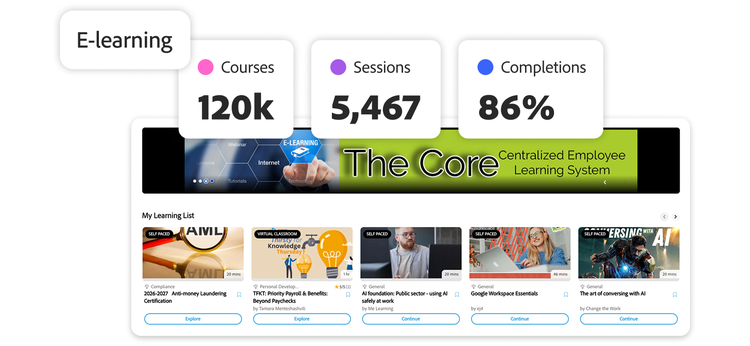
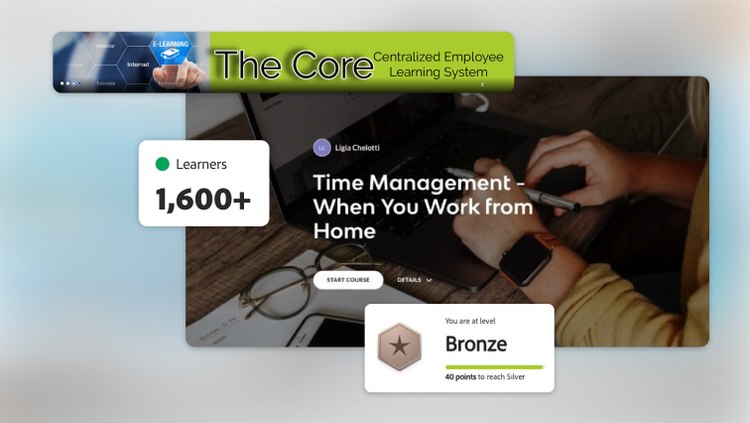
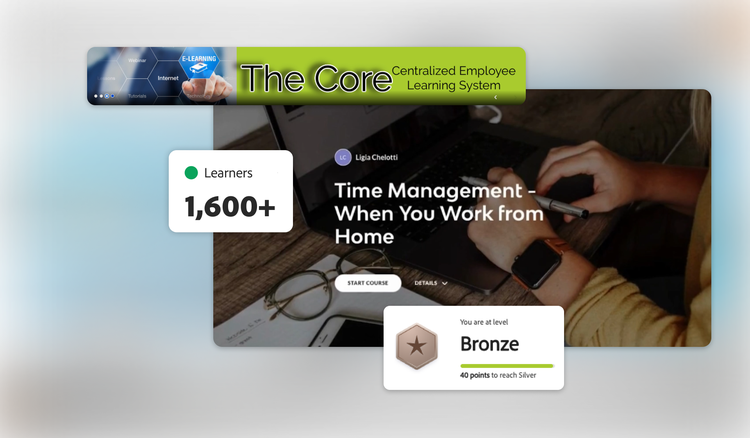
Today, Adobe Learning Manager, known internally as “The Core,” brings all self-paced e-learning, in-person and virtual instructor-led sessions, and hybrid courses into one environment. Employees know exactly where to find the onboarding, reskilling, upskilling, and leadership development they need.
Instructional designers create company-specific content using tools such as Adobe Captivate, while the company’s Go1 catalog covers more general training such as soft skills and digital security. Altogether, employees can access more than 120,000 courses.
Learning is now ingrained in the company culture. Priority Commerce recorded 5,467 course and session completions from 1,643 active learners in one year, with a course completion rate of more than 86%. That commitment to continuous learning helps employees grow alongside the company, building the skills to take on new roles and giving the company the workforce agility it needs.
Getting employees up to speed, faster.
Centralization makes it easier to deliver learning tailored to different roles. Rather than asking employees to navigate a massive library, L&D creates focused learning paths and can quickly customize existing courses for new needs, such as reskilling employees during a reorganization.
“We may decide the standard learning path is 80% there, so we just need to fill in 20% of the gaps,” says Knowles. “It can happen very quickly because all of our courses are right there.”
The impact can be seen in operations. In one case, targeted training helped teams strengthen skills and identify communication gaps, reducing the time it takes to change a customer’s bank account from several business days to just 48 hours.
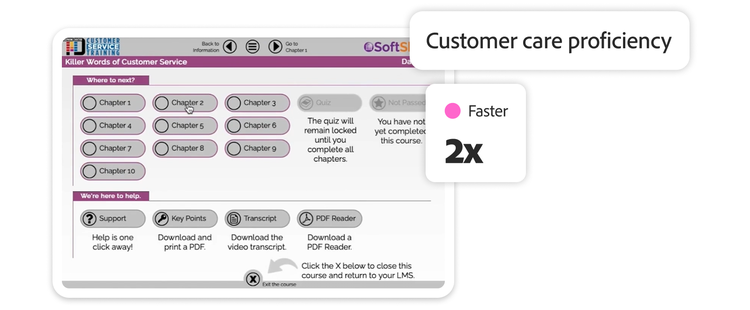
Personalized learning also accelerates onboarding. Customer care employees once took six months to reach proficiency in their roles. L&D redesigned the training path, and now employees typically reach proficiency within 90 to 120 days, up to twice as fast as before. That means new hires can become confident, productive members of the customer care team sooner.
“Being able to personalize the learning experience with Adobe Learning Manager helps us keep learners engaged and identify the skills they need to grow,” says Knowles.
“Reporting was how I was able to grow support for learning initially. I didn’t wait to be asked for data. I presented it.”
Hope Knowles
Director of Learning & Development, Priority Commerce
Proving learning works where it matters.
For Knowles, reporting has always been central to building credibility for L&D. “Reporting was how I was able to grow support for learning initially,” explains Knowles. “I didn’t wait to be asked for data. I presented it.”
Adobe Learning Manager gives the team a consistent foundation for measuring participation and effectiveness. The team measures learning beyond completion rates, using assessments to measure knowledge acquisition and retention. Manager evaluations 90 days after training show that 89% of new hires are able to use the skills they have been taught after completing training. All responding managers also agreed that new hires gain the foundational knowledge they need for their roles.
“We’re focused more on looking at changes in behavior with training,” says Knowles. “We want to know that they’re applying what they learned and that it’s making a difference to the business.”
The data also reveals opportunities for training growth. Knowles found that technology employees consumed far more learning content than other groups, even though most was optional. This insight is encouraging L&D to develop more targeted training for technical roles.
Getting ready for the next role.
Priority Commerce is continuing to expand learning to meet changing business needs, including piloting programs for external sales partners, developing sales certification, and exploring data visualization to connect training more clearly with business outcomes.
“We have to move more toward skills-based jobs versus job titles,” says Knowles. “What human elements can you bring to the table? That will be the key in the future.”
With Adobe Learning Manager as its foundation, Priority Commerce can respond faster to organizational change, help employees build skills for what comes next, and turn learning into a strategic driver for employee and business growth.
Recommended for you