#F8F8F8

ADOBE REAL-TIME CDP FEATURES

Flexible data connectivity

To deliver timely, personalised experiences, brands need flexible solutions that harmonise zero-, first-, second- and third-party data into intelligent, actionable profiles without unnecessary duplication or movement. Flexibly connect to a wide variety of data sources for faster adoption, better data governance and more scalable personalisation.

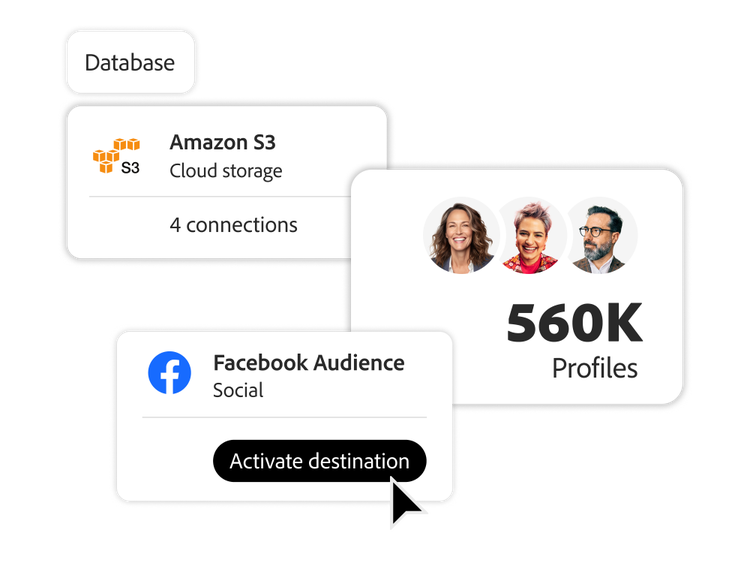
Interface showing Amazon S3 and Facebook Audience connections with 560K profiles.

Composability

With Adobe’s flexible and warehouse-centric approach, enterprises can use Real-Time CDP to activate warehouse data and provide a pathway for marketing to affect real-time experiences without having to move or copy underlying datasets. Balance data strategy and business objectives with the flexibility to federate or ingest as much or as little data as desired, depending on use cases.

  • Focus on composability. Build audiences from warehouse datasets without copying underlying data, then use Adobe for enrichment and activation.
  • Ingest data directly from warehouses. Ingest data directly from enterprise warehouses into Adobe for audience creation and activation that powers low-latency, in-the-moment experiences.
Federated Audience Composition

Allow customers to create audiences directly from their data warehouse and enrich them with attributes from warehouse partners. With this flexible approach, customers can continue to ingest data directly from both internal and external sources.

  • Data integration. Boost flexibility and efficiency with the ability to query relevant pre-built audiences and datasets from your enterprise data warehouse and partners into a single environment to augment Adobe Experience Platform use cases.
  • Enhanced marketing processes. Unlock additional support for segmentation, targeting and activation use cases with streamlined, adaptable workflows.
  • Efficient data management. Minimise data copy, govern sensitive data usage and optimise IT investments to complement real-time cross-channel use cases on Adobe Experience Platform.
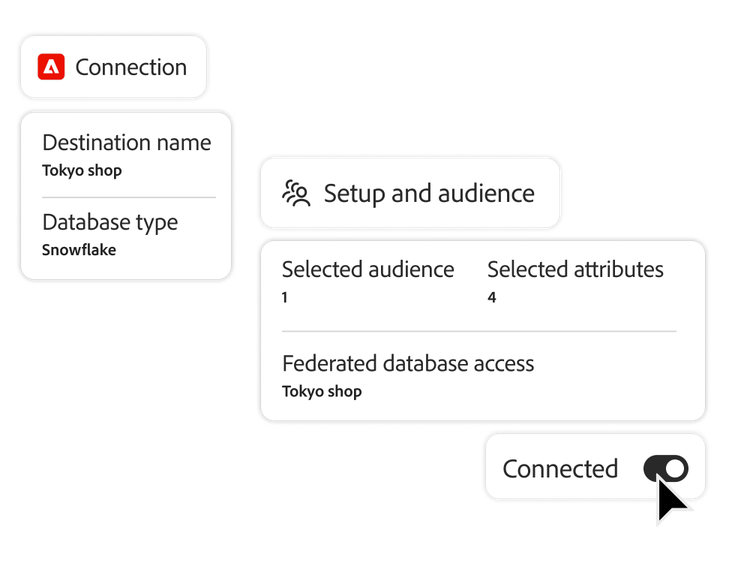
Connection set-up screen showing Snowflake destination, selected audience and attributes and a toggle indicating the connection is active.
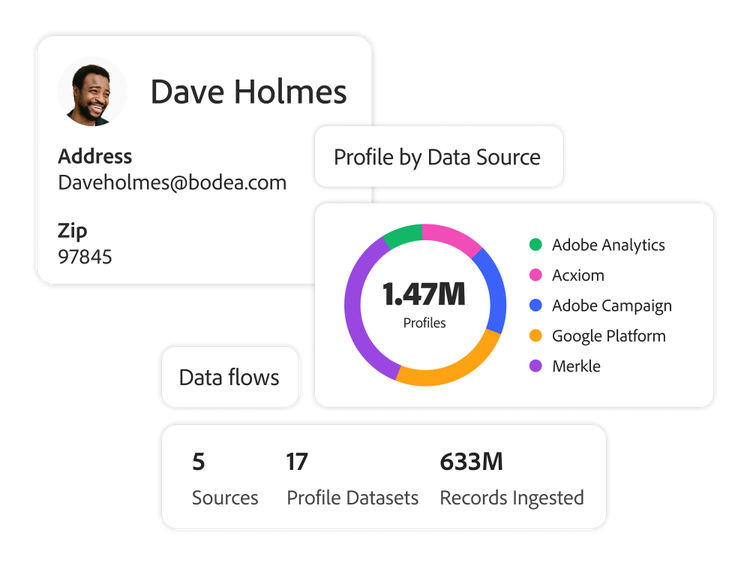
Customer profile view showing details, a 1.47M profiles data-source chart and counts of sources, datasets and records ingested.

Data types

Real-Time CDP offers robust support for the full spectrum of data types, including zero-, first-, second- and third-party data, to provide a well-rounded view of prospects, customers and accounts, enabling successful engagement at every step of the journey.

  • Zero- and first-party data. Ingest or federate data directly from a variety of sources, from event-level customer-provided data to analytics, survey, commerce and CRM data to fuel a comprehensive customer view.
  • Second-party data. With Real-Time CDP Collaboration, work with other brands, publishers or data partners to enrich your existing audiences or discover new high-value audiences.
  • Third-party data. Use cookieless identifiers and hashed PII (personally identifiable information) from third-party data partners to reach net-new customers and reduce third-party cookie dependency.

Learn more about flexible connectivity.

Content as a Service v3 - Learn more about flexible connectivity. - Friday, 16 January 2026 at 13.45

Learn how to use flexible connectivity features.

Find what you need in Experience League, our vast collection of how-to content — including documentation, tutorials and user guides.

Learn more | Learn more about how to use flexible connectivity features

Questions? We have answers.

What does composability mean in Adobe Real-Time CDP?
In Adobe Real-Time CDP, composability refers to a flexible approach that allows enterprises to activate data wherever it lives, without unnecessary duplication or movement. Organisations can ingest data directly from enterprise data warehouses for low-latency experiences, build audiences from warehouse datasets without copying underlying data or combine both approaches based on use case needs. This flexibility enables unified, intelligent profiles while supporting scalable personalisation and better data governance.
Why might some customers want a composable approach to customer data?
Enterprises increasingly rely on cloud data warehouses as the foundation for collecting, storing and managing large volumes of customer data, including historical transactions and past interactions. Marketing teams typically require only a subset of this data to create audiences and deliver timely, personalised experiences. A composable approach allows organisations to harmonise zero-, first-, second- and third-party data for activation without moving or duplicating entire datasets, supporting faster adoption and operational efficiency.
What is the difference between ingesting data and federating data in Adobe Real-Time CDP?
Ingesting data involves bringing data directly from enterprise data warehouses into Adobe Experience Platform to power low-latency, in-the-moment experiences. Federating data allows audiences to be built and enriched directly from warehouse datasets without copying the underlying data. Adobe Real-Time CDP supports both patterns — as well as combinations of the two — so organisations can choose the most appropriate approach for different datasets and use cases.
How does federated audience composition work?
Federated Audience Composition allows customers to create audiences directly from their enterprise data warehouse and enrich existing audiences with attributes from warehouse partners. With this approach, customers can query relevant datasets in a single environment to support segmentation, targeting and activation, while continuing to ingest data from internal and external sources as needed. This helps minimise data copy, govern sensitive data usage and optimise IT investments.
Can Real-Time CDP support real-time experiences while using warehouse data?
Yes. Adobe Real-Time CDP enables organisations to activate warehouse data while also supporting real-time experiences. By selectively ingesting data needed for low-latency interactions and federating other datasets, customers can power real-time personalisation, same-page experiences and cross-channel activation without having to migrate or duplicate all warehouse data.
How does composability help IT and marketing teams work together?
Composable data connectivity allows IT teams to maintain control over data governance, privacy and security by keeping sensitive data within enterprise systems. At the same time, marketing teams can access relevant audience data through a marketer-friendly interface to create, enrich and activate audiences across channels. This unified approach simplifies workflows, reduces data duplication and supports consistent, scalable delivery of personalised experiences.