REPORT
State of personalised financial wellness in APAC.
Using the Adobe Financial Wellness Index to guide customer growth in 2026.

JUMP TO SECTION
Financial wellness matters as consumer goals shift across Asia Pacific.
Consumers want help taking control of their financial futures.
Assessing personalised financial wellness maturity across retail banking apps.
Financial wellness opportunities and exemplars.
Reimagining Financial Wellness in APAC’s Next Growth Chapter
Consumers across APAC want their banks to be trusted partners—helping them plan, save, and invest with confidence. Yet, many still feel their banks fall short in offering personalised, proactive, and human support that makes managing money easier and more meaningful. Customers expect experiences that anticipate their needs and guide them toward long-term financial wellness. The State of Personalised Financial Wellness in APAC 2026 report helps CXOs pinpoint where customer expectations outpace delivery. Through the Adobe Financial Wellness Index, it benchmarks leading banks on personalisation, digital experience, and trust. The report outlines how FSIs can embed wellness at the heart of engagement, unlocking stronger relationships, higher loyalty, and sustainable growth in the AI-first era.
A word from Adobe.
Welcome to our second edition of the State of personalised financial wellness in Asia Pacific report, your guide to delivering better customer and business outcomes through financial wellness initiatives.
For many financial services organisations, financial wellness has become an ExCo priority. Leaders recognise that delivering meaningful, tailored support to help customers achieve financial goals can build lasting trust, engagement and loyalty. It’s a strategy that empowers customers and generates shared value.
Financial wellness remains in focus following a period of persistent economic uncertainty and elevated living costs across Asia Pacific. That’s led to consumers adopting financially responsible and cautious behaviours.
Adobe’s new research reveals that many consumers struggle to manage their finances, but most are eager to take charge of their financial futures. They believe retail banks should be doing more to support them and expect tailored guidance, tools and content along their financial journeys.
Our new Financial Wellness Index benchmarks how well retail banking apps deliver the financial support consumers expect. It shows encouraging progress in some areas, like money management, but constraints in other areas, such as personalised guidance and relevant products and offers.
AI also has a powerful influence as consumers and brands increase adoption. For financial services firms, this means being discoverable as more people use LLMs to find financial products and designing AI-assisted tools based on consumer readiness and preferences.
By examining consumer expectations and banks’ effectiveness in delivering holistic support, this report highlights opportunities to enhance financial wellness strategies. When delivered effectively and achieved at scale, financial wellness can help consumers achieve long-term financial health and enable financial services providers to capture greater lifetime value.

Financial Services Director
Digital Strategy Group APAC
Adobe
Financial wellness matters as consumer goals shift across Asia Pacific.
Across Asia Pacific countries, the macroeconomic cycle continues to turn. Interest rates have eased and inflation is subdued, bringing some financial relief to consumers across the region. This has supported a rebound in consumer sentiment in several countries. According to Ipsos, consumer confidence in India and Singapore is the highest globally, while Australia ranks among the top five1.
However, ongoing uncertainty, elevated cost of living, and memories of recent financial strain have left many people cautious. Consumer sentiment in India and Singapore is still below last year’s levels, and many across the region want to continue spending and saving responsibly, and make sure their money works harder.
That mindset, combined with changing interest rates, is prompting consumers to turn towards new financial products and seek guidance on making the right choices. That can mean moving funds from term deposits to higher-yielding options, refinancing loans, or resetting savings goals, to protect their financial wellbeing.
Retail banks’ opportunity to make a positive difference.
By understanding consumer needs and offering personalised financial support and products, retail banks can deepen engagement and capture a greater share of consumers’ wallets.
The risk lies in standing still. Adobe research shows that people most often buy financial products or switch providers for better rates and fees. Competing on these factors offers little room for differentiation without margin compression and can risk commoditisation. The next highest drivers centre on personalised digital experiences, which provide more room for retail banks to stand out.
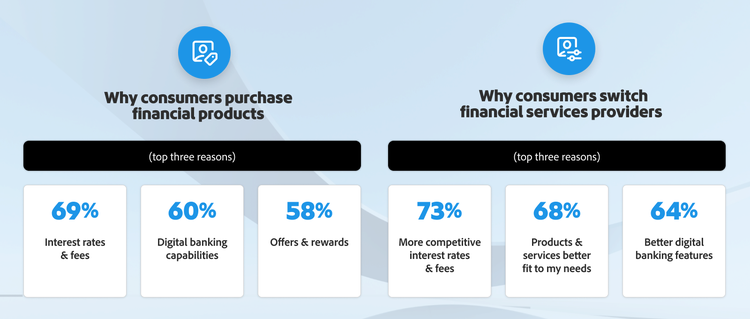
The next highest drivers of growth centre on personalised digital experiences, which provide more room for banks to stand out.
Consumers want help taking control of their financial futures.
People struggle to meet their financial goals
People have different circumstances and levels of financial security. For example, 54% of Asia Pacific consumers are spending less than they earn, so have the means to save and build wealth. Many have nothing left over or are outspending their income.
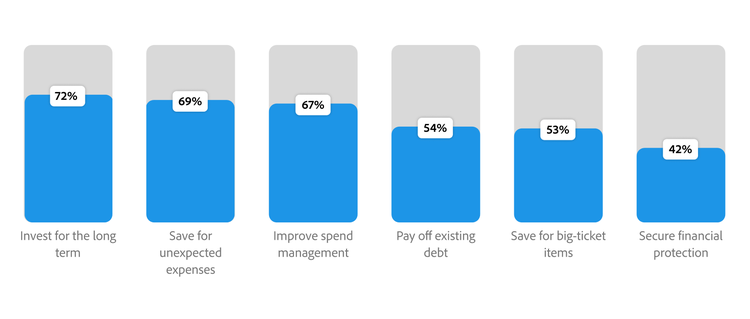
Top financial goals for Asia Pacific consumers
Despite a proactive mindset, many consumers face barriers to self-directed progress. These include prioritising everyday expenses and repayments, uncertainty about what steps to take and lack of time for planning. This highlights the need for more support in money management, financial guidance and time-saving experiences.
Consumers expect retail banks to do more for their financial health
Helping consumers attain their goals and improve their financial wellness is a win-win for customers and retail banking providers. When people feel confident managing their money, they are more likely to grow their relationship with a retail bank and less likely to struggle with repayments.
Many Asia Pacific retail banks recognise this connection, reflected in the rise of financial wellness initiatives across the region. Despite these efforts, a trust gap remains. Just 37% of consumers list their primary bank as their most trusted source of financial guidance.
At the same time, consumer expectations are heightened. At least half of Asia Pacific consumers expect their bank to support their saving, budgeting, tracking and planning tools and explain best-fit products. Almost two thirds want this to be personalised and relevant to their circumstances.
The financial planning support consumers expect from retail banks
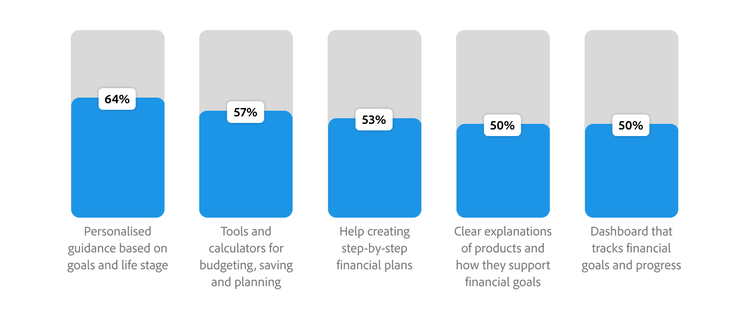
When asked which customer experience features would best support their financial goals, consumers favoured a mix of digital and human support. Integrated tools (83%), knowledgeable representatives (77%) and tailored financial guidance (74%) were top ranked.
Mobile apps were also the channel of choice for applying for, or securing, new financial products, and only slightly behind phone calls for help or support. To cut through the crowded app landscape, banks should focus on the features consumers value most, such as improving financial outcomes and delivering personalised experiences. These include:
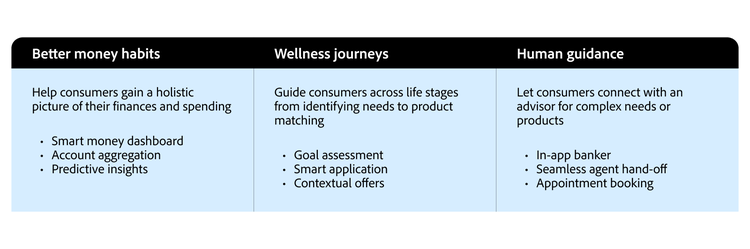
Segmentation as a starting point for delivering tailored guidance
A foundational step to bridging the gaps in trust and expectation is developing a clear view of consumers, their preferences, behaviours, expectations and how they like to be supported. The research unearths two persona types that covered over eight in ten consumers. Viewed as segments, they offer a baseline for meaningful engagement and deeper personalisation across thousands or millions of customer contexts.
Simplify financial management for me
36.5% of consumers
Empower me to meet my financial goals
46.9% of consumers

At least half of Asia Pacific consumers expect their bank to support their saving, budgeting, tracking and planning tools and explain best-fit products.
Assessing personalised financial wellness maturity across retail banking apps.
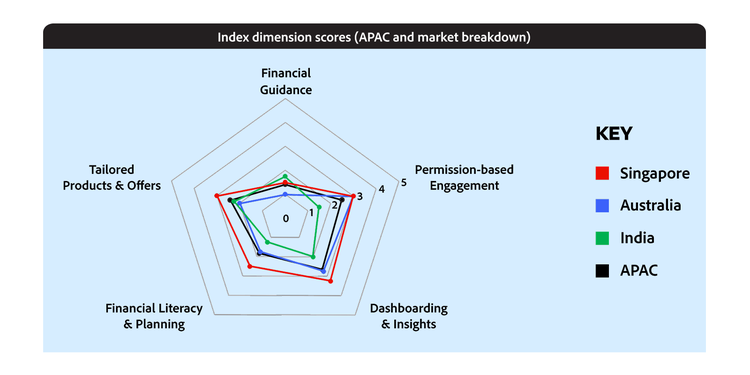
To benchmark the performance of Asia Pacific banking apps in delivering tailored financial wellness, Adobe created an industry-first index. Known as the Financial Wellness Index (FWI), it measures maturity across five core dimensions and 10 sub-dimensions at a bank, country and Asia Pacific region level.
Together, these highlight the opportunities for retail banks to improve personalised financial wellness, drive customer engagement and create cross-sell opportunities.
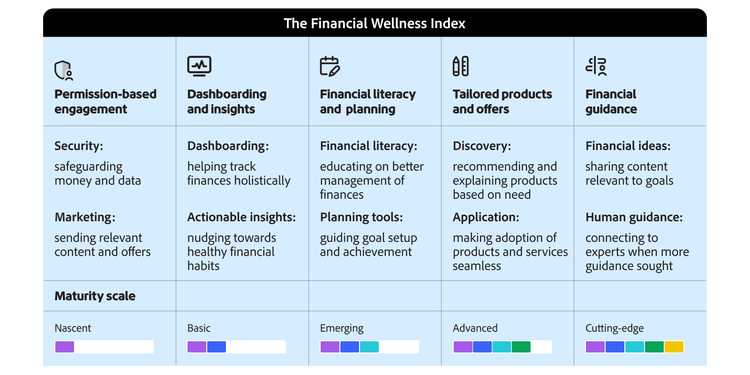
Connected financial wellness experiences the next frontier for Asia Pacific banks.
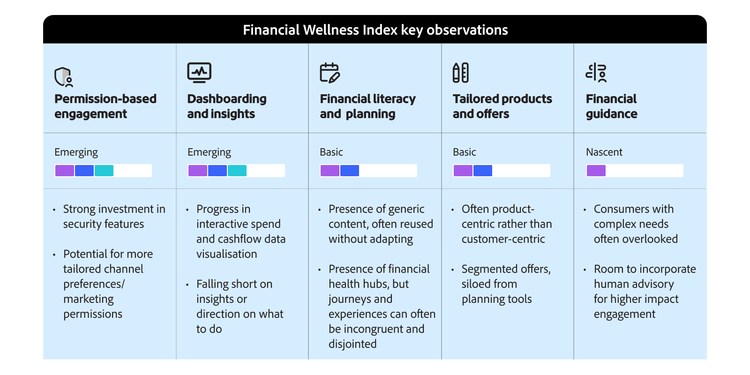
Singapore in focus
Of the three countries evaluated, Singapore recorded the highest Index score with an emerging level of maturity. This included rating the top or equal best in four of the five index dimensions. Investment in dashboarding and money management insights was prevalent alongside initiatives to uplift financial literacy and planning. While this helps banks in their ongoing efforts to engage mass affluent consumers, opportunities to cater to wider audiences can be missed. Leaders are delivering more cohesive journeys for consumers with different levels of wealth by matching the right tools and support with a broader spectrum of financial goals.
Australia in focus
Collectively, Australian banks also posted an Index reading that placed them in the emerging maturity tier. Scores were highest for permission-based engagement, reflecting a clear focus on cyber protections. Dashboarding and insights was close behind, supported by investment in spending and cash flow tools to help consumers navigate higher living costs. Financial literacy and planning ranked just below the Asia Pacific average, while tailored products and services lagged further. Banks scored lowest on financial guidance, with in-app access to human support often hard to find or unavailable, even when hardship assistance is offered.

India in focus
India’s index result indicates a basic level of Financial Wellness maturity. While this may be due to a focus on functional experiences, such as account management and transactions, there were notable bright spots. This included achieving the highest score in the financial guidance dimension, which was boosted by the availability of human relationship managers. There is also an opportunity to focus on foundational financial literacy and planning, which can be a cornerstone for growing relationships as consumers' needs become more sophisticated.
Financial wellness opportunities and exemplars.
Enhancing financial wellness experiences with AI.
Most Asia Pacific consumers use generative AI at least weekly, but its adoption for personal financial management is not as widespread. Consumers tend to use AI-driven search for brand and product research but prefer humans, or a combination of both, for financial guidance.
As AI-led banking features become more common, maintaining trust remains essential. Key to this is giving people control over how AI tools use their personal data and designing features with consumer comfort levels in mind.
LLMs are the new battleground for brand discovery
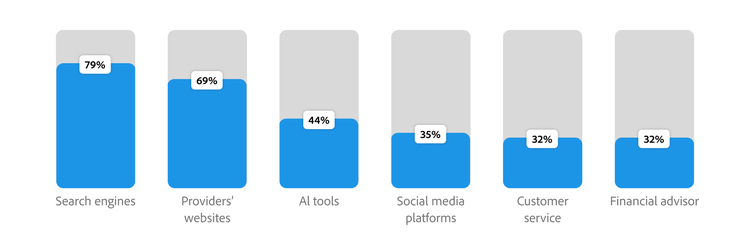
Most consumers are using large language models (LLMs), which have become the preferred channel for research among 44% of Asia Pacific consumers, ahead of social media and customer support. This is driving a surge in LLM-referred traffic, with separate Adobe Digital Insights showing a 1200% increase between July 2024 and February 20252.



Take action:
To maintain their ‘AI share of presence’, financial services brands can apply generative engine optimisation (GEO) to their content. Ground answers in bank-verified facts and recalibrate measurement framework.
Respecting consumers’ preferences is vital to trust
While 55% of Asia Pacific consumers are comfortable with AI-assisted financial management, people are still more likely to trust a human. That’s most acute for sensitive situations, like account issues or dispute resolution.
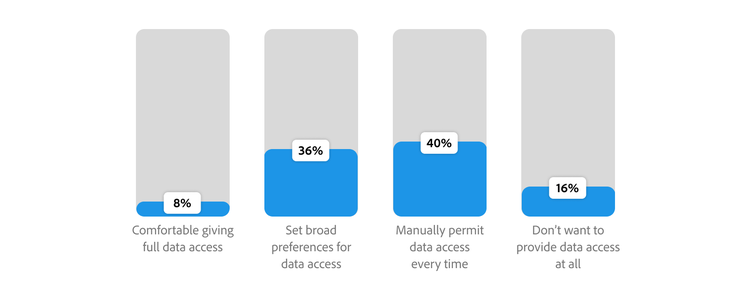
For financial planning, two-thirds want both digital tools and the option to speak to someone. Consumers also value data control and transparency. In fact, 76% of people want oversight on how much data access to give AI, whether broad settings or granular control.
Consumers’ personal data access control preferences
Take action:
Ensure AI agents have smart escalation logic to sense complexity or hesitation, handing off requests quickly to human representatives. By transparently explaining AI features and how data is used for AI-driven personalisation, consumers can be confident that their data is being used appropriately.
Mixed AI comfort across generations calls for right-fit approaches
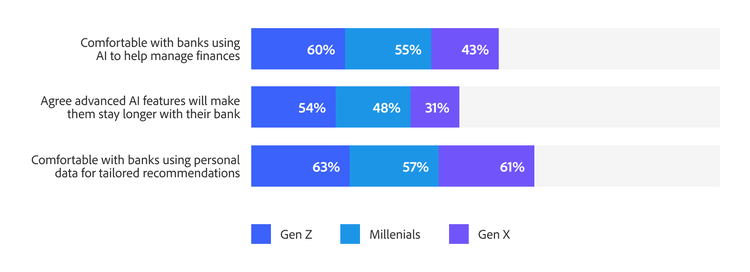
Gen Z are most comfortable with retail banks using both AI to manage their finances and their data for tailored recommendations. Millennials value control and transparency, expecting personalisation on their terms. While Gen X is open to AI, they prefer human interactions. While trust and readiness for AI features vary by age, there is little difference in generational attitudes towards banks using personal data to tailor recommendations.
Comfort level with GenAI helping to manage finances
Take action:
Adopt tiered engagement models based on readiness. For Gen Z, banks can provide AI-first journeys including financial coaching, personalised insights and agentic tools. Consumers with lower comfort levels may respond to more balanced or human-led hybrid models with transparent data usage.
The road to mutual value creation.
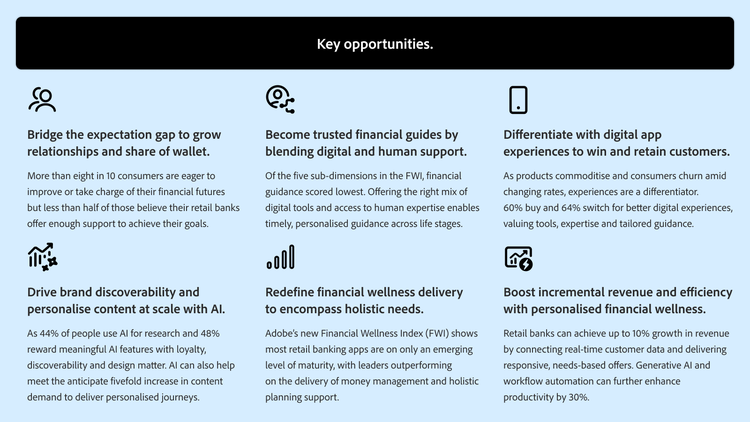
Adobe’s research reveals that Asia Pacific consumers expect their main financial institutions to better support their financial goals. In response, retail banks have opportunities to create more meaningful experiences that help consumers manage their finances, get support as needs evolve, and access digital or human guidance.
Personalisation is central to effective delivery. It starts with listening to the voice of the consumer and tailoring experiences to their goals and preferences. It relies on the intelligent use of data and AI to uncover insights, accelerate content creation and engage customers in the moment.
Marketing leaders play an outsized role in embedding financial wellness into brands’ value propositions and ensuring it is taken to market in the right way. Done well, it transforms financial wellness into a growth enabler, supporting new customer acquisition and cross-sell opportunities.
Based on Adobe modelling and industry benchmarks across the retail banking landscape, personalised financial wellness strategies have the potential to deliver:

incremental revenue by profiling customer needs in real-time to deliver personalised content and offers consistently across channels.

uplift in productivity using AI and workflow automation to transform the content supply chain.
Marketing leaders play an outsized role in embedding financial wellness into brands’ value propositions and ensuring it is taken to market in the right way.
How Adobe can help.
Adobe works with some of the world’s leading retail and institutional banks, insurance providers, wealth advisory firms and investment managers to enhance personalised financial wellness and grow customer engagement and revenue. Money is personal, and when customers trust their financial institution with their wellbeing, they expect experiences that genuinely drive better outcomes. Leading financial services organisations meet these expectations by unifying data, using generative AI to scale content and offers, and delivering real-time experiences across journeys and life stages.
To learn more about how Adobe can support you or the data, content and customer journey solutions that can empower leading financial wellness programs, request a consultation.
Research methodology
- Voice of the consumer research: Online survey with 700+ respondents across Australia, India, Malaysia, New Zealand, and Singapore conducted from April to July 2025.
- Financial wellness index: Heuristic evaluation of 12 mobile apps by Adobe digital strategists, covering four banks in Australia, four in India and four in Singapore.
- Business value: Estimated uplift in commercial metrics and productivity using priority use cases. Figures relate to the median-sized Asia Pacific bank, produced using Adobe and industry benchmarks.
About the research team
Varun Kapoor is a practice director in Adobe’s Singapore office, where Clement Quek is an engagement manager. Garima Nijhawan is an engagement manager and Tikendra Singh is a senior digital strategist in the India offices. The team wishes to thank the following colleagues for their contributions to this report: Jasmine Tran, Nicole Gemmell and Niveditha Somashekarrao.
Recommended for you