Guide
How Adobe boosted B2B conversions with an AI-powered go-to-market strategy.
Preparing for a human-led, agentic future of digital experiences.
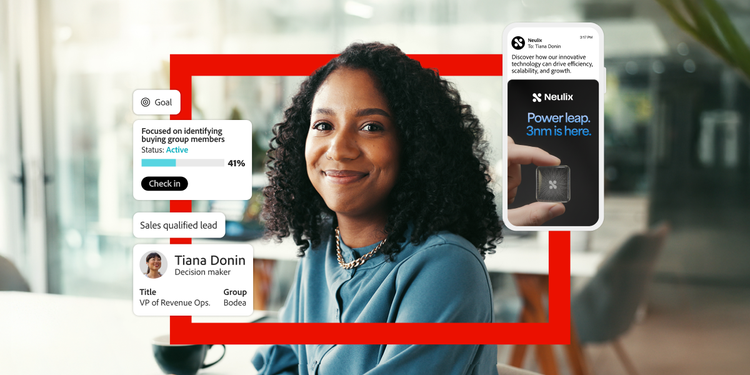
There’s a rapid shift in B2B marketing, driven by buyers who expect digital-first experiences, self-service options, and smarter engagement.
In our guide, How Adobe boosted B2B conversions with an AI-powered go-to-market strategy, we explore how Adobe has:
- Integrated AI into our marketing workflows.
- Built a new go-to-market operating model.
- Used real-time data and agentic AI for precision and scale.
Guide
How Adobe boosted B2B conversions with an AI-powered go-to-market strategy.
Preparing for a human-led, agentic future of digital experiences.
JUMP TO SECTION
Igniting a new era of B2B marketing at Adobe
The B2B complexities we needed to simplify
Building a strong data foundation for transformation
A unified technology architecture for go-to-market shift
Designing a new marketing model to boost B2B conversions
Adobe transforms B2B marketing with AI and unified data.
Adobe has revolutionized its B2B marketing strategy by integrating AI and establishing a unified data foundation to enhance customer engagement and drive conversions.
With agentic AI and connected data, Adobe has streamlined operations, improved precision in customer interactions, and aligned sales and marketing teams. This transformation serves as a blueprint for other companies to reimagine their go-to-market strategies and deliver exceptional B2B experiences.
Igniting a new era of B2B marketing at Adobe.

of B2B marketing practitioners are under pressure to deliver more content, more often, across more channels.
Source: Adobe
We always work to ensure our offerings keep up with the evolving B2B market. And often, when we see change on the horizon, we pilot new operating models, pivot our strategy, and fine-tune our products by using them on our own workflows first. Then, with success in hand, we set a new path forward. We needed to follow this same strategy to change how we engaged with our B2B customers.
Adobe has a rich legacy of innovation. We started with a few innovative products and today we’re a global enterprise serving both B2C and B2B customers with nearly 100 applications, platforms, and solutions. And, we’re always looking to innovate and grow, which is why we've incorporated AI into our mission to create personalized digital experiences. And with each new AI evolution, we’ve fueled more powerful capabilities with our products — such as using generative AI to expand creative possibilities. Recently, the next iteration of AI emerged: agentic AI. This technology constantly enriches real-time data to autonomously, and conversationally, engage customers with greater precision. It’s already proving to be a critical tool for engaging buyers and optimizing B2B journeys.

of B2B buyers feel organizations don’t understand when they value personalized interactions, and when they don’t want them.
Source: Forrester
The B2B complexities we needed to simplify.
The average Adobe B2B customer journey involves:



In addition, B2B sales cycles are growing more complex. Instead of engaging a single customer, marketers must target different buying groups within an account, each made up of multiple decision makers who each expect a personalized interaction. These long, multi-touch journeys required new ways of working to move beyond channel-based marketing and linear demand generation.
We were also focused on marketing qualified leads (MQL) at the top of the funnel, which was too narrow, accounting for a small percentage of our business.
We needed to:
- Understand prospects in the dark funnel — the phase before customers enter the sales pipeline — so we could deliver relevant content to personally engage them.
- Construct a unified data governance policy across the enterprise.
- Create a closed-loop strategy so sales and marketing work as a single entity to drive engagement and progression.
- Demonstrate the impact and ROI of marketing investments and efforts.
This could only be achieved with the ingenuity of our teams, coupled with the speed of AI and a centralized approach to data.
The launchpad for transformation — building a strong data foundation.

of B2B practitioners say having disconnected data is a roadblock to personalizing experiences at the right moments.
Source: Adobe
Like many B2B organizations, we faced a patchwork of systems, duplicated datasets, and limited visibility of accounts and buying groups. Although our go-to-market teams — marketing, sales, customer success, and retention — were steeped in data, they lacked an integrated technology stack to build a single, holistic view of customers or the ability to generate real-time actionable insights. This meant, they often relied on third-party data over zero- and first-party data.
As a result, our B2B go-to-market strategy was out of sync with the accounts, buying groups, and the personas we were targeting. This limited our ability to effectively nurture the most valuable leads with messaging tailored to their specific needs. Instead of intentional, personalized engagement at every interaction, customers often received an overabundance of communication that lacked relevancy.

We laid a foundation of connected data to align our teams to the same insights and systems. This centralized approach also prepared us for the advantages of an agentic future. Agents thrive on structured data — it gives them the context they need to work autonomously, drive efficiency, and deliver highly personalized and just-in-time customer experiences.
We established a unified marketing data foundation with dynamic audiences built from 36.7million contacts, 1.5 million accounts, and 201 attributes, consolidated from more than 1,600 data sources. Finally, we could turn customer behaviors into actionable signals for marketing and sales, enabling them to work from a single source of truth. Today, teams share insights to create highly personalized, account-based journeys that guide buyers through a customized experience that meets their unique needs, challenges, and buying stages.
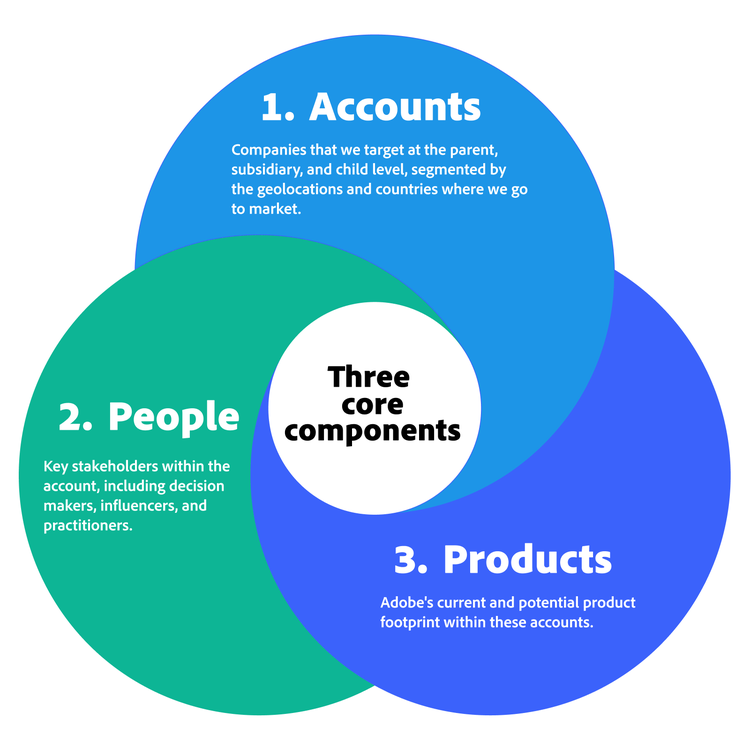

Aligning sales and marketing to the same customer data leads to four times more conversions.
Source: Adobe
Restructuring our data into a cohesive foundation required close collaboration with our CIO, IT, and martech teams. IT ensured data is reliable, secure, private, and scalable, while the martech team made it accessible so go-to-market teams can find the insights they needed in one convenient place.
With connected, real-time customer data, our go-to-market team can identify:
- Sales velocity
- Conversion insights
- Retention and engagement signals
- Accounts most likely to buy
- Opportunities by product
- Optimal overall marketing spend and mix
- Channels that deliver the highest ROI
- Revenue impact of marketing spend
Once we pooled our marketing data into a solid foundation, our new model started to take shape. The benefits expanded across the organization through a self-enriching data flow that generates new insights and creates a cycle of ongoing improvement, delivering more refined and unified experiences.
A unified technology architecture to power our go-to-market transformation.

of B2B organizations believe their firms’ tech sprawl is moderate to extensive.
Source: Forrester
Our engineers and product teams expertly design, test, and optimize our line of enterprise marketing tools. By using our own solutions to tackle challenges such as reimagining customer experiences and modernizing the content supply chain, we proved what’s possible — and what’s scalable — for every enterprise. We applied this strategy for our B2B transformation as well, deploying the full suite of Adobe's enterprise solutions. By implementing them in their native form, we enabled first-party data to connect at the application layer without offline data stitching, allowing various applications to work as a connected ecosystem. The result is a go-to-market solution that delivers higher ROI, reduced cost of ownership, and an accelerated speed to value.
There were three key benefits to deploying the full suite of products off the shelf:
- We avoided technology debt by using products as built, maximizing total cost of ownership.
- We simplified scalability with standardized systems that integrate easily.
- We shortened the deployment timeframe for early implementations, like Adobe Real-Time CDP and Adobe Experience Platform, to less than six months.
Built on the Adobe Experience Platform, our applications connect data, content, and journeys for a cohesive B2B customer experience. Our teams get a view of entire journeys, our marketing budget favors experiences rather than operations, and our go-to-market workflows meet customers at the speed they’ve grown accustomed to.
Our martech infrastructure includes a curated selection of tools:
Adobe B2B go-to-market orchestration
Adobe Experience Cloud

Adobe Experience Platform
Adobe Real-Time Customer Data Platform (CDP)
Workflows
Adobe Workfront complements our unified data foundation with a marketing system of record. We can plan, assign, and coordinate workflows from a single system. This allows us to manage specific campaigns and projects while also supporting efficient enterprise-level strategic planning.
Customer data
Adobe Real-Time Customer Data Platform (CDP) unifies customer data from various sources to create comprehensive customer profiles that are used to deliver personalized experiences across all channels and devices in real time.
Journey orchestration
Adobe Journey Optimizer B2B Edition is the ultimate tool for sales and marketing alignment. With the same customer insights, teams can coordinate their efforts to qualify buying groups and design and execute targeted campaigns that match every buyer with the right product.
Adobe Marketo Engage is a marketing automation platform that supports campaign execution across channels and aligns sales and marketing to the same intelligent buyer insights.
Adobe Target is an AI-driven application that continuously refines user profiles based on real-time behaviors, content performance, and A/B testing across all digital channels to optimize and deliver relevant experiences.
Content
Adobe Experience Manager Sites lets marketers build and test pages for web, mobile, or apps. Real-time feedback helps them optimize site performance and create personalized web experiences.
Adobe Experience Manager Assets is a digital asset management system that stores millions of brand assets for use across the organization.
Adobe GenStudio for Performance Marketing uses generative AI to power fast, scalable on-brand content creation and delivery to personalize experiences for every buyer.
Insights
Adobe Customer Journey Analytics delivers actionable insights from billions of data points across the end-to-end customer journey. These combined insights help us attract, target, and reach the right B2B audience.
A faster, more efficient content supply chain with a new B2B technology solution.
The data from interactions with anonymous leads and known customers allow us to understand buyer context — like role, intent, and readiness. Now, instead of generic messaging, we deliver hyper-personalized on-brand content that makes buyers take notice and engage. Our generative AI-powered creative tools boost the speed and scale of personalized content delivery and refine it based on what's making an impact. With GenStudio for Performance Marketing, we deliver assets in two days — down from eight weeks.
The five key principles that guided our marketing and IT partnership through a successful technology transformation.
- Integrated systems. To prepare for an AI-driven future, Adobe’s enterprise marketing and IT teams agreed that martech tools had to integrate with enterprise IT systems for seamless data flow and deeper customer insights.
- Shared vision. Both teams shared a goal — to unlock real-time insights and deliver personalized customer experiences at scale. This could only be achieved with close collaboration between IT and martech.
- Data interoperability. Data had to be secure, agile, and interoperable across all systems.
- Federated approach to interoperability. For greater agility and efficiency, we took a federated approach to data, allowing teams to access and use data where it lives, without moving it into a single system. This provided broader accessibility while maintaining security and governance, avoiding the silos and inefficiencies that often come with fully centralized or overly open data environments.
- Fluid data exchange across the organization. Both marketing and IT teams made sure insights flow seamlessly across teams in real time, free of latency issues so all teams are linked to the same customer data. For example, customer success teams can now add relevant details about B2B customers, enriching data that can help sales with cross-sell and upsell opportunities.
Designing a new go-to-market model to boost B2B conversions.
Next, we needed a new approach to engage our B2B audiences — one that could turn long, complex B2B lifecycles into streamlined journeys to drive growth. One study found that 92% of B2B customers make their decisions based on the first brands that come to mind. To stand out, we needed to solve for our customers’ unique challenges to showcase our business value and our brand impact. In other words, our messaging needed to match a buyer's intent wherever they were in the buying stage to ensure we’re top of mind.
With our underperforming lead-based model, unknown visitors and prospects remained in a dark funnel, making it difficult to turn unidentifiable visitors into qualified leads — and only a small percentage converted. According to Forrester, 27% of B2B revenue comes from new customers. Without the ability to personally engage these unknown prospects, we were leaving money on the table. So, we often shared generic, ineffective, and often irrelevant messages with those prospects while trying to collect data to identify them. This had the opposite effect of what we intended — it frustrated sales teams and turned prospects away.
Our enterprise marketing team needed a customer-centric approach that synchronized with sales and improved conversion rates. Our goals were to:
- Market to customers based on their intent signals.
- Personalize experiences for each role in an account.
- Drive sales based on insights.
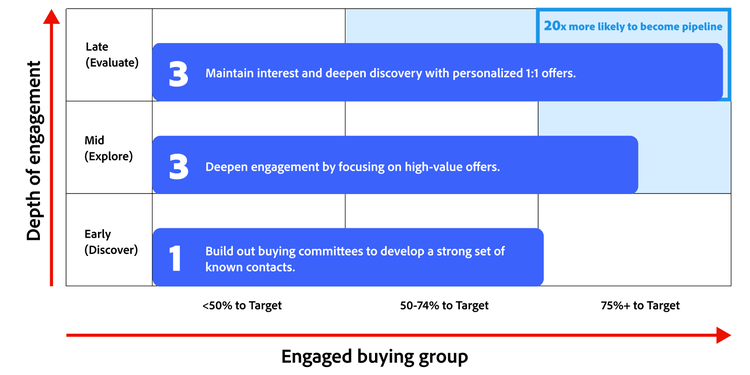
With our enterprise-wide database and new technology ecosystem, we moved away from traditional channel-based marketing approaches in favor of a journey-based approach, using an innovative progression model we call account engagement stages.
By analyzing buying group coverage, cross-channel engagement data, and intent signals, our marketers can uncover true demand, identify accounts to target regardless of engagement level, and guide those who demonstrate interest through personalized journeys and campaigns. This strategy also decodes signals from unknown visitors, so marketers can create an automated, efficient pipeline that improves both demand qualification and conversion rates.
Using real-time signals and intent data to gauge a buyer's level of interest and readiness to purchase, marketing and sales can pinpoint accounts with an uptick in momentum — like expressing interest in specific products. By recognizing the starting point of their journey, we avoid pushing customers into the pipeline too soon and succeed in creating more meaningful, customer-led engagement. We can also detect late-stage opportunities that are losing momentum, allowing the go-to-market team to act in real time. With this new model, the customers who reach stage three are 20 times more likely to become pipeline.

boost in average deal size. With our new B2B model and strategy, we’ve already seen measurable growth — and with continuous improvement, this number will keep growing while timelines shorten.
Putting it all together and bringing the model to life — an exercise in change management.
STEP 1: Set the vision and define business value by focusing on growth and cost savings.
Our ultimate goal was to create a high-functioning, world-class B2B marketing organization. We wanted this operating model to scale globally across the enterprise, support business growth, reduce churn, and maximize value and efficiency. This isn’t an overnight process, but rather a long-range strategy focused on two key initiatives:
- Growth. Our model was designed to improve conversion rates at every stage of the funnel and boost revenue by enhancing account engagement across channels. We would measure the results of this effort in two ways. First, by acquiring new customers and increasing upselling and cross-selling from existing customers. Second, by increasing retention and driving user adoption and advocacy.
- Efficiency. To remedy the pains of the B2B deal cycle and save money, we wanted our new model —fueled by our AI-first applications — to reduce manual work and target buying groups with greater precision, shortening our sales cycle.
By clearly defining and communicating our vision and anchoring it to business value, we built stakeholder belief in our transformation goals.
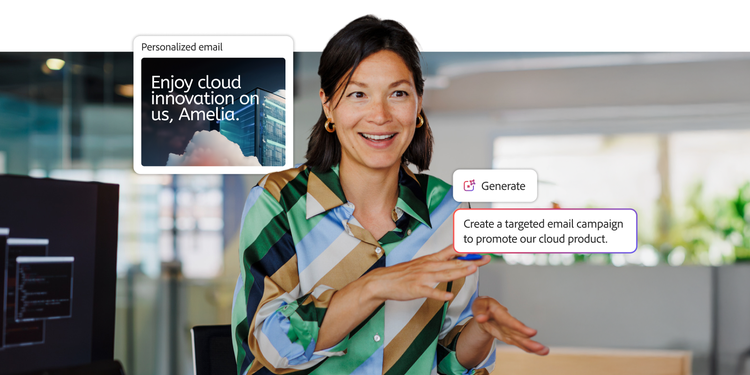
STEP 2: Securing stakeholder buy-in for successful change.
With these goals in mind, we considered two approaches:
- A technology-first approach, where innovation dictates what’s possible.
- A vision-driven approach, where business goals define the strategy and technology follows suit.
Each approach has merits, but we ultimately decided to use both. We believe we could have a greater impact with technology and business teams pushing the boundaries of possibility rather than trying to fit legacy processes into new systems. This was not a clear-cut path, but a customized approach that came with unknowns — yet our culture and history of risk-taking supported our decision.
Like any organizational change that requires people to adopt new workflows and ways of thinking, this shift from a lead-based model to account engagement was met with some resistance. We needed to secure stakeholder buy-in to be successful.
As an organization that is continually adjusting and adapting, change management is woven into our DNA. We assembled a cross-functional executive steering committee — made up of leaders from marketing, martech, and IT — to design a roadmap aligned with desired business outcomes. This team met bi-weekly to advance transformation and proactively address any concerns. We also set up a regular marketing and sales interlock where the teams discussed the impact of our progression model and learned how to activate sales with data and insights to prioritize actions.
For example, one hurdle involved our business development representatives (BDRs), who bridge the gap between sales and marketing by identifying high-propensity leads. Previously, their performance was measured by pipeline volume. But, with an account-based strategy, success is defined by pipeline quality, survivability, and win rate. This shift raised a red flag for sales, which initially saw a decline in the sheer volume of BDR-generated pipeline. In response, we built a proof of concept and piloted a new lead-scoring model to help us identify buyers most likely to convert. We gradually scaled our approach across the go-to-market organization. These detailed insights helped BDR-generated pipeline progress and convert faster, allowing stakeholders — particularly in sales — to see the benefits firsthand and throw their support behind the new model.
Overcoming resistance to change takes a structured approach, which should include:
- Communicating the long-term benefits to everyone involved.
- Demonstrating improved efficiency and outcomes with tangible proof points.
- Taking a phased approach to implementation, allowing stakeholders to adjust.
- Ensuring alignment across teams with leadership advocacy.

STEP 3: Running with a clearly defined operating model.
With executive priorities in sync and technology capabilities tied to business goals, we had the framework for a well-defined process and operating model. Our marketing and technology teams then developed a centrally managed, scalable, and adaptable strategy to address go-to-market business challenges.
First was the discovery phase, during which the marketing team defined gaps and needs to create use cases. This helped us define the capabilities required for go-to-market success. We used these insights to produce a business requirement document (BRD), which served as a roadmap for meeting our business objectives. Next, we prioritized these use cases according to our business goals and created a product requirement document (PRD), which helped our developers write code to build the functionality and features we needed in our products. These two documents unified strategy and execution, so our technology investments stayed in sync with our business objectives. We launched and activated each use case, with ongoing iterations for constant improvements.
Working with multiple stakeholders and decision makers can be challenging. Here are three guiding principles we used to stay on track:
- Take a centralized approach to implementation for consistency across systems, people, and marketing efforts.
- Collaborate with data experts to gain insights on a granular level.
- Focus on foundational capabilities as well as specific marketing use cases to build toward future applications, such as integrating natural language interaction in Adobe products to prepare for an autonomous agentic world.
By reinventing our B2B model, we created a go-to-market solution to drive the same results for other companies by enabling them to:
- Integrate data, content, and journeys on a single platform to grow revenue.
- Boost go-to-market efficiency with real-time insights on customer readiness.
- Improve marketing agility and precision with personalization based on a buyer’s role and needs.
- Increase engagement and lower acquisition costs with self-serve digital experiences.
- Scale and accelerate workflows with generative AI and agents built for B2B go-to-market strategies.
STEP 4: Making the people, process, and culture the core components of effective change.
Technology is the nuts and bolts of our new model — the hardware that makes it all happen. But people, processes, and culture are equally pivotal to implement change. With an upskilled, customer-focused team, automated processes that enable agentic AI, and a culture that embraces experimentation, we are well-positioned to deliver exceptional customer experiences that drive the outcomes we want to achieve.
People
As we transitioned to an account- and buying-group-based go-to-market strategy, we had to redefine some of the roles within our teams. We developed a comprehensive understanding of what each team member does and how they can achieve success under the new operating model. They had to evolve from task-oriented to strategic-minded, focusing on using data to drive revenue.
To move forward with a human-led, AI-supported structure, we evaluated the processes and tasks that required human engagement, as well as those that had become redundant due to automation. Teams redefined their tasks to prioritize high-value contributions that better support the progression framework. For instance, channel marketing managers — who once drove marketing efforts by channel — are now journey managers, responsible for the more strategic, cerebral task of managing micro-journeys to drive engagement with our target B2B accounts. Meanwhile, our AI-powered tools took over repetitive tasks. Real-Time CDP manages list creation and processing, while Adobe GenStudio for Performance Marketing supports journey managers and creatives with content creation.
Process
To support a data-rich, interoperable tech stack that delivers the B2B experiences we envisioned, we realigned our processes with our go-to-market frameworks — our new North Star. We began by identifying the digital go-to-market capabilities needed and simultaneously developed an adoption model.
Having the same KPIs was also crucial, including time to launch a campaign, speed to insights, and insights to actions. These metrics helped validate the effectiveness of our execution, motivating teams to switch to the new processes to receive the tangible benefits that drive adoption across departments. This alignment had an added efficiency benefit — we consolidated nearly 100 performance management dashboards across marketing down to 12.
Culture
At Adobe, we’ve built a culture that supports innovation, rapid learning, and falling forward — the belief that what feels like a setback is actually a learning opportunity. Our teams are empowered with ownership of innovation to drive meaningful progress for themselves, their colleagues, and the company. Success for one is success for all. These values keep us continuously improving and working toward new goals.
Using our solutions to achieve a desired outcome placed us in a unique position to influence the trajectory of AI in creativity and marketing. Our go-to-market teams use their hands-on experience to make suggestions that enhance product roadmaps and capabilities. For example, our sales reps assisted in testing and providing feedback for Adobe Journey Optimizer B2B Edition. This solution features a robust dashboard that helps sales teams visualize and prioritize accounts, automated scoring to qualify buying groups, and — the latest feature — an AI agent designed specifically to support sales.
Building on our culture of innovation and our four core values — create the future, own the outcome, raise the bar, and be genuine — our centralized approach and the close partnership of our teams complements our unified, collaborative model to ignite change. We also equip our staff with the right skills for long-term growth. This builds resilience, a key quality to thrive during periods of change. With these principles embedded in our operating model, we’re paving the way for a future that is agile, data-driven, and deeply aligned with our business goals and those of our customers.
6 key takeaways to futureproof your B2B marketing transformation:
- Start with a centralized data foundation.
- Embrace innovations like AI agents that enhance your B2B strategy.
- Prioritize customer-led engagement for more meaningful experiences.
- Lead with partnerships and a central directive.
- Build a tighter CMO and CIO alignment early in the transformation.
- Foster a culture of innovation and experimentation to support rapid learning.
A B2B go-to-market strategy built for tomorrow and beyond.
The B2B customer journey is always evolving. Where it’s headed is filled with opportunity — as long as your organization is prepared. Adobe’s breadth of platforms, applications, and capabilities has been fine-tuned by our own evolution in the B2B realm. Today we deliver insight-enlightened experiences tailored to roles, intent, and readiness. The result is a next-generation go-to-market solution where human innovation is powered by AI for greater speed and precision to meet buyers exactly where they are in their journeys. Adobe’s go-to-market strategy and solution are agile, innovative, and deeply attuned to the needs of enterprise buyers in a future shaped by agentic AI.
Discover how Adobe’s AI-powered solutions can help transform your B2B marketing model.
Sources:
“2025 AI and Digital Trends in B2B Journeys,” Adobe, 2025.
“B2B Transformation Series: Adobe on Adobe Digital Marketing,” Adobe, March 2025.
Biswajeet Mahapatra, “CIOs: Get Tech Sprawl Under Control,” Forrester, September 17, 2024.
Eoin Cahill, “The B2B buyer has evolved. But has your marketing?,” Google, May 2024.
“How to Improve the ROI of Personalization at Scale,” Forrester Consulting and Adobe, May 2025.
Ross Graber, “B2B Marketing Leaders Don’t Trust Their Measurement, And What They Measure Isn’t Helping,” Forrester, May 1, 2024.
“The State of B2B Marketing Measurement,” Forrester, February 7, 2025.
Recommended for you