Supervised machine learning


AI-powered marketing measurement and planning with Adobe Mix Modeler.
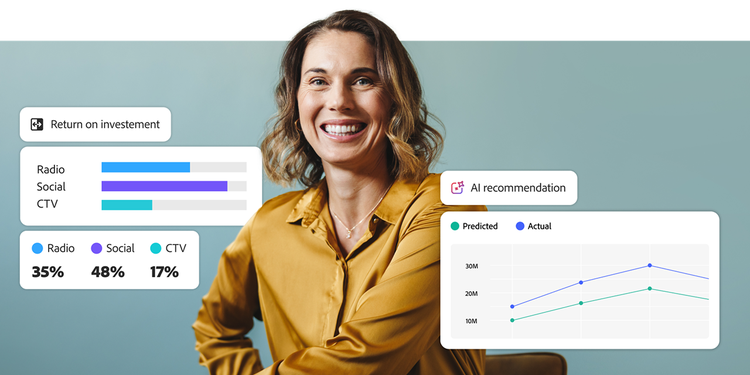
Marketers need to prove the effectiveness and ROI of their investments and do so quickly — while growing revenue, increasing efficiency, and dealing with declining marketing budgets.
This is becoming a greater challenge as shifts in consumer privacy cut off access to valuable customer data, degrading the perceived accuracy and value of marketers’ analyses. Unfortunately, traditional methods of marketing mix modeling often take too long to yield actionable insights in the fast-paced business world. In short, the usual ways marketing professionals measure performance and plan future marketing investments are no longer sufficient.
In short, the usual ways marketing professionals measure performance and plan future marketing investments are no longer sufficient.
At Adobe, our own marketers faced some of these same problems. After realizing that there were no suitable solutions in the market, they asked the Adobe data science team to build a new tool that could deliver faster, more robust analyses to inform strategic marketing decisions and increase ROI.
Crucially, the tool needed to:
“Most tools in the market use a model that scores each channel fully before moving on to the next one,” says Kiyoshi Ihara, director and head of product for Adobe Mix Modeler. “But that takes a lot of time and makes forecasting and planning difficult because there are no modeled relationships between channels.”
“There’s a balance: You need confident, accurate, and timely information, not a false sense of precision three months after you needed to pivot.”
“We needed something that would score each channel relative to the others to account for the impact channels have on each other,” Ihara continues. “We also needed to improve forecasting, which allows for planning — a huge gap in the industry when it comes to turning insights into action. And we wanted these insights and recommendations to be available in time for marketing decision-makers to act on them.”
The result was Adobe Mix Modeler, an innovative marketing solution that uses predictive AI to join two powerful methodologies — marketing mix modeling (MMM) and multi-touch attribution (MTA). Marketing mix modeling in Adobe Mix Modeler is a privacy-friendly machine learning analysis used to measure the incremental impact of various marketing tactics with conversion metrics. Multi-touch attribution in Adobe Mix Modeler is a machine learning analysis in which you can attribute credits to event-level touchpoints. Marketers use this attribution to help quantify the marketing impact of each individual touchpoint across customer journeys that are trackable.
Together, they form a holistic approach that enables marketing teams to quickly create and compare scenario plans and make decisions efficiently based on incremental ROI analysis.
Mix Modeler delivers faster insights and more trustworthy measurements than other tools. And the story of this unique and disruptive solution, a marriage of marketing art and data science, is one worth telling.
Adobe Mix Modeler is the AI-powered answer to a question that marketers have been asking for decades: How do I accurately measure the cost and impact of my efforts?
But first, it’s important to understand how we got here.
In the early 1950s, Harvard Business School Professor Neil Borden got marketers thinking about this question when he coined the term “marketing mix,” which refers to the collection of marketing channels a company invests in. Today, those include a diverse array of online and offline channels spanning both the digital and physical worlds.
Borden believed that, in a universe of complex forces, marketers must juggle the elements in their marketing mix while keeping a close eye on the resources they must work with.
What was true then is still true: Marketers must maximize limited resources to navigate a challenging and ever-changing business environment. Another truth that still holds up is the difficulty of accurately determining return on investment — what business outcomes marketers are achieving, how much those outcomes are costing them, and what is the best decision based on that information?
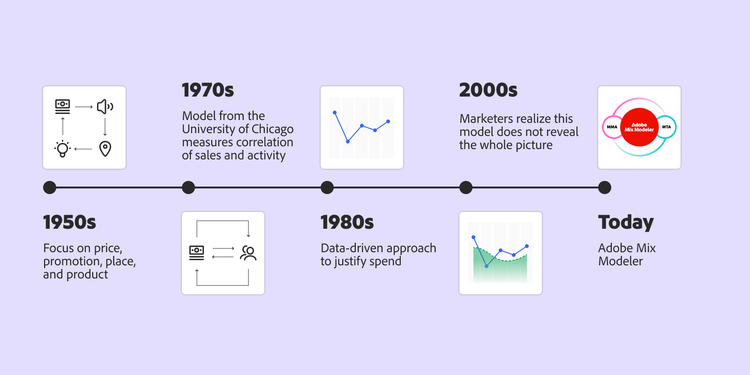
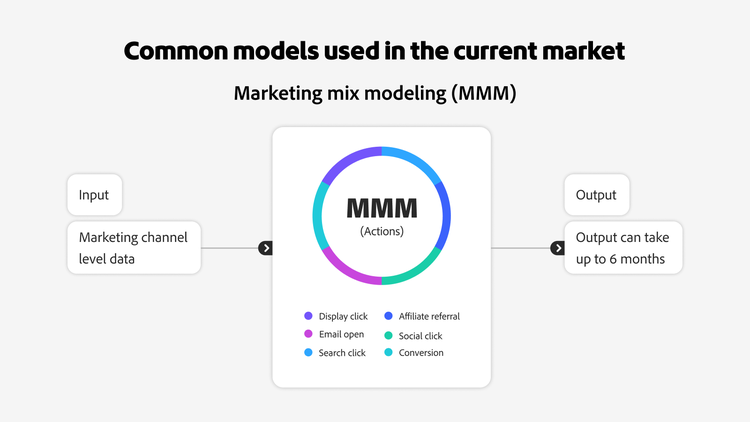
Marketers applied Borden’s idea to create marketing mix modeling, which uses regression analysis on historical data to quantify the impact of various marketing activities on any conversion event. However, MMM had several shortfalls that kept it from remaining in widespread use as other digital methods of tracking customer behavior emerged. Specifically, the MMM methodology suffered from being painfully slow to provide results due to its manual approach, lacking granularity in its analysis, and missing the bigger picture value of building brand equity.
As technology advanced and the internet became prevalent, multi-touch attribution became a popular approach for tracking the increasingly complex ways consumers interact with brands and products across digital channels. MTA offered marketers a way to get granular insight into individual purchasing decisions.
But it was also flawed. MTA only measures digital channels, rather than the full share of wallet that includes offline channels, so it doesn’t represent the entire customer journey. The methodology depends on click-path data, which primarily relies on tracking cookies that are being phased out.

“Most tools use a model that scores each channel fully before moving on to the next one, but that takes a lot of time and makes forecasting and planning difficult because there are no modeled relationships between channels. There’s a balance: You need confident, accurate, and timely information — not a false sense of precision three months after you needed to pivot."
Kiyoshi Ihara
Director and Head of Product, Adobe Mix Modeler
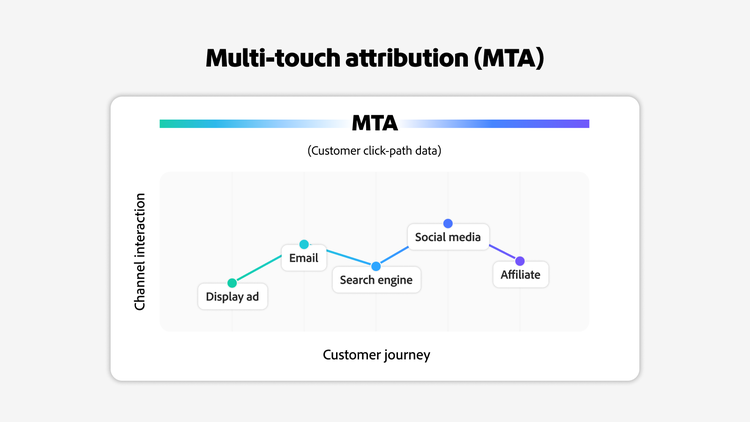
Today, there are more diverse and personalized media options than ever, but customers are harder to find and track due to signal loss. Available tools don’t show the full picture of wallet share and fail to give modern marketing teams the holistic insights they need to make good decisions.
In many cases, teams combine insights from several tools and methods, creating a complicated and inefficient workflow that takes too long to execute and drives up costs. Operationally, this process provides results that are not only unsatisfying but also potentially conflicting, making it hard to defend key decisions with confidence.

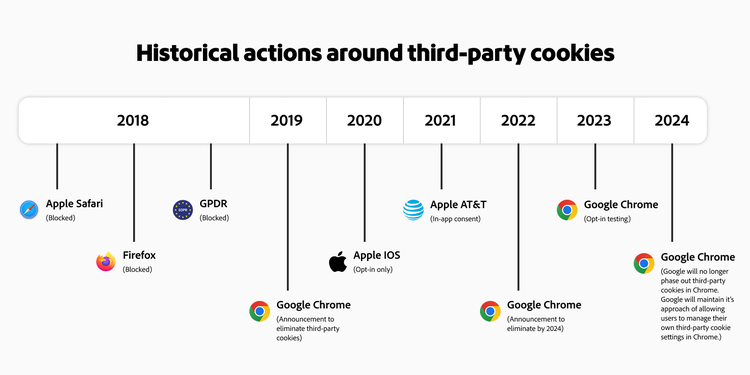
A primary reason these tools fall short is the degradation of customer engagement data due to changing online privacy standards — a minor earthquake for the marketing world. Some browsers, like Apple’s Safari and Mozilla’s Firefox, have completely blocked third-party cookies by default to preserve user privacy. Google now restricts cookies for 1% of browsers. While Google did reverse course on eliminating third-party cookies, users can block them in their Chrome browser settings.
The result is widespread cookie deprecation, a growing obstacle to marketers’ established methods of capturing user behavior and assessing where to prioritize marketing efforts and dollars. Additionally, some email programs, like Apple Mail and Gmail, are obfuscating tracking pixels through manual configuration, while walled gardens like YouTube, Meta, and TikTok won’t share any individual-level data. Meanwhile, only 18% of Apple device users are opting for device tracking, according to the FTC’s Economic Impact of Opt-in versus Opt-out Requirements for Personal Data Usage.
These changes dramatically reduce marketers’ ability to track user interactions across platforms and touchpoints. MTA, the most common method of analyzing the importance of each marketing touchpoint in customer decision-making, can produce data insight inaccuracy due to signal loss.
Many available marketing tools do not inform users of the incremental contribution of various activities and scenarios. According to the 2025 Gartner Technology Marketing Benchmarks Survey, 59% of CMOs report they have insufficient budget to execute their strategy. As marketing budget reduction pressures financial leaders to ask for proof of ROI, marketing leaders must demonstrate the cost-effectiveness of their media spending. Marketers who work in companies with $100 million or more in annual revenue cite proving ROI with analytics as a top three challenge that hinders their ability to demonstrate success. This crucial gap prevents marketers from making informed decisions about when and how to spend to optimize ROI.
Crunched marketing budgets also mean that relying on current tools is overly expensive. In many cases, teams use a mishmash of tools to gain insights, which drives up costs. Companies can ill afford this type of inefficiency, with marketing budgets at US companies shrinking from 9.3% of total revenue in 2023 to 7.7% in 2025. Accordingly, the 2025 Gartner CMO Spend Survey found that CMOs now leverage AI technology to automate key tasks so that funds are used in a more productive way. “CMOs are leveraging data analytics and technology, particularly AI, in order to squeeze more from static budgets”, according to Ewan McIntyre, VP Analyst and Chief of Research in Gartner Marketing Practice.
And these investments are likely to increase as the business world continues to digitize, privacy restrictions multiply, and economic headwinds keep blowing.
Marketers now require ongoing access to data-driven, cost-informed analysis to inform their marketing plans and adapt as conditions inevitably change. They seek a measurement and planning solution that is fast, flexible, agile, trusted, and scalable, enabling them to maximize marketing investments with advanced AI.
Adobe Mix Modeler is a purpose-built solution for rapid, confident marketing measurement and optimization. This tool utilizes the power of artificial intelligence and machine learning technology to analyze data, provide actionable insights, and optimize workflows.
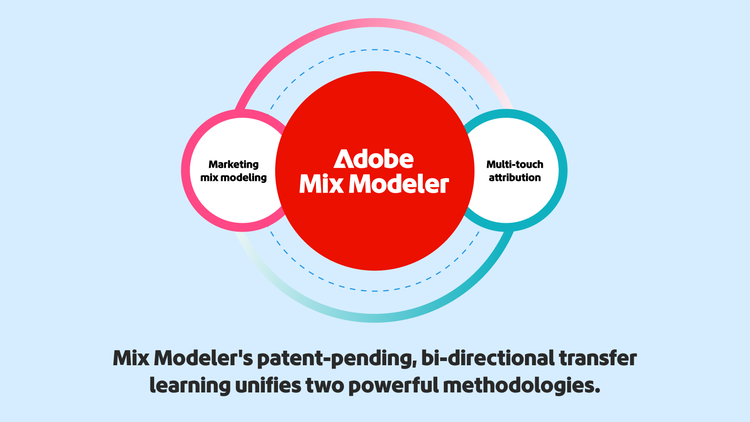
Mix Modeler’s patent-pending, bi-directional transfer learning unifies MMM and MTA. Combining these two methods into a single holistic approach enables faster and more intelligent analysis of historical marketing efforts, allowing teams to measure incremental performance at both touchpoint and aggregate levels.
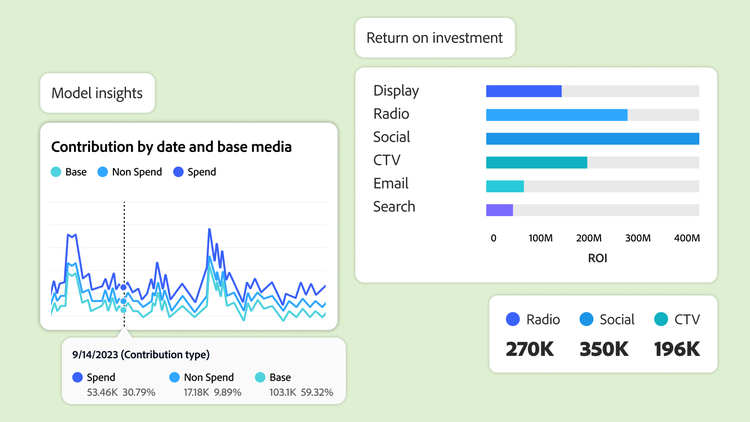
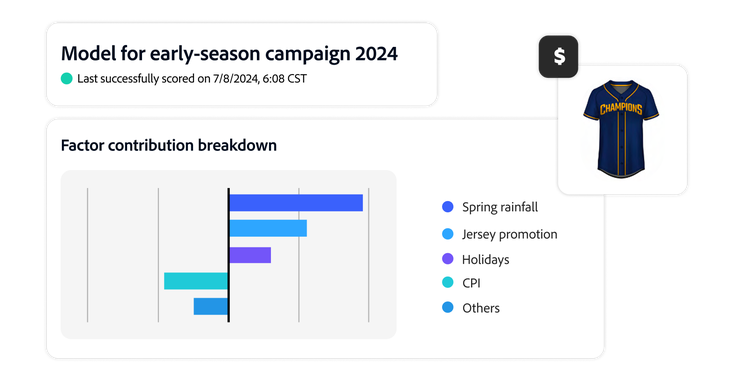
The ability of AI to rapidly integrate an enormous volume of disparate information means Mix Modeler can incorporate into its models any factors the user chooses — economic trends like unemployment or inflation, custom promotion calendars, weather patterns, or other time-series datasets. These are factors that marketers couldn’t effectively account for previously, and this newfound ability to do so allows for advanced predictive modeling and future decision-making possibilities using forecasted data.
For example, a professional sports team’s marketing department might use Mix Modeler to run scenarios that help answer several questions: How much marketing budget should be allocated per game if the team makes the playoffs? Will a rainy April negatively impact the ROI of a planned early-season campaign? Would a jersey giveaway garner more interest at the beginning or end of the year? Would the social campaign play better on Instagram or Facebook? The team can run various scenarios quickly and figure out the relative ROI to inform data-based decisions. If an early-season jersey giveaway will only be cost-effective if April is sunny, the team can schedule the giveaway for September if the April forecast calls for rain.
“There’s a huge interest now in trying to overlay the reasoning behind performance, based on what marketers can control and what they can’t control,” Ihara says. “We try to reveal to marketers how much each factor matters. How much does a jersey giveaway matter relative to spending on Facebook? There’s a relationship involved there.”
Not only does Mix Modeler provide better analysis than existing tools, but it does so far more quickly. Legacy media mix modeling solutions can take 3 to 12 months for initial model creation, are usually only updated once a year, and provide insights monthly, with delays that leave you analyzing results and making decisions several quarters later.
In stark contrast, Adobe models can be adjusted frequently to yield rapid results, allowing marketing teams to generate a range of scenarios to assess the potential impacts of marketing budget changes, channel constraints, or other business factors. All of this enables better, faster decision-making and more agile pivoting before, during, and after a campaign as business goals and priorities evolve.
Additionally, Mix Modeler’s machine learning measurement and attribution capability allow marketing teams to accurately calculate channel and campaign ROI and understand the incremental contribution of each marketing investment. In short, this tool incorporates costs into its models, enabling marketing teams and business leaders to understand the actual value of each action and where to allocate resources to increase ROI or lower the cost per conversion.
Using our earlier example, the sports team would certainly benefit from knowing whether the jersey giveaway, which will cost $250,000, will likely boost ticket revenue by $200,000 or $2,000,000. It could also benefit from insight into how much additional sales revenue to expect from a giveaway in April compared to September.
Employing Mix Modeler in concert with other Adobe Experience Platform tools allows users to tweak scenarios and see the impacts of changes on their specific business reality — though they can use Mix Modeler with their other systems, too. Suppose the jersey giveaway campaign is underperforming on Facebook with fewer click-throughs than expected. In that case, Mix Modeler can help uncover how to increase the value of that channel, perhaps by changing the timing of ads or shifting emphasis to another channel.
Mix Modeler packages long-established statistical methodologies into a single product boosted by the latest innovations in AI and machine learning. The intuitive user interface means powerful and complex modeling is now accessible and scalable to marketers, analysts, and data scientists. Sophisticated analytics run behind the scenes to provide valuable insights that don’t require a deep understanding of regression analysis. “It’s critical that we reveal all this data as clean, marketer-focused insight that’s very digestible and that marketers can make decisions based on,” Ihara says. “But it also must be underpinned by a rigorous, modeling-based approach that their data science team has confidence in.”
Mix Modeler is natively built on the foundation of the Adobe Experience Platform. Built-in AI algorithms leverage state-of-the-art technologies using:
Supervised machine learning

Econometrics (e.g., time series analysis)

Applied statistics (e.g., survival analysis)

Bayesian method

Causal inference

Marketing and advertising science (e.g., adstock, diminishing return)

Transfer learning

Cooperative game theory (e.g., Shapley value)
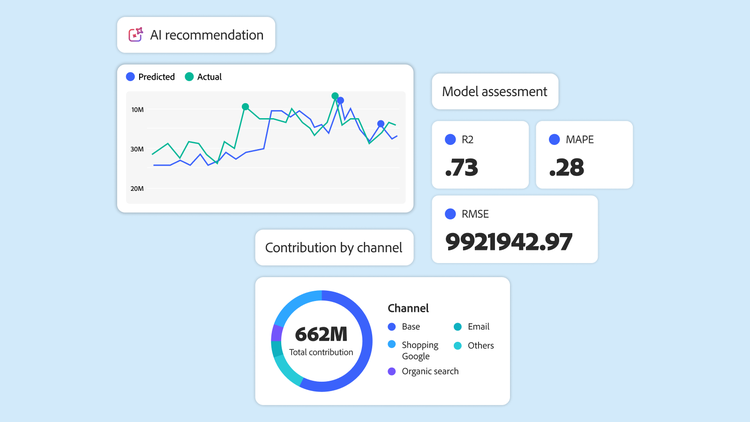
Mix Modeler differs from other marketing modeling solutions by employing a multiplicative — or log-log model instead of an additive model of analysis. A log-log model is a generalized linear model that can account for trends and patterns in data sets. The model can incorporate the effects of independent and dependent variables, identifying nonlinear relationships among them.
The log-log model is valuable for producing meaningful analyses and interpretations of complex datasets and trends over time. Put simply, it allows marketers to understand the impact and interplay of various channels and enables forecasting and scenario planning so that teams can quickly translate insights into meaningful actions.
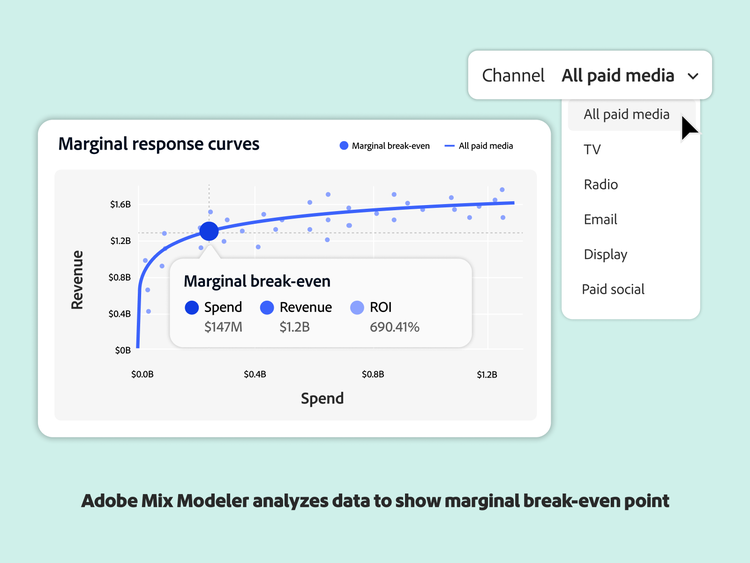
To put the modeling technique into action, marketers input data at the deepest granularity they can access. This includes aggregate-level data such as historical units sold, historical marketing channel volume and spend, impression-volume data from walled gardens like social channels, and offline advertising channel data. The system can capture conversion and revenue numbers from Adobe Analytics, Adobe Customer Journey Analytics, or a third-party data source to provide a comprehensive picture of marketing activities, spend, and results.
“In Mix Modeler, the data this runs on from Experience Platform is the same data you analyze in Customer Journey Analytics — so it’s the perfect exploratory tool to really get into the weeds of whether or not a campaign was successful and where a drop-off happened,” says Lily Chiu-Watson, Director of Product Marketing for Experience Intelligence, Adobe. “You could then go into Journey Optimizer and create a new journey to fix this problem. Then in Mix Modeler, you can see the incremental value of that channel go up.”
Integration adds value and efficiency for teams already using solutions like Customer Journey Analytics but Mix Modeler doesn’t require data from Adobe tools to deliver results.
Users can also include non-spend data and factors like internal sales figures and headcount numbers, stock index information, and economic indicators like unemployment rate and industry-sector growth. Event-level touchpoints captured by MTA add to the bigger picture. In this way, users can create a model, incorporate prior beliefs, assign numeric confidence to each prior, and input internal and external business factors.
Once the model has ingested data, the user can configure it for business needs by adding goals, channels, forecast windows, rules, and constraints. Then, Mix Modeler’s multi-variate regression engine determines the incremental impact of each channel, while its supervised machine learning attribution engine learns the incremental impact of event-level touchpoints.
Users can create and run models directly in Mix Modeler’s interface and access insights in a few hours or even minutes. These models can be configured in the platform with custom look-back windows, touchpoints, conversions, segments, prior knowledge, and more. AI-powered scenario planning capabilities predict the optimal marketing budget allocation so you can confidently reach your business goals.
Mix Modeler brings measurement and planning together in a single application to help marketers understand channel and campaign performance, forecast plans effectively, and optimize marketing channel investments with greater speed and confidence.
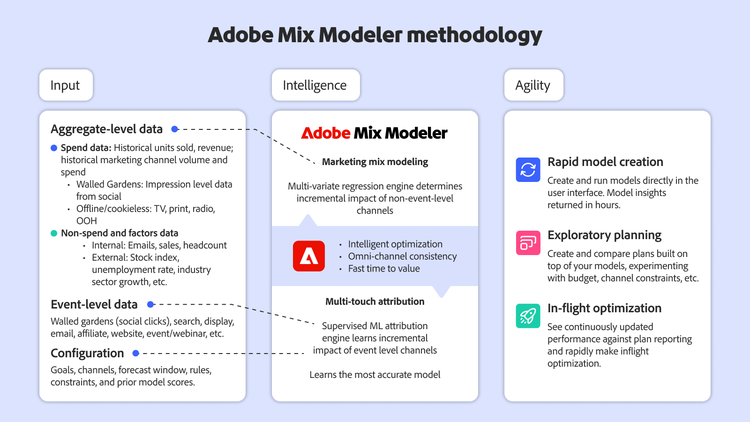
The marketing team at a prominent luxury retailer witnessed this firsthand when it participated in a pilot program to test Mix Modeler in its marketing workflow.
The global brand has long used custom models and last-touch attribution to assess its marketing spend. Before Mix Modeler, team members found modeling arduously slow. They were able to complete just a couple of modeling scenarios in a work week. Their methods also prevented them from modeling hypothetical scenarios with any real granularity or confidence.
Mix Modeler changed all that. With Adobe’s help, the team increased operational efficiency by 50%. The platform’s embedded machine learning helped generate better and faster insights as the team input more data and ran more scenarios.
“It’s cumulative and grows as we grow,” said the brand’s vice president of global analytics. “It’s already undeniable from an efficiency perspective. And for me, efficiency is money. If you’re able to act faster, you’re able to get a competitive advantage faster.”
The marketing team also benefits from Mix Modeler’s capability to model potential scenarios. Team members can reduce costs by optimizing the effectiveness of their marketing dollars. And, they’re able to rapidly build a business case for extra marketing investment on key priorities using models that detail how such spending is likely to translate into sales.
A prominent luxury retailer achieved:

increase in operational marketing efficiency.
Adobe Mix Modeler can help you strategically plan your marketing mix, optimize campaign spending in the moment, and make intelligent, data-driven recommendations critical to your business — all based on AI-powered measurement models that inspire confidence in the results.
Adobe has long been a trusted partner of organizations worldwide to deliver personalization at scale.
Mix Modeler adds to the powerful capabilities of Adobe Experience Platform by allowing teams to understand the impact of their efforts and massively speed up marketing measurement and scenario planning, which helps them prove business value and make smarter decisions more quickly. That’s a game-changing advantage in an increasingly competitive world.
Watch this Adobe Summit session to find out about the strategic imperative of establishing a scalable, transparent measurement and planning framework and explore the strategies for developing an architecture that seamlessly connects marketing efforts and insights to actionability and business value.
“Marketing Budgets: Benchmarks for CMOs in the Era of Less” Gartner, May 11, 2025.
“2025 Gartner CMO Spend Survey,” Gartner, May 11, 2025.
Jacob Kastrenakes, “Firefox Will Begin Blocking Trackers by Default,” The Verge, June 4, 2019.
“Marketing Attribution Models: How Did We Get Here? A History of Measurement,” Marketing Evolution, November 17, 2017.
Lennart Kraft, Bernd Skiera, Tim Koschella,“Economic Impact of Opt-in versus Opt-out Requirements for Personal Data Usage: The Case of Apple’s App Tracking Transparency (ATT),” Federal Trade Commission, October 7, 2023
Neil Borden, “The Concept of the Marketing Mix,” Journal of Advertising Research vol. 8, no. 2, 1964.
Nick Statt, “Apple Updates Safari’s Anti-Tracking Tech with Full Third-Party Cookie Blocking,” The Verge, March 24, 2020.
Anthony Chavez, “A new path for Privacy Sandbox on the web.” Privacy Sandbox, July 22, 2024.
“State of Attribution 2024 - 8th Annual Marketer Benchmark Report,” MMA Global, June 2024.