
Optimize account marketing:
Focus on buying groups within accounts to measure responses to campaigns, channels, and content for optimizing marketing orchestration and investments.





The right analytics platform provides a unified view of your customers’ journeys, helping you identify opportunities, reduce friction, and drive long-term growth.
B2B customer journeys are not linear or predictable. They’re spread across a variety of channels and devices and shaped by an increasing network of stakeholders within every account. A single deal can span over a year, involve multiple decision makers, and generate hundreds of touchpoints. As this complexity increases, so do the challenges for organizations to understand, measure, and act on buyer behaviors and activities. It’s about uncovering what they did, why it matters, and how to take action on those insights.
However, each team sees a different part of the journey. For example, marketing teams often track impressions, clicks, and MQLs. Sales teams log emails and calls. Product teams monitor activation and feature usage. But without a shared view, no one sees the full story — not just for individuals, but also at the buying group and account levels.
This leaves important questions that B2B companies often struggle to answer. Is one digital channel driving traffic to another? Is content interesting and relevant to different members of the buying group? Where in the sales cycle are prospects and existing accounts falling off and why?
In B2B, decisions aren’t made by individuals. They’re made by buying groups: dynamic, multi-person teams navigating iterative processes. Traditional marketing analytics (meaning built for both B2B and B2C), customer relationship management (CRM) reporting, and business intelligence (BI) dashboards weren’t built to capture this reality. They track individuals, not group dynamics.
These traditional analytics tools were designed for isolated stages of the funnel, not the full, multi-layered B2B customer journey and lifecycle. On top of that, they often have trouble unifying data across channels, web properties, and offline activities, producing siloed insights. And with increased use of forms of media in marketing programs like video, audio, and social media, that brings even more inputs to bring unto the unified view of customer behavior. This highlights the need for a purpose-built B2B analytics solution that is built for the entire buyer journey.
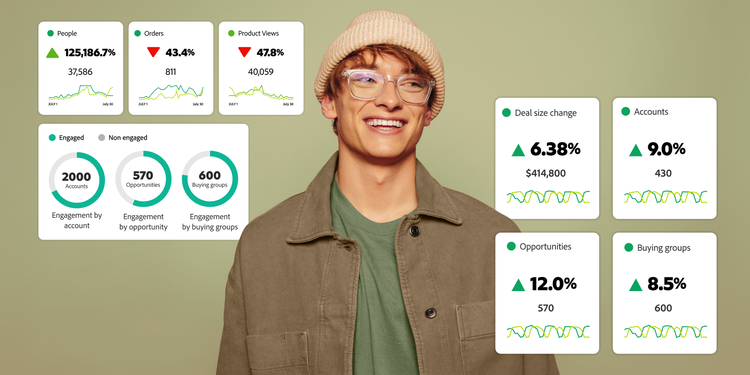
Organizations need a platform that brings together fragmented data, uncovers actionable insights, helps teams make coordinated decisions, and delivers the following:
Adobe Customer Journey Analytics B2B Edition does just that. As an analytics solution purpose built for B2B, Customer Journey Analytics B2B Edition delivers comprehensive, cross-channel analysis at the individual, buying group, account, and opportunity level. This multi-level analysis capability is an architectural first among B2B analytics tools. Enterprises that implement and adopt Customer Journey Analytics B2B Edition will be able to improve campaign performance, go-to-market processes, and upsell, cross-sell, and renewal initiatives across the entire customer lifecycle.
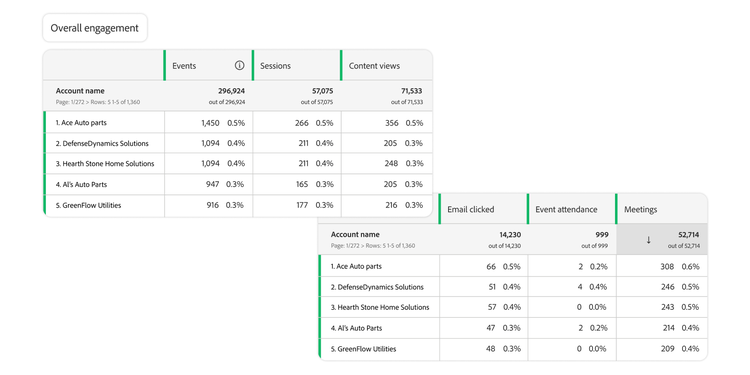
For many companies, they will finally be able to connect marketing and sales activities to downstream conversion events and revenue outcomes. This includes:
Optimize account marketing:
Focus on buying groups within accounts to measure responses to campaigns, channels, and content for optimizing marketing orchestration and investments.

Grow key accounts:
Identify high-value touchpoints within buying groups of target accounts to drive next-best actions for revenue growth and retention.

Build product value:
Track product adoption, usage and customer satisfaction at both account and user levels to prevent churn and inform future product development.

Identify friction points in the sales funnel and understand how different buyer roles influence sales stage progression.
Moreover, B2B companies will be able to better understand buyer behavior throughout a deal cycle. This becomes especially powerful when you consider even a simple scenario — let’s say you have 10 accounts, and each account has three buying groups you must connect with, each comprised of three individual stakeholders. Each stakeholder has a different buying group role and specific skills in their group — often looking for different information at different points along their journey. How are you going to measure marketing and sales impact across nine fragmented data sets per account?
Customer Journey Analytics B2B Edition connects and leverages all that data into advanced attribution models and journey visualization tools, so you can identify high-performing channels, campaigns, and content.
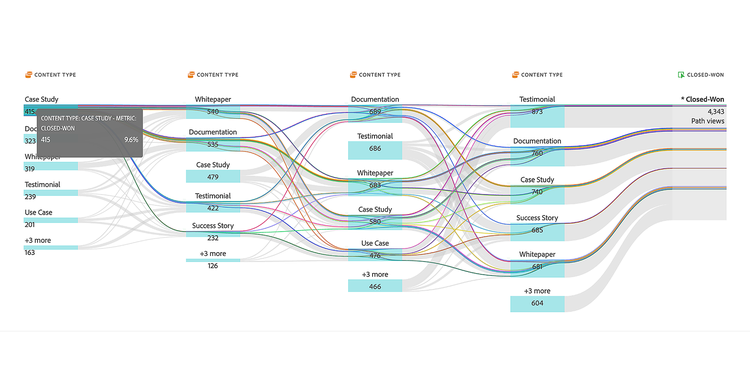
With flexible data governance, agentic AI-powered insights, and comprehensive analysis, Adobe Customer Journey Analytics B2B Edition helps your teams overcome common B2B analytics challenges — while delivering fast, precise, and scalable customer insights that support evolving customer expectations, regulatory requirements, and competitive pressures. Learn more about how Adobe Customer Journey Analytics B2B Edition can help you understand your buyers’ journeys so you can meet them with personalized experiences that convert.