Strategy
Clear AI vision with ownership and investment commitments.





Healthcare organizations are increasingly investing in AI, yet sustainable impact depends on how AI is managed, measured, and governed. This study examines the practices that help turn AI activity into more accountable, measurable, and repeatable execution.
Artificial intelligence (AI) is becoming part of how healthcare leaders approach patient and member experience, communications, content, service, and operational workflows. Readiness depends on more than adopting tools. It requires an operating model that connects investment decisions with clear accountability, oversight, and outcomes that matter to people accessing healthcare services.
That work matters in healthcare. AI initiatives may involve sensitive data, regulated activities, and communications that affect trust. Marketing and experience teams cannot operate in isolation. They need partnership with clinical leadership, as well as data, technology, operations, privacy, security, compliance, and governance teams.
The challenge is to create coordination without treating oversight as an obstacle. Clear ownership does not mean giving one function authority over every decision. It means establishing accountability, decision rights, and a process for evaluating where AI is appropriate, how performance will be measured, and when review or escalation is required. These foundations can help organizations build repeatable execution.
This report examines where healthcare respondents stand and uses the global, cross-industry Leader cohort as a benchmark for five operating model behaviors. The findings offer a basis for strengthening ownership, measurement, collaboration, learning, and adoption while keeping trust, privacy, security, accessibility, equity, and patient safety in view.

Emily Rice

executives participated across 12 industries and 11 global markets.

respondents represented healthcare. Of these, 220 were included in the active healthcare analysis across five stages: exploring, piloting, deploying, expanding, and transforming.

of healthcare respondents held positions at the vice president level or above.

of healthcare respondents worked for organizations with more than $1 billion in annual revenue.
MARKETS COVERED
The healthcare respondent base covered Central Europe, Latin America, North America, the United Kingdom and Ireland, and Western Europe in this report.
The 342 AI Leaders referenced in this report come from the full study population of 5,633 senior executives across 12 industries. This is a global, cross-industry cohort rather than a healthcare-specific group. It provides the benchmark used to compare healthcare performance.
Each organization was assessed across six operating model pillars, with every pillar scored on a scale of 1 to 5. The six scores were combined into an operating model maturity (OMM) composite.
Strategy
Clear AI vision with ownership and investment commitments.

Structure
Dedicated AI ownership with budget authority.

People
Roles and culture evolving for an AI-enabled environment.

Governance
Risk framework calibrated for AI velocity.

Technology
Infrastructure built for scale, not just pilots.

Workflows
AI embedded into how work is actually done.
To qualify as a Leader, an organization had to meet two criteria: achieve an OMM Composite above the top-quartile threshold of 3.27 and operate at the Expanding or Transforming stage of AI deployment. Applying both criteria identified 342 Leaders across the 12 industries, equivalent to 6% of the 5,323 active respondents.
The designation reflects operating model maturity and deployment stage. Unless otherwise stated, Leaders refers to this global cross-industry cohort, not a healthcare-specific group, and does not imply that these behaviors caused outcomes.
Healthcare respondents are actively piloting and deploying artificial intelligence (AI), but the operating model supporting that activity has often struggled to keep pace. Ownership remains limited, measurement is inconsistent, and coordination between marketing and information technology (IT) frequently relies on sequential handoffs. This report examines those gaps and uses the global, cross-industry Leader cohort to identify practices associated with more mature AI execution.

of healthcare respondents are in the Frozen Middle. They are at the ‘piloting’ or ‘deploying’ stages, having moved beyond exploration without yet reaching ‘expanding’ or transforming’. This concentration shows that AI activity is underway, but repeatable execution is less common. It does not establish that respondents have stalled. Progress may become more difficult when initiatives depend on different data, approval processes, measurement frameworks, and functional priorities.

report having a formal AI owner with a defined title and budget authority. Elsewhere, accountability may be part-time, committee-led, assigned on a project-by-project basis, or absent. A named owner does not need unilateral authority over clinical, compliance, privacy, security, or operational decisions. The role is to maintain accountability, coordinate the relevant partners, clarify decision rights, and connect AI investment to agreed priorities.

manage the relationship between marketing and IT through siloed, transactional, or consultative ways of working. These models rely on requests, reviews, and sequential handoffs. AI initiatives often require more frequent coordination as teams evaluate data access, technical feasibility, experience requirements, risk, and performance. Without shared objectives and responsibilities, initiatives may become harder to evaluate and extend.
The 342 AI Leaders identified across all industries demonstrate more mature approaches to ownership, measurement, partnership, learning, and adoption. They are not a healthcare-specific cohort, and the comparisons do not establish that any single behavior caused stronger performance. They provide a cross-industry benchmark for five operating model decisions.

Real Ownership
Leaders are 5.1 times more likely to have a formal AI owner with a defined title and budget authority. For healthcare respondents, the implication is having an accountable owner who coordinates across relevant functions while preserving established clinical, privacy, compliance, security, and governance decision rights.

Day-One Measurement
Leaders define the return on investment (ROI) framework before deployment. 44% of Leaders measure ROI comprehensively, compared with 6% of healthcare respondents. Early agreement on measures helps teams distinguish implementation activity from patient, member, service, workforce, operational, or organizational value.

Genuine Partnership
Marketing and IT share objectives and key results (OKRs) and joint accountability. 81% of Leaders operate at the collaborative or integrated level, compared with 12% of healthcare respondents. This provides a model for involving experience, marketing, data, technology, operations, and governance partners earlier.

Learning Culture
Leaders are more likely to use setbacks to improve subsequent deployments. 39% of healthcare respondents report destructive failure patterns, compared with less than 1% of Leaders. In healthcare, learning should occur through controlled evaluation, appropriate escalation, and responsible oversight rather than reduced safeguards.

Empowered Champions
42% of Leaders name finding and empowering internal champions as their most effective culture action, ahead of every other lever measured. Champions can help extend approved practices when they have defined support, appropriate authority, and access to cross-functional partners.
Part One
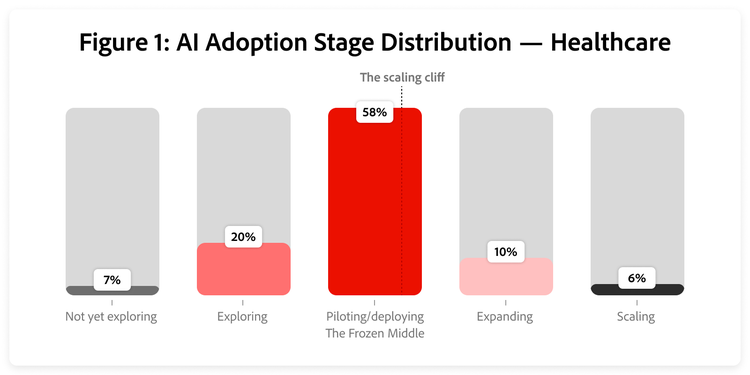
Healthcare respondents are exploring AI across experience, marketing, service, technology, and operational workflows. Individual use cases may advance on different timelines and within different functions, creating pockets of activity that are difficult to connect through a shared approach to ownership, data, governance, and measurement.
The Frozen Middle describes respondents who have progressed to piloting or deploying but have not yet reached expanding or transforming. It does not mean that progress has stopped. It indicates that moving from individual initiatives to repeatable execution may become more difficult when learning, measures, decisions, and responsibilities remain distributed across teams.
Moving beyond these stages requires clearer accountability, defined decision rights, and stronger coordination among the functions involved. It also requires teams to assess how AI fits into workflows rather than adding isolated tools to existing processes. When these decisions are deferred, initiatives can become harder to compare, evaluate, and align around shared patient, member, service, operational, or organizational priorities.
Where ownership exists, its mandate may still stop at a functional boundary.
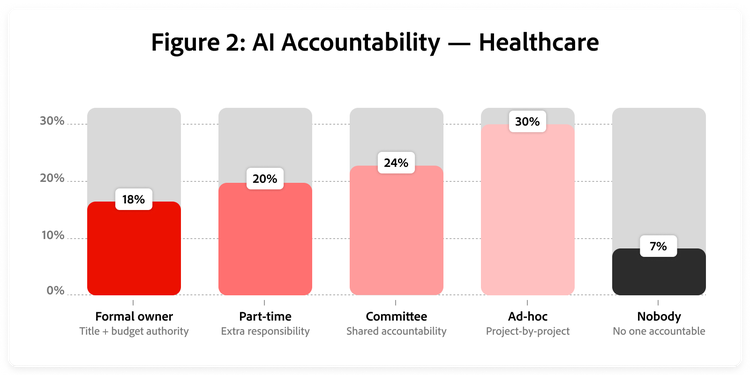
AI accountability may be distributed across experience, marketing, data, technology, operations, privacy, security, compliance, and governance teams. Each function contributes expertise, but dispersed responsibility can make it difficult to resolve competing priorities, allocate resources, or maintain accountability for an initiative from evaluation through deployment.
A formal owner can provide continuity across that work. The role is not to replace clinical, legal, privacy, compliance, security, or operational decision-making. It is to coordinate relevant partners, clarify who can make each decision, maintain visibility across the initiative, and connect investment with agreed objectives and measures.
Part-time ownership and committee-led accountability can leave decisions unresolved as individual teams move ahead. A title and budget are important, but they are not sufficient when the owner’s mandate stops at one functional boundary. Healthcare respondents need an accountable owner with the authority to coordinate the work and a partnership model for decisions that remain with specialist functions.
Compliance and integration evaluation removes the largest share at the first measured gate.
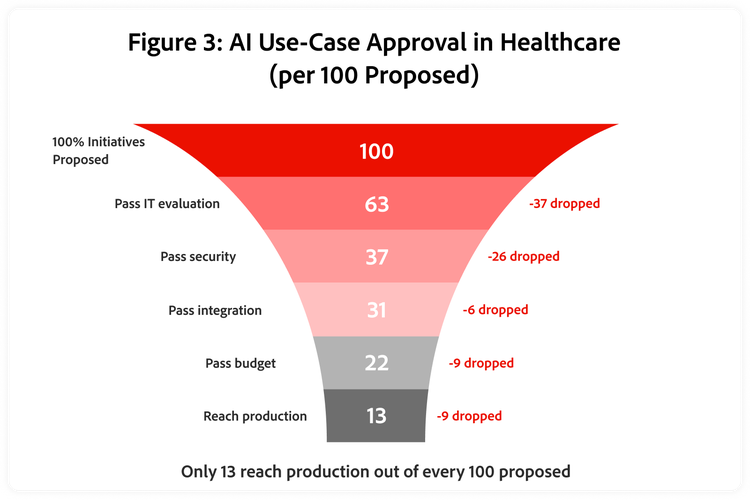
Moving an AI use case from idea to production requires several decisions across business, technology, and governance teams. The survey follows requests through initial information technology evaluation, compliance and integration review, business leadership approval, executive committee approval, and production launch. The largest decline occurs at the first measured gate.
This evaluation may consider integration complexity, data availability, privacy, security, compliance, cost, ownership, and implementation requirements. These are necessary considerations in healthcare. The challenge is to assess them alongside the intended patient, member, service, operational, or organizational value, rather than treating technical feasibility as the only basis for advancement.
Clearer ownership and earlier cross-functional involvement can provide a stronger basis for evaluation. When data rights, system ownership, integration requirements, safeguards, and success measures are considered during ideation, teams can evaluate feasibility, risk, and value together. The research does not establish that one action improves funnel survival, but it indicates where clearer coordination may support more informed decisions.
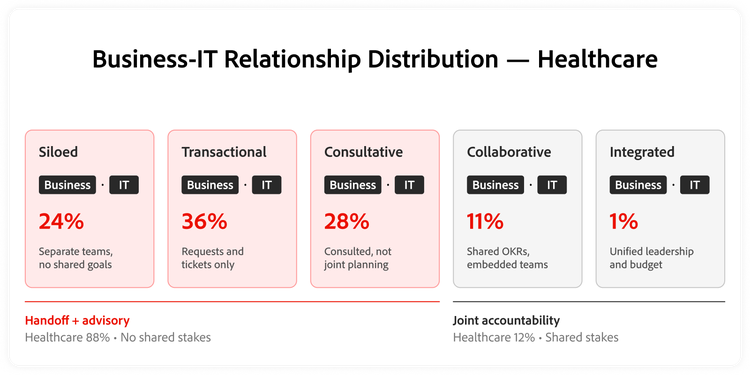
Marketing and experience teams adjust communications, content, and services as needs and performance change. AI increases the need for coordination as teams evaluate data, integration, governance, and measurement. Yet most healthcare respondents still manage the relationship between marketing and information technology (IT) through sequential handoffs.
Whether the relationship is siloed, transactional, or consultative, the pattern is similar: marketing submits a request, and IT responds. This approach can support defined projects, but it is less suited to work that requires frequent testing, adjustment, and shared decision-making. Issues involving data access, privacy, security, compliance, or technical feasibility may surface after the initiative has already been scoped.
Collaborative and integrated relationships involve marketing and technology partners when the work is defined. Shared objectives and key results give both teams responsibility for delivery and the agreed outcome. This helps teams address data, integration, timing, and governance requirements as the work progresses, rather than passing them between functions through a request or approval process.
Most respondents report basic measurement practices that track activity without consistently showing whether AI contributed to the outcomes that matter.
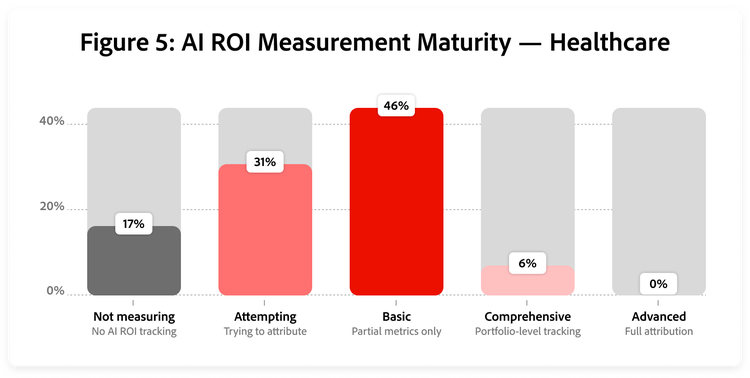
As AI becomes part of healthcare workflows, teams need to measure more than output. They may track content produced, communications delivered, audiences segmented, tasks completed, or hours saved. These measures confirm activity and efficiency, but they do not show whether AI contributed to patient or member experience, service, workforce, operational, or organizational outcomes.
Stronger measurement begins before deployment. Teams define the intended outcome, establish a baseline, and agree on how performance will be assessed. After an initiative launches, other changes in demand, operations, communications, or service delivery can make AI’s contribution difficult to separate. Pre-deployment planning provides a clearer basis for evaluation without assuming that AI caused the result.
Clear measurement also supports planning and budget decisions. It helps leaders compare use cases, determine whether an initiative warrants continued investment, and distinguish technical performance from experience or organizational value. In healthcare, measurement should also reflect applicable privacy, security, accessibility, compliance, governance, and data-use requirements.
PART TWO

Leaders vs. Industry
AI can affect many aspects of the patient or member experience, marketing, service, data, technology, and operations. As work crosses these boundaries, part-time owners, committees, and ad hoc leads may lack the mandate to resolve competing priorities, maintain visibility, or coordinate decisions across the initiative.
Leaders address this challenge by appointing a named AI owner with a formal title, a clear mandate, and budget authority. The owner provides accountability and connects the functions involved. This does not mean replacing clinical, legal, privacy, security, compliance, or governance authority. Specialist teams retain their decision rights and work with the owner through an agreed partnership model.
The named owner needs access to experience, marketing, data, technology, operations, and governance partners. The role may sit within a relevant line of business rather than marketing. Organizations can establish this mandate within existing structures by defining responsibilities, escalation paths, budget authority, and the decisions that require specialist review or shared approval.
Leaders treat measurement as a condition of deployment, providing a clearer basis for evaluation and investment decisions.
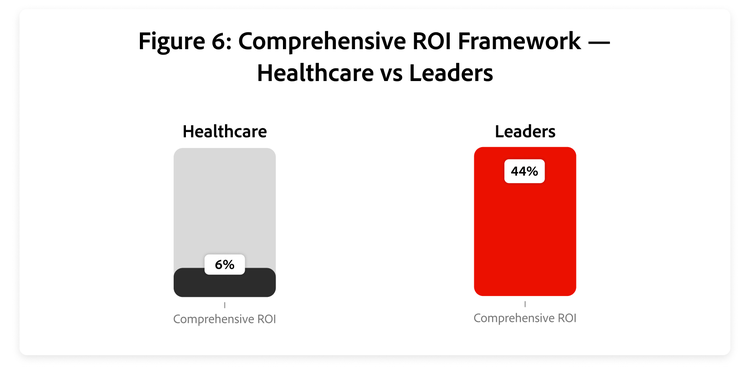
Healthcare executives need evidence early enough to guide funding and expansion decisions. Leaders build measurement into the design of each AI use case. 44% of Leaders have a comprehensive return on investment framework, compared with 6% of healthcare respondents. Every Leader measures AI performance, while a meaningful share of healthcare respondents does not.
Before launch, Leaders define the intended outcome and establish how it will be assessed. Depending on the use case, measures may address patient or member experience, engagement, service, workforce productivity, operational performance, or organizational value. These are illustrative measurement categories, not achieved outcomes. Relevant experience, data, technology, operations, privacy, compliance, and governance partners should agree on the approach.
Timing matters because the original baseline can become difficult to reconstruct after deployment. Recording current performance before launch and assessing the same measures afterward provides a clearer basis for evaluation. It also helps teams distinguish AI’s contribution from other operational, communication, service, or market changes.
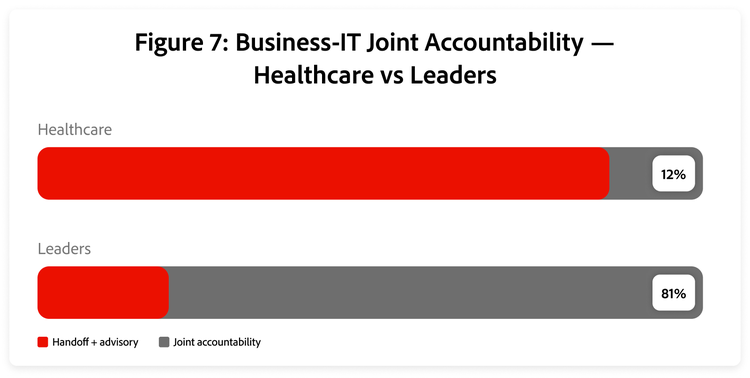
AI initiatives may depend on data, technology systems, integration support, governance, and measurement. Sequential handoffs create friction when requirements or decisions must move between teams. Most healthcare respondents operate at the siloed, transactional, or consultative level, where information technology may advise marketing without sharing accountability for the outcome.
Among the 342 global, cross-industry Leaders, Collaborative and Integrated relationships are the norm. Marketing and its data and technology partners become involved when the work is defined rather than receiving a completed request. In healthcare, other relevant experience, operations, privacy, security, compliance, clinical, or governance partners may also need early involvement.
Shared accountability continues through delivery and measurement. When participating teams work toward the same objective, scope, implementation decisions, and evaluation follow an agreed direction. Leaders establish this partnership through shared objectives and key results within existing reporting lines, allowing teams to work together without requiring a reorganization.
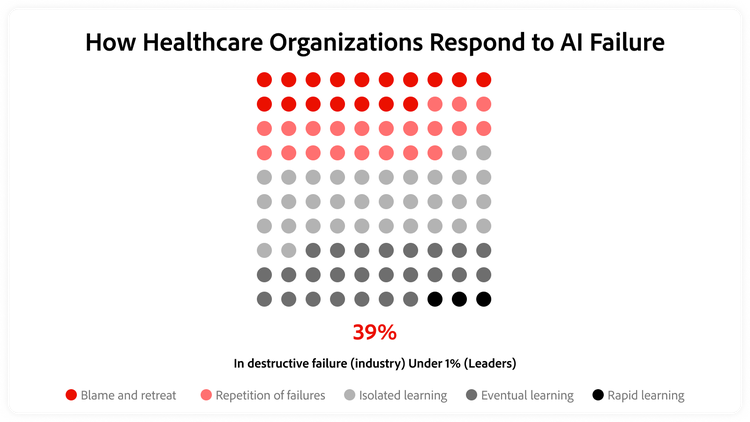
AI underperformance in healthcare can carry meaningful experience, operational, privacy, compliance, financial, or safety implications. Teams must respond through appropriate review, escalation, and corrective action. A learning culture does not minimize these consequences or weaken safeguards. It creates a disciplined way to understand what happened and prevent repetition.
When the causes of underperformance remain within one team, other initiatives may carry forward the same assumptions. Shared learning helps relevant experience, marketing, data, technology, operations, privacy, security, compliance, clinical, and governance partners understand the issue, document the lesson, and apply it where appropriate.
A learning culture becomes visible in regular operating and governance reviews. The named AI owner creates time to examine what underperformed, why it happened, which controls worked, and what should change. When leaders support open discussion alongside formal accountability, teams can turn approved lessons into changes to data, workflows, measurement, oversight, or training before future deployment.
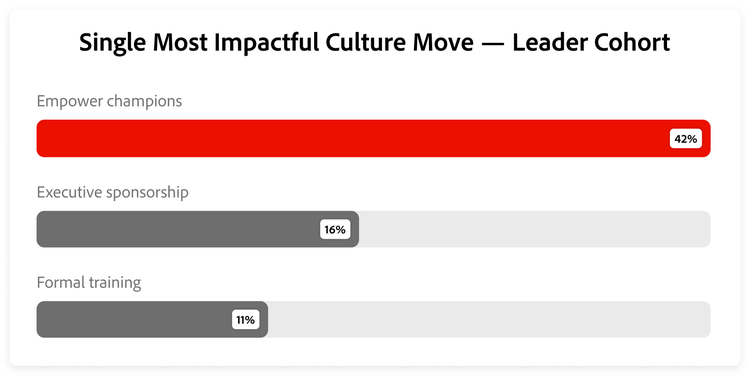
People may be more willing to adopt AI when they see a colleague use it effectively in familiar work. In healthcare, champions may emerge from experience, marketing, communications, service, data, technology, or operations teams. The specific role and example will depend on the organization and the approved use case.
Leaders identify these practitioners and give them recognition, support, and permission to extend an approved approach to adjacent teams. Evidence from a relevant workflow can make adoption more tangible than centralized training alone. Champions build influence by sharing what worked, what did not, which safeguards were required, and how performance was evaluated.
Champions still operate within established decision rights and governance. Their role is to support adoption, not to independently approve new applications or extend access to sensitive data. Cross-functional partners can help champions adapt proven practices responsibly, while shared resources, evaluation methods, training, and governance frameworks provide consistency across teams.
These actions translate the Leader behaviors into practical steps for healthcare executives. They build on existing experience, marketing, data, technology, operational, and governance capabilities rather than requiring a wholesale organizational redesign.
Name one AI owner with the mandate to coordinate decisions across functions.
Appoint a named leader with a clear mandate and budget authority for the AI portfolio or a defined area of responsibility. The role may sit within a relevant line of business rather than within marketing. Existing reporting lines and specialist decision rights can remain in place, but the owner should coordinate priorities, resources, and escalation when work crosses experience, marketing, data, technology, operations, privacy, security, compliance, clinical, or governance teams.
Agree on the intended outcome before the next AI deployment.
Define the intended patient, member, service, workforce, operational, or organizational outcome before an AI use case moves forward. Establish a baseline and agree on how results will be assessed. The participating business, data, technology, finance, privacy, compliance, and governance teams should align on the measures and evaluation approach before launch. Treat these as intended outcomes, not guaranteed results.
Make business, data, and technology partners jointly accountable.
Create shared objectives and key results for AI initiatives that depend on data, technology systems, communications, service delivery, or operational workflows. Involve privacy, security, legal, compliance, accessibility, health equity, clinical, and responsible AI partners where relevant. Shared objectives help teams address feasibility, data use, safeguards, integration, and measurement while the work is being defined rather than through a series of late handoffs.
Turn AI underperformance into responsible learning.
Make structured learning part of operating and governance reviews. Examine what underperformed, why it happened, which controls worked, and what should change before another deployment. Serious privacy, security, compliance, accessibility, equity, clinical, or patient safety issues should continue through the appropriate review and escalation processes. Learning should strengthen accountability and safeguards, not replace them or reduce the consequences of material failures.
Support the practitioners already making AI work.
Identify practitioners who have demonstrated effective, approved AI use in a relevant workflow. Give them recognition, training, appropriate resources, and permission to help an adjacent team evaluate the approach. Document the use case, measures, limitations, safeguards, and lessons as a practical playbook. Champions can support adoption, but they should not independently approve new applications, expand access to sensitive data, or bypass established governance.
CONCLUSION
Artificial intelligence is becoming part of healthcare experience, marketing, service, technology, and operational workflows. The research shows that activity alone does not create readiness. Moving from individual initiatives to repeatable execution requires an operating model that connects clear ownership, early measurement, cross-functional partnership, shared learning, and supported adoption.
For healthcare executives, the next step is to choose a defined AI initiative and strengthen the conditions around it. Name an accountable owner, agree on decision rights, establish the intended outcome and baseline, and involve relevant data, technology, operations, privacy, security, compliance, clinical, accessibility, equity, and governance partners before deployment.
This approach supports progress without placing speed ahead of trust, privacy, security, accessibility, equity, patient safety, or human oversight. It also gives leaders a clearer basis for deciding what to continue, change, expand, or stop. By building these disciplines into everyday work, healthcare respondents can move beyond disconnected activity and consistently create a more responsible, measurable, and repeatable approach to AI execution over time.
Adobe empowers organizations to create impactful digital experiences. Our portfolio of customer experience products and services helps businesses put every interaction in context, understand what each customer needs right now, and design and deliver digital experiences that build loyalty and drive growth. Visit adobe.com to know more.
Incisiv is an industry insights and strategy firm that combines close to a decade of industry trend data with primary research, messaging architecture, and content development to help enterprises navigate transformation, evaluate solutions, and unlock growth. Visit incisiv.com to know more.