The healthcare industry is undergoing a transformation. Trust, personalization, and seamless engagement are no longer “aspirational” or “ad ons” — they are strategic imperatives. As patients and members interact across telehealth platforms, mobile apps, provider portals, insurance systems, and in-person care settings, expectations for connected and intuitive experiences continue to rise.
Adobe’s State of Customer Experience in Healthcare in an AI-Driven World report highlights a pivotal moment for the industry. While organizations recognize the importance of personalized, AI-enabled engagement, most remain early in their journey. The opportunity ahead is clear — unify data, modernize marketing operations, and scale AI responsibly to deliver more connected and patient-centric care experiences.
Personalization remains limited across the care journey.
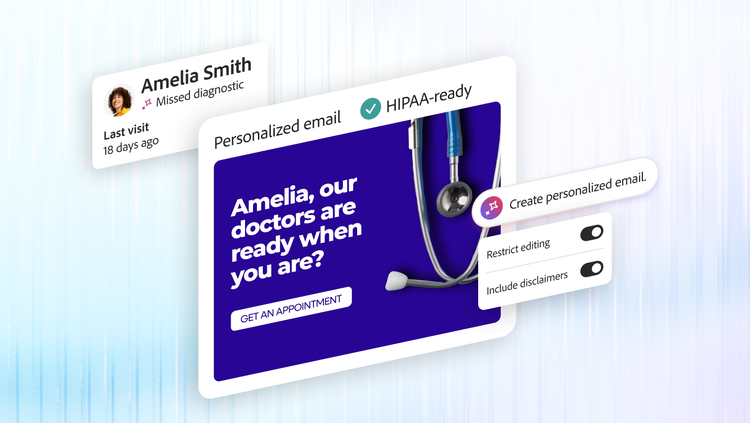
Despite widespread digital adoption, personalization in healthcare remains fragmented. According to the report, only 5% of healthcare organizations have personalized more than half of the customer journey. Most deliver tailored experiences in isolated moments — appointment reminders, targeted outreach, or post-care follow-ups — but fail to extend personalization seamlessly across the full continuum of care.
The root cause is structural. Patient and member data often reside in disconnected systems — EMRs, insurance platforms, CRM tools, and marketing systems — that rarely communicate in real time. Regulatory requirements, including strict privacy protections, further complicate integration.
Yet the demand for tailored engagement continues to grow. Patients expect relevant health education, proactive reminders, and digital experiences that reflect their specific conditions and needs. Bridging this gap requires secure, interoperable data ecosystems that can activate insights responsibly across touchpoints.
Marketing is becoming a measurable growth driver.
Healthcare marketing is evolving from a support function to a performance-oriented growth engine. The research shows that 76% of healthcare marketers are expected to directly contribute to sales and revenue, while 90% are under pressure to improve efficiency. This shift signals a broader transformation: marketing is now accountable for measurable outcomes such as patient acquisition, retention, and lifetime value. Technology investments are increasingly evaluated based on revenue impact rather than brand metrics alone.
As a result, marketing leaders are gaining strategic influence within their organizations. They are aligning digital engagement strategies with care delivery, insurance offerings, and health-tech innovation — ensuring that every interaction contributes not only to organizational growth but also to improved health outcomes.
Data silos remain the biggest barrier.
If personalization is the goal, unified data is the prerequisite. Yet only 4% of healthcare organizations report having fully integrated and accessible customer data. The majority operate with partially integrated or siloed systems.
This fragmentation undermines both analytics and AI readiness. Without a comprehensive patient profile that integrates clinical, behavioral, and engagement signals, organizations struggle to deliver real-time recommendations, predictive outreach, or coordinated care journeys.
To overcome this barrier, healthcare leaders are investing in interoperable platforms, customer data platforms (CDPs), and secure data environments that can unify signals across care touchpoints. Building this foundation is mission-critical for enabling advanced analytics, proactive engagement, and trustworthy AI deployment.
AI is boosting efficiency — but scaling remains elusive.
Generative AI is already improving the efficiency of content production. The report highlights a 49% increase in content output and a 17% reduction in content costs, yet 0% of organizations have reached full GenAI scale for content operations. Healthcare organizations remain cautious — and for good reason. Concerns around regulatory compliance, clinical accuracy, bias, and patient data protection require a structured governance framework before AI can be fully embedded into workflows.
Similarly, while 49% of organizations are exploring agentic AI, deployment remains limited, primarily focused on internal operations rather than patient-facing applications. Early use cases center on administrative efficiency and controlled environments, allowing teams to validate performance before expanding externally.
The message is clear — AI adoption is accelerating, but operational readiness and governance frameworks must catch up.
Governance and trust are non-negotiable.
AI innovation without oversight presents a significant risk. More than half of healthcare organizations lack formal AI governance frameworks, exposing potential vulnerabilities in compliance, quality control, and brand integrity.
In healthcare, where misinformation can directly affect patient safety, AI must be paired with human oversight, ethical guardrails, and lifecycle management processes. Automated fact-checking, compliance scanning, and monitoring tools can help streamline oversight — but trust must remain the guiding principle.
Healthcare leaders who embed governance into AI workflows will be better positioned to scale innovation responsibly while protecting patient confidence.
The path forward: Connected, intelligent, and human-centered.
The future of healthcare customer experience will not be defined by isolated campaigns or incremental digital upgrades. It will be shaped by organizations that:
- Deliver connected care journeys across digital and in-person touchpoints.
- Unify and activate healthcare data securely and in real time.
- Scale AI responsibly with governance, compliance, and human validation.
- Extend personalization beyond transactions to proactive, empathetic engagement.
Patients and members increasingly expect seamless, relevant experiences across the entire care lifecycle. Organizations that modernize their data ecosystems, evolve their marketing structures, and deploy AI with transparency and trust will lead the next era of healthcare engagement.
In an AI-driven world, the ultimate differentiator isn’t technology alone — it’s the ability to combine intelligence with empathy to deliver truly patient-centric experiences.
Explore the full report to see how leading healthcare brands are closing the personalization gap and scaling AI responsibly.
Dr. Salinas is a trailblazer at the intersection of medicine, technology, and strategy — driving the future of healthcare through bold innovation and visionary leadership. With over two decades of experience spanning global markets, Dr. Salinas has redefined how healthcare and life sciences organizations engage with patients, providers, and regulators in an increasingly digital world.
Known for his strategic vision and deep industry expertise, Dr. Salinas has held leadership roles at top organizations including Salesforce, Stryker, Pfizer and Best Buy Health where he pioneered strategies that empowered companies to reimagine their commercial models, enhance patient outcomes, and scale innovation across the globe.
As Head of Global Industry Strategy for Healthcare and Life Sciences at Adobe, he partners with leading organizations to architect transformative solutions that elevate care delivery, accelerate innovation, and unlock new value across the health ecosystem. His work is rooted in a deep understanding of clinical practice, market dynamics, and emerging technologies — from AI and wearables to connected devices and digital therapeutics.
A frequent speaker and thought leader, Dr. Salinas is shaping the dialogue around the future of health — where data, empathy, and innovation converge to create a more intelligent and inclusive system of care.