#F8F8F8

Adobe Real-Time CDP Features

Data governance and privacy

Real-Time CDP has the industry's leading enterprise data security and privacy tools so you can build customer trust and protect one of your most important assets — your data.

Watch demo | Watch Demo Adobe Real-Time CDP Features

adobecom.aem.live/assets/videos/products/rtcdp/media_1e438ec5db369b62e3448715fbd040aa955f2b9c2.mp4#_autoplay1

Labeling and cataloging

Create, manage, and enforce data usage policies with labeling, cataloging, and out-of-the-box templates that can be customized to fit your brand's needs.

  • Categorize data sets. Use labels to define governance and access for both datasets and fields.
  • Customizable labels. Start with provided labels, and customize as needed to meet your organizational requirements.
  • Flexible label access. Apply and edit labels in a user interface or programmatically via API for scale.

Alerts and policies

Prevent users from activating sensitive data with clear policies that are enforced in-system.

  • Automated governance. Set up and automate usage alerts to prevent privacy policy violations.
  • Team empowerment. Enable teams to market responsibly while honoring consumer permissions.
  • Risk elimination. Prevent activation of customer data that could violate internal and external directives.
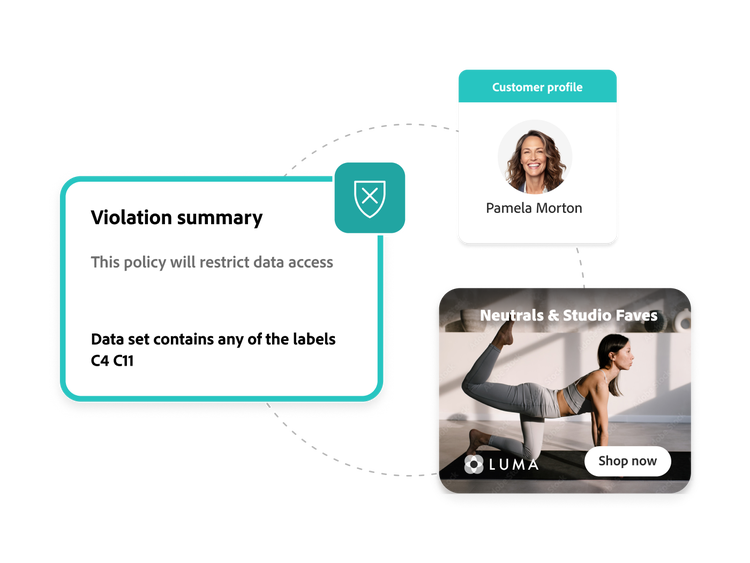
Customer profile and a data restriction violation alert informing a fitness ad

https://main--bacom-pink--adobecom.aem.live/assets/videos/products/rtcdp/media_10432ec79fea138983635a60dc6e8122a6898a3cc.mp4#_autoplay1

Lineage

Give team members detailed information about where data is sourced and its associated policies by viewing the lineage before activating audiences.

  • Enforcement. Track lineage and enable labels and associated policies flow to downstream services, such as the real-time profile and other destinations.
  • Contextual feedback. Inform practitioners why a specific policy violation may have occurred.
  • Data audit support. Give users detailed information when performing internal or third-party audits on data usage.

Help teams honor customer preferences for consent and data privacy using both an API and marketer-friendly user interface.

  • Consumer rights protections. Recognize customers and their rights as required by regional regulations.
  • Global policy support. Support for regulations such as GDPR, CCPA, and CPRA.
  • Centralized data governance, security, and privacy. Efficiently manage all requests in one place via API or UI.
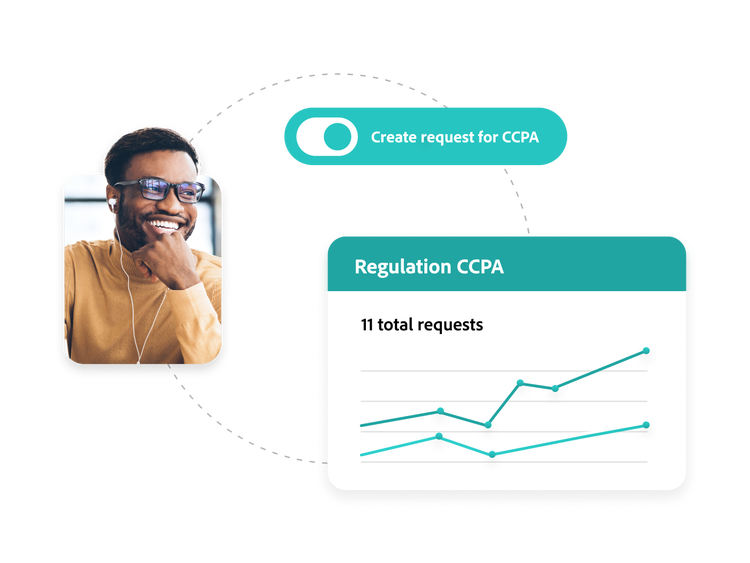
Marketer and a graph of total CCPA regulation requests

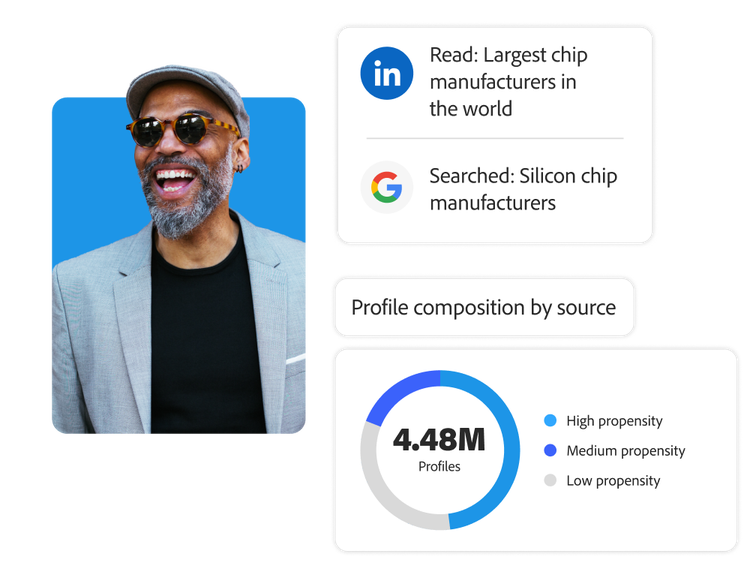
Pop-ups of checklists and toggle controls showcasing governance features in Adobe Real-Time CDP

Access control

Maintain data privacy and security by designating which users and teams can access certain types of data and take specific actions.

  • Define and manage user and group level access.
  • Assign permissions to groups and individuals, such as view or edit.

Privacy and Security Shield add-on

Enhance data protection for privacy-conscious brands and regulated industries with advanced features like customer-managed encryption keys (CMK), automated data deletion, and granular consent enforcement.

  • Customer-managed keys. Allows organizations to use their own encryption keys for data in transit and at rest.
  • Enhanced data governance. Includes automated dataset retention, deletion, and advanced consent enforcement policies.
  • Improved security controls. Offers attribute-based access controls for data.
  • Compliance support. Helps meet stringent regulatory requirements.

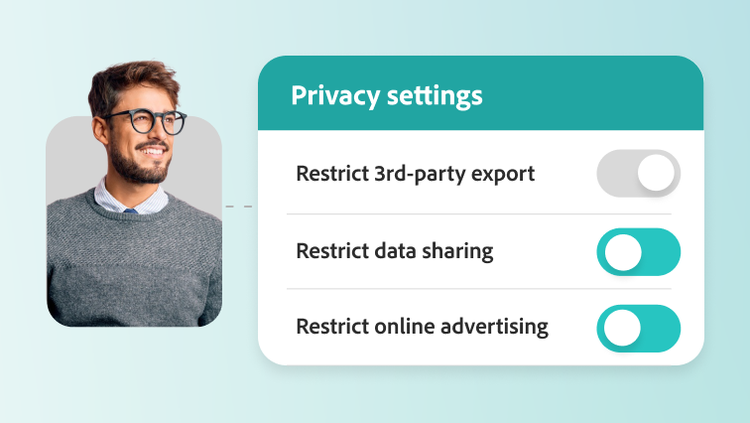
Healthcare website with privacy settings being selected

Healthcare Shield add-on

For healthcare brands that need to follow HIPAA guidelines in the United States, the Healthcare Shield add-on for Real-Time CDP is a set of innovative new features and enhancements that empower you to uphold consumer privacy and govern customer data at scale.

  • Leverage protected health information (PHI). Enrich unified profiles with protected health information (PHI) as defined by the customer’s privacy team and HIPAA guidelines. Adobe will execute a BAA (Business Associate Agreement) as required by Business Associates.
  • Enhanced privacy. Granular access controls, specific labels for sensitive data, lifecycle management, and time settings for data sets ensure customers can safely solve for data hygiene.
  • Premium features for HIPAA readiness. Extended thresholds for data deletion and automated consent policy enforcement help healthcare organizations meet the needs of customers and patients.

More about data governance.

https://main--bacom--adobecom.aem.live/fragments/products/cards/rtdcp/data-governance-security-privacy/learn-how-to-use-data-governance-features

background image

Learn how to use data governance and CDP security features.

Find what you need in Experience League, our vast collection of how-to content — including documentation, tutorials, and user guides.

Learn more | Learn more on how to use data governance and privacy features. Find what you need in Experience League, our vast collection of how-to content

Questions? We have answers.

How does Real-Time CDP stop sensitive data from being activated where it shouldn't be?

Real-Time CDP automatically enforces your data usage policies at the moment of activation, blocking an audience or field from going to a destination that would violate a policy. You label data, define policies that say which marketing actions are allowed on which labels, and assign marketing actions to each destination; when an activation would breach a policy, it is stopped and the interface shows the data lineage explaining which policy was violated and why. Enforcement is built into the activation workflow, so compliance does not depend on someone remembering the rules.

What are data usage labels, and how do they work?

Data usage labels are tags you apply to data (at the dataset level or the individual field level) to categorize it by how it may be used, and they are the foundation the whole governance framework enforces against. Adobe provides label categories including Contract ("C") labels for contractual obligations, Identity ("I") labels for data that can identify or contact a person, and Sensitive ("S") labels for data such as precise geolocation. Best practice is to label data as it is ingested, so that from the first activation onward, policies can evaluate those labels and prevent non-compliant use.
Real-Time CDP enforces consent through consent policies that check each profile's consent state before that profile is used, so a customer who has not consented to a given use is filtered out of it automatically. The platform supports standard consent frameworks, including the IAB Transparency and Consent Framework 2.0, and lets you ingest consent signals from a consent management platform and enforce them at segmentation and activation. Consent enforcement runs alongside data usage policies, so both the "may this data be used this way" and "did this person agree" questions are checked before activation.

Can I control which teams and users can see or export which data?

Yes, through attribute-based access control administered in Admin Console, where roles link users to the specific capabilities, sandboxes, and data they are permitted to use. You can grant or restrict access to particular Real-Time CDP capabilities per set of users, and control visibility down to labeled data, so a team only sees and acts on the data its role allows. This is what lets a large organization give many teams self-service access to the same platform without every team seeing everything.

Is governance something I set up separately, or is it built into the platform?

It is built in, inherited from Adobe Experience Platform rather than maintained as a separate layer, so you configure governance once and every application on the platform respects it. The labels, policies, and consent rules you define apply to the underlying data, and they travel with that data through audience building, activation, and export, and across sibling applications like Adobe Journey Optimizer and Adobe Customer Journey Analytics. You are not standing up a parallel governance system for the CDP; you are configuring the platform's framework that the CDP enforces.