Agile Manifesto — a walkthrough.

Adobe for Business Team

12-01-2025

Interface with task list and team feedback, reflecting Agile’s success in streamlining product development.

With the proven success and widespread adoption of the Agile Manifesto, businesses and project management professionals across various sectors have embraced its principles. Organisations adopting the Agile Manifesto's principles should consider how to structure project teams to minimise uncertainty in product development.

This post will cover:

What is the Agile Manifesto?

The Agile Manifesto for Software Development is a declaration that unifies the philosophy behind frameworks like Scrum, Extreme Programming and Feature-Driven Development (FDD). It represented a significant shift from the waterfall-style project management approaches prevalent before its creation.

The Manifesto for Agile Software Development states:

“We are uncovering better ways of developing software by doing it and helping others do it.

Through this work, we have come to value:

That is, while there is value in the items on the right, we value the items on the left more.”

Agile solutions emerge when self-organising, cross-functional Agile teams apply practices suited to their specific context. However, managers are still needed to:

Agile Manifesto principles and values.

The Agile Manifesto is built upon 4 core values and 12 guiding principles. These values and principles provide a foundation for Agile methodologies, emphasising collaboration, adaptability and delivering value to customers.

The four Agile values

  1. Individuals and interactions over processes and tools: Prioritising people, who drive the development process and respond to evolving business needs, over rigid processes and tools. This ensures teams remain adaptable and customer focused.
  2. Working software over comprehensive documentation: Emphasising the creation of functional software over extensive documentation, which can consume more time and hinder progress. Agile shifts the focus to delivering tangible results.
  3. Customer collaboration over contract negotiation: Encouraging continuous customer involvement throughout the development process, ensuring their feedback is incorporated and the final product aligns with their needs.
  4. Responding to change over following a plan: Embracing change and adapting to evolving requirements, rather than rigidly adhering to a predefined plan. Agile focuses on iterative development and delivering a minimum viable product that can be refined based on feedback.

The 12 Agile principles

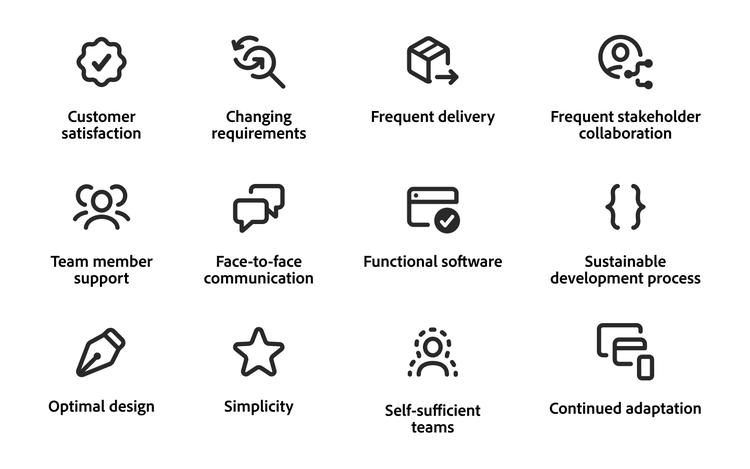
  1. Satisfy the customer by delivering valuable software early and continuously.
  2. Welcome changing requirements, even late, to give customers a competitive edge.
  3. Deliver working software frequently in short, consistent cycles.
  4. Ensure close collaboration between business stakeholders and developers.
  5. Build projects around motivated individuals and give them trust, support and the right environment.
  6. Use face-to-face conversation as the most effective way to share information.
  7. Measure progress primarily by working software.
  8. Promote sustainable development at a pace that can be maintained indefinitely.
  9. Maintain agility through continuous attention to technical excellence and good design.
  10. Maximise simplicity by focusing on the work that matters most.
  11. Empower self-organising teams to create the best architectures, requirements and designs.
  12. Regularly reflect on how to improve and adjust behaviour accordingly.
Agile principles visual with icons, illustrating how motivated teams and adaptive cycles drive better outcomes.

Who created the Agile Manifesto?

In 2001, 17 individuals gathered at a ski resort in Snowbird, Utah, to discuss the future of software development. Representing various methodologies like Extreme Programming, Scrum and Dynamic Systems Development Method (DSDM), they sought an alternative to traditional, documentation-heavy processes. 14 of these attendees became signatories of the Agile Manifesto which set the foundation for modern Agile practices.

The Agile Manifesto story

In the 1990s, software developers began exploring more responsive ways of working, blending established practices with new and innovative ideas to shape what became Agile development. Their goal was to find approaches that delivered greater flexibility and value.

Their methodologies emphasised:

During the 2001 Agile Manifesto meeting, participants identified common principles across these diverse approaches. They codified these shared agreements into the Agile Manifesto, establishing a set of value statements and coining the term "Agile software development."

Later that year, the Agile Alliance was formed as a platform for software developers to share ideas and experiences. Initially adopted by development teams, Agile has since expanded to other teams, especially those managing projects with unclear scopes and requirements.

As Agile gained traction, an ecosystem emerged, encompassing practitioners, consultants, trainers, framework providers and tool developers.

Benefits of following the Agile Manifesto.

Since its inception, the Agile Manifesto has led to significant successes in product development. Key benefits include:

These benefits have driven the adoption of scaled Agile frameworks like Scaled Agile Framework (SAFe) and Large-Scale Scrum (LeSS), extending Agile principles beyond software development into other enterprise functions

Relevance today.

Since its signing, the Agile Manifesto has become one of the most widely adopted approaches to product development, driving significant success across industries. It has also given rise to scaled Agile development processes, such as the Scaled Agile Framework (SAFe) and Large-Scale Scrum (LeSS), which extend Agile practices beyond software development and into other teams within the enterprise. According to Harvard Business Review, roughly 80% of companies are using at least some aspects of Agile in all of their principal business functions: research and development; production and operations; customer service and support; marketing and communications; sales; and even HR, finance and administration.

This general adoption underscores Agile’s evolution from a software methodology into a versatile organisational framework for driving collaboration, adaptability and efficiency across the entire organisation.

https://business.adobe.com/fragments/resources/cards/thank-you-collections/workfront