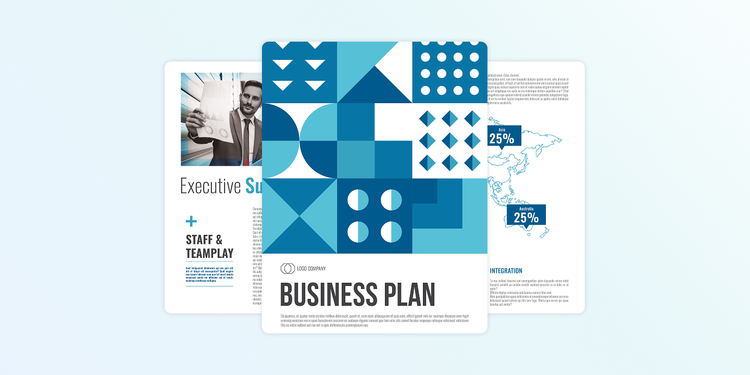
A successful marketing plan outline provides a comprehensive, data-driven narrative that justifies investments and aligns teams to the enterprise strategy. Each component should connect marketing activities directly to business outcomes.
Executive summary.
This is your strategic narrative for the C-suite and board. Far more than a simple introduction, it’s a concise, powerful argument for your marketing vision. It must immediately articulate the core business challenge, the proposed marketing strategy to address it and the specific, high-level objectives. Crucially, it must close with the expected financial impact, framing the entire plan as a driver of business growth and a sound investment with a clear projected ROI.
Here is a sample executive summary:
"InnovateTech is facing rising competition and customer acquisition costs in the saturated enterprise market, leading to slower year-over-year growth. This marketing plan addresses this challenge by shifting our focus to penetrating the high-opportunity mid-market segment. Our strategy is to implement a scalable account-based marketing (ABM) model, leveraging data-driven insights to identify and engage the top 500 target accounts. We will orchestrate personalised, omnichannel journeys for key buying committee members within these accounts, ensuring tight alignment between marketing engagement and sales outreach to accelerate the buying cycle and increase deal size.
To achieve this, our primary objectives for the fiscal year are to generate $15M in new mid-market pipeline, increase marketing-sourced revenue from this segment by 25% and reduce overall customer acquisition costs by 10%. This initiative requires a dedicated investment of $1.2M in targeted media and programme spending, which we project will deliver a 5:1 return on investment. This plan positions marketing as a primary driver of new, predictable revenue and establishes a scalable engine for InnovateTech's next phase of growth."
Mission and strategic objectives.
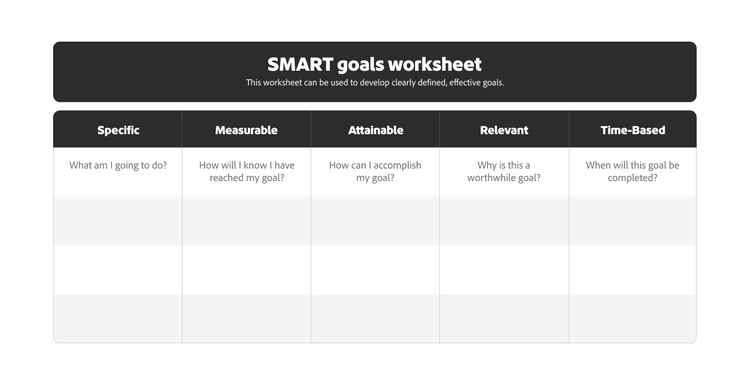
This section aligns your marketing efforts to the broader corporate mission, ensuring every campaign and activity has a clear purpose. The mission statement should define marketing's role in the organisation's success. Following this, establish SMART goals (specific, measurable, attainable, relevant, time-orientated goals) that translate this mission into tangible outcomes. Set SMART goals using this template and then identify which KPIs are best suited for analysing results.
For a CMO, these goals must move beyond activity metrics and connect directly to growing a predictable pipeline and revenue.
Target market and buyer personas.
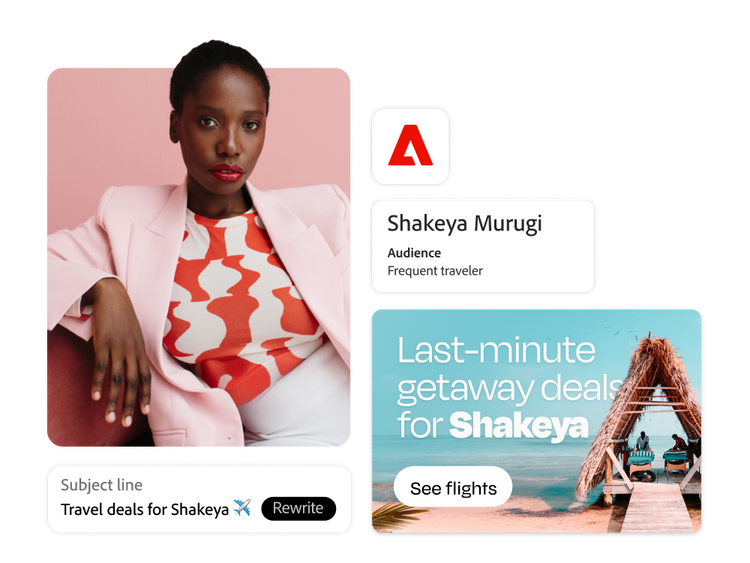
This is the foundation for personalisation at scale. A deep understanding of your audience allows you to move from broad campaigns to precise, relevant engagement that drives conversions. Go beyond basic demographics to build robust, data-driven personas that combine firmographic, behavioural and CRM data. This analysis should define not only who your buyers are, but also their pain points, what drives their decisions and how they engage across their complex journey. This level of insight is foundational for orchestrating the personalised experiences that modern B2B buyers expect. Explore the different types of buyer personas to see how this insight can be put into action.
SWOT and competitive analysis.
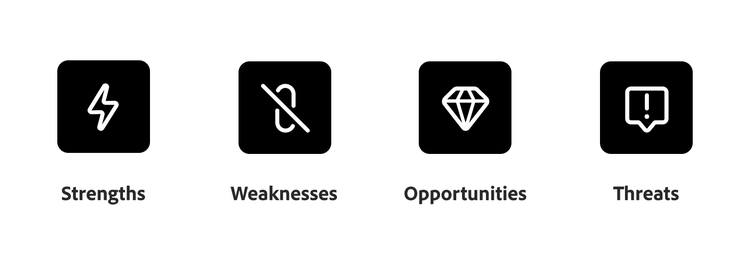
A clear-eyed assessment of the market landscape is essential for crafting a differentiated and resilient strategy. This analysis provides the context for all subsequent decisions. Strengths and weaknesses offer an internal view of your capabilities, while opportunities and threats map the external environment. For a CMO, this exercise is critical for identifying untapped market opportunities, positioning the brand against competitors, proactively mitigating risks and informing a unique value proposition that resonates with your target market.
To go beyond a basic SWOT analysis, guide your team to answer these strategic questions about your key competitors:
- Market positioning. Who are your primary and secondary competitors? What is their market share, brand perception and target audience?
- Product strategy. What are their core product features, pricing models and key value propositions? Where are the functional gaps or weaknesses in their offerings?
- Go-to-market strategy. What are their primary marketing channels (digital ads, content, events etc.)? What is their core messaging and how do they structure their sales process?
- Customer experience. What do their customers praise or complain about in public reviews? What are their recognised strengths and weaknesses in customer support and success?
The value of this analysis is translating the findings into a powerful competitive advantage. Use the insights to craft a unique value proposition that sets you apart.
- Identify white space. Look for the gaps between what your target market needs and what your competitors offer. Is there an underserved audience, a critical feature they lack or a common customer pain point they fail to address?
- Align gaps with your strengths. Cross-reference the market gaps you've identified with your company's core strengths from your SWOT analysis. The intersection where the customer needs meet your unique capability is the foundation of your differentiation.
- Craft your value proposition. Articulate this unique value in a clear, concise statement. It should briefly and clearly answer why a customer should choose you over anyone else. A strong value proposition clearly states who you help, what you help them to achieve and why you're the only one who can do it that way.
Omnichannel engagement strategy.
Modern buyers interact across varied touchpoints and your strategy must meet them where they are — with a consistent, seamless experience. This section outlines the tactical mix for engaging prospects throughout their journey. Describe how you will utilise digital and off-line channels, including email, web, mobile, AI-powered chat, events, webinars and digital advertising, to nurture leads from acquisition to advocacy. A strong plan will define the role of each channel and how they will work together in automated, multi-step campaigns to deliver the right message at the right time. This walkthrough illustrates how different channels collaborate to nurture a prospect, "Maria," after she shows initial interest in a B2B software solution.
- Step 1: Initial engagement and nurture enrolment. Maria downloads a white paper from your website. This action triggers a smart campaign in your marketing automation platform, enrolling her into a targeted nurture stream, based on the content's topic.
- Step 2: Educational email follow-up. Two days later, an automated email is sent. The goal is to educate, not sell. Linking the email to a case study relevant to her industry, using dynamic content to personalise the message based on her profile data, adds additional value.
- Step 3: Digital advertising retargeting. Maria is automatically added to a retargeting audience for a paid media campaign. Over the next week, she sees display ads on LinkedIn and industry websites promoting an upcoming webinar on a related topic.
- Step 4: Webinar invitation and registration. The next email in her nurture stream is a direct invitation to the webinar. After she registers through a landing page, she receives a confirmation and calendar reminders.
- Step 5: High-intent engagement. Maria attends the interactive webinar and her engagement, such as questions asked and polls answered, is tracked. This high-value interaction significantly increases her lead score, indicating sales readiness.
- Step 6: Sales alignment and hand-off. The high lead score automatically triggers an alert to the assigned sales representative directly within their CRM. The alert includes a summary of Maria’s recent activities, providing the representative with critical context for a timely and relevant follow-up.
This co-ordinated, multi-step approach ensures a seamless transition from marketing to sales, delivering a highly qualified and well-informed lead, ready for a sales conversation.
Measurement, attribution and ROI.
This is where you define how marketing will prove its value. To justify investments and optimise future spending, you must connect every marketing activity to business impact. This section should detail your approach to campaign analytics, moving beyond last-touch attribution to embrace multi-touch models that assign credit across the buyer journey. A robust measurement plan outlines the key performance indicators (KPIs) for each stage of the funnel and provides a clear methodology for tracking pipeline, revenue and marketing ROI. This ensures that every decision is data-driven and focused on maximising business growth.
While campaign-specific metrics are important for your team, your report to the board should focus on KPIs that directly reflect business impact. Your measurement plan should prioritise:
- Customer acquisition cost (CAC). The total marketing and sales expenses required to acquire a new customer. This is a critical measure of the efficiency and scalability of your marketing engine.
- Customer lifetime value (CLV). The total projected revenue a single customer will generate over the course of their relationship with your company. A rising CLV indicates success in retention and customer loyalty.
- Marketing-sourced pipeline. The total value of the sales pipeline generated by marketing-led initiatives. This is a forward-looking metric that demonstrates marketing's direct contribution to the future revenue.
- Marketing’s contribution to revenue. The percentage of closed-won revenue that marketing has influenced. This is the ultimate bottom-line metric that proves marketing’s role as a revenue driver.
A single-touch attribution model (like first- or last-touch) is no longer sufficient for understanding complex B2B buying journeys. These models assign 100% of the credit for a sale to a single event, ignoring the dozens of other valuable interactions, from webinar attendance to content downloads, that influence a buyer’s decision. This leads to an incomplete picture and poor investment choices.
Multi-touch attribution provides a more accurate and holistic view by distributing credit across multiple touchpoints. This allows you to understand the actual impact of each channel and campaign. Common models include:
- U-shaped: This model emphasises two key touchpoints — the very first interaction (awareness) and the moment a prospect becomes a known lead. It is excellent for understanding which top-of-funnel activities are most effective at generating new leads.
- W-shaped: This model highlights three significant milestones — the first touch, lead creation and opportunity creation. It provides a clear understanding of what drives a prospect from initial interest to a sales opportunity.
- Full-path: This comprehensive model considers every touchpoint from the first interaction all the way to the closed-won deal. It provides the most complete picture of the end-to-end customer journey, showing how marketing and sales activities work together to generate revenue.
Budget and Resource Planning
Once the attribution strategy is defined, effective budget and resource planning becomes critical. A comprehensive budget justifies your strategy with a clear financial plan. It should detail projected costs across all categories, including technology, personnel, content creation and media expenditure. More importantly, it must connect this spending directly to the projected pipeline and revenue goals established in your objectives. This provides leadership with the visibility needed to make data-backed investment decisions and gives you a framework for accurately allocating resources across key initiatives to ensure enterprise goals are met.