Today, the demand for content is at an all‑time high. The average UK consumer spends 10 hours and 5 minutes with media, and almost two-thirds (65%) of that time is explicitly digital. On top of this, there is increased pressure to deliver personalised marketing content that is on-brand and available on a spectrum of channels. As a result, marketing, brand, and creative teams must find ways to increase their output to stay relevant — often with reduced or static resources.
In recent months, artificial intelligence (AI) has emerged as a solution to these complexities facing content teams, offering significant potential for using AI in marketing. Crucially, AI is designed to augment human creativity, not replace it. It can be viewed as a “copilot”, streamlining workflows and assisting in the early stages of ideation, as well as throughout the end-to-end content lifecycle.
In this article, we’ll explore the potential for AI and how its impact can be felt at every stage of the content supply chain. With the help of Chris Sofokleous, EMEA GTM Lead at Adobe, we’ll look at the foundations of content creation and ideation, to the delivery of the final product, performance analysis, and everything in between. We’ll also examine the relationship between content teams and AI in marketing — how they can collaborate effectively and maximise value with Adobe AI business tools.
Accelerating content velocity: AI across the production lifecycle.
While the immediate focus for AI in content often centres on "creation", its true value lies in optimising the entire content supply chain. Although AI is gaining attention for its generative abilities, we want to shine a light on the way artificial intelligence can increase efficiency at every stage of the content lifecycle, to provide a faster, more integrated and efficient way of working.
From brief to ideation: Smarter starts.
For many content teams, the initial stages of production can be fraught with complications, especially when initial drafts don’t align with the strategist’s vision. Here, AI can help by enhancing traditional briefs with mock-up art, mood boards, and imagery. As Chris puts it,
“In that ideation phase, [it’s better] to go to my creative teams or my studio teams with a more fleshed out idea and make sure that what they create is closer to my vision the first time rather than sending them a substandard brief.”
Using a more extensive brief first time around can help human creatives “get to that vision quicker” and reduce the odds of wasted creative cycles that arise out of ambiguous instructions.
Generative AI tools, like Adobe Firefly Boards, can help with this ideation, enabling teams to collaborate and build on each other’s ideas in a single shared space. As Chris says, it’s a “…huge game changer for ideation work.” When briefs are packed with information and ideas are shared collectively, creative teams can work together to align their outputs with the original vision they set out to create.
Augmenting creation: Scaling output and personalisation.
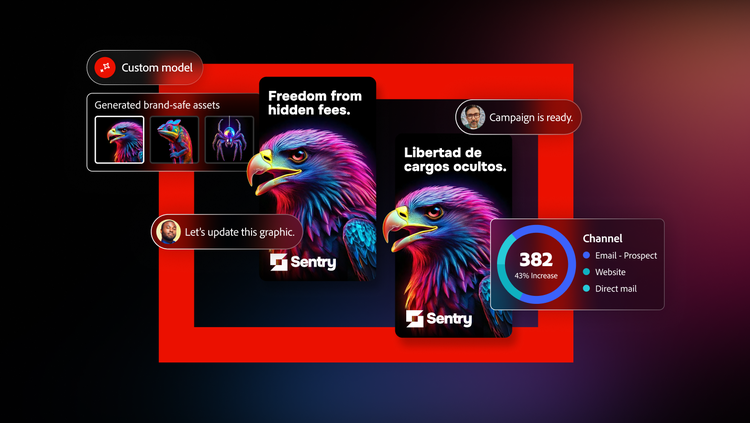
Once the briefs are fleshed out and established, generative AI provides the opportunity to scale outputs without sacrificing brand integrity. Designed to streamline human outputs and augment creativity, generative AI enables content teams to rapidly produce a diverse set of creative assets — all aligned with brand guidelines and governance guardrails. This is a crucial aspect of effective AI in digital marketing.
Perhaps more importantly, AI facilitates the creation of persona-differentiated pieces of content. That is to say, tweaking existing content to suit the audiences you’re trying to reach, whether defined by age, income, or nationality. As tailoring content to varied demographics becomes increasingly important, AI in marketing can help you meet those needs while allowing you to focus on creative storytelling.
Unlock creative precision at enterprise-scale with deeply-tuned AI models in Adobe Firefly Foundry.
Streamlining review and approval: Ensuring compliance and quality.
As the production of content increases, bottlenecks can arise, particularly during the review and approval process. To help with this, agentic AI tools can perform an “initial…QA [Quality Assurance] and brand check” when given access to style guides and regulatory requirements.
Chris points out that AI can get an asset “most of the way there” before a human is needed to review it, giving brand and compliance teams time to focus on the strategic oversight, rather than worry about typos or logo colours. While AI can be very literal — a trait some users find frustrating — it proves valuable in content assessment, ensuring that no detail, large or small, is overlooked.
Seamless integration and performance intelligence.
Content teams must recognise AI as more than a draft-generating spellchecker, however. Digital marketing AI is most effective when integrated as a core component of the ecosystem, bridging that gap between the creative studio and the end consumer.
Native integrations for end-to-end delivery.
Traditionally, content production involves many moving parts. It relies on teams manually sharing assets across various tools and platforms, whether it’s Dropbox links, WeTransfer files, or emails. AI drives the need for a more integrated approach, encouraging native integrations across systems that teams can easily access. By eliminating manual downloads and uploads, it allows for direct activation across delivery channels.
Chris explains this in more detail with an example of creating content in Adobe GenStudio before directly publishing in Meta Business Manager.
“Let's say I'm creating some content for Meta in GenStudio for Performance Marketing. I can create that content. I can get it reviewed and approved. My compliance team [sees it] in an integrated tool set. Once approved, I can literally click publish. I can add in any metadata that I need…and then that's…sent within the tool directly to the Meta Business Manager, where…someone on the media team is going to pick that up. [They’ll then] do the trafficking [and] ad-buying with that content I produce for them.”
This end-to-end connectivity, a hallmark of effective digital marketing AI, reduces friction to a minimum and ensures that content can go from ideation to its destination in a fraction of the time.
Attribute analytics: Understanding what resonates.
Alongside delivery, AI can support performance intelligence with attribute analytics. While traditional metrics can show you when your content has performed well, AI-powered marketing tools can explain why.
AI manages this by breaking down assets — whether images, videos, or copy — into granular insights. These insights might range from the imagery used (such as people over objects), the colour of the background, and the tone of voice used (informal vs formal). It then takes all these factors and pairs them against the audience to provide a level of analytics that might otherwise be missed by the human eye. This detailed understanding allows organisations to track key performance indicators (KPIs) beyond just output volume, such as:
- Reduced time‑to‑market for content. Increased content engagement rates.
- Improved conversion rates from personalised content.
- Cost savings in content production.
- Reduction in compliance errors.
- Faster experimentation cycles.
The results may even be surprising, and the reasoning behind consumer decisions may elude you. Chris gives an example, “An ad campaign for Adobe Photoshop showed that adverts proved more effective if they featured images of food, specifically cake. It isn’t always clear why these things work the way they do, but the insights alone are far more actionable than standard click-through rates. They can influence future AI prompts, creative briefs and content direction – leading to a self-optimising feedback loop that impacts the entire content supply chain.”
The foundational prerequisites: Architecture for scale.
As with any new system, teams that want to integrate AI will need to make some architectural and infrastructural changes to their organisation. For AI to scale effectively within an enterprise, there needs to be certain prerequisites, otherwise AI-generated marketing content could fall by the wayside and become digital noise.
Centralised digital asset management.
A centralised digital asset management (DAM) is an absolute necessity for any organisation that wants to effectively use AI in marketing and content production. As AI drives the need for a more integrated approach and native integrations across systems, a DAM acts as the single, centralised source of truth for every content asset within the business. An established DAM can manage everything from drafts to delivered finished assets, ensuring everything can be found and reused when needed by these integrated AI workflows.
After all, AI is redundant if content is created only to be buried on a “server somewhere”, never to be found or repurposed. To scale effectively, AI needs to be able to take from (and contribute to) an accessible library where assets are recorded, searchable, and well managed.
A marketing system of record.
Alongside a DAM, a marketing system of record is also necessary. This is a single, unified platform that allows teams to manage the whole of the digital marketing lifecycle, from submitting briefs and managing projects to assigning tasks and approving work. A marketing system of record also doubles as an audit trail, helping to establish consistency across teams, outputs, and workflows.
Regardless of the specific marketing and AI strategies employed, having both — a DAM and a marketing system of record — is the "foundational elements of an effective content workflow across any large organisation." After all, you can’t manage something you can’t track.
AI as a pressure test for foundations.
It’s a common misconception that AI does away with the need for pressure tests. In reality, AI makes these foundations more important than ever. Chris utilises the analogy of a pipe to illustrate this:
“If we're trying to fit more content through these pipes, we need to make sure that we've got that foundation in place…to create 10 times more assets than we could do before that. Review and approval really need to [be able to withstand] the pressure, whether that's systemically through the architecture or even through the kind of change management.”
Essentially, the systems in place need to be robust enough to manage a sudden spike in workload. Many teams are hesitant to adopt generative AI marketing solutions, purely out of fear of a review bottleneck, concerned that existing teams won’t be able to validate the quality and compliance of a new flood of work. To avoid situations like this, it’s important to strengthen your DAM and system of record so that your “pipes” can handle the quantity without sacrificing quality.
The human element: Navigating cultural shifts and adoption.
For all the change and technological upheaval that AI has brought, the most significant challenge — and opportunity — for content supply chains is people and process. For AI to be a success, organisations must address new ways of working that address these cultural shifts.
Fostering AI literacy and overcoming hesitancy.
Successful adoption of AI hinges on the AI literacy of employees. This means ensuring that every employee understands what AI can do, how it works, and where the limitations lie. Apprehension is to be expected, and is only natural, especially if teams are concerned with replacement or devaluation. To prevent concerns from spiralling, employers need to encourage open and honest conversations that address these fears and foster a comfort level around using AI in marketing and content.
You can also implement grassroots initiatives that introduce AI as an effective tool that can be used to enhance human outputs, rather than replace them:
- AI ambassadors: These will be internal team members who champion best practices and encourage quick wins.
- AI hackathons: Carve out dedicated time and space for teams to experiment and play around with AI. Encourage them to “break” the system and push limitations without the stress of a live campaign. Demystifying the technology transforms AI from a perceived threat into a powerful collaborator.
Empowering marketers, protecting the brand.
It’s not uncommon for tension to exist between creative teams, as the custodians of the brand, and marketers, who prioritise the speed of self-service, AI can help to bridge this gap. With AI-powered templates and models based on brand guidelines, marketers can build content independently. Despite this, creative teams remain the ultimate authority, setting the guidelines and training the AI on what is appropriate for assets.
AI-powered brand checks can offer suggestions and guidance, resulting in creative work that’s compliant, regardless of which team built it. Creative teams, with the assistance of AI, can then offload repetitive or basic tasks and devote their time to high-value work and original campaign concepts.
Leadership and governance in a regulated world.
For leadership teams in highly regulated sectors, such as financial services or healthcare, hesitancy around AI is typically rooted in risk. AI is capable of hallucinations and factually incorrect outputs, which can damage reputations and lead to serious investigations if published. To mitigate these threats effectively, enterprises need to utilise rigorous governance models.
By implementing proper metadata, multi-stage reviews, and audit trails, organisations can show that adopting AI in marketing and creative isn’t a loss of control. Chris looks back at an interaction with a Head of Brand who was reluctant to engage with AI.
“We sat down and had that conversation about how this isn't going to replace what they're doing, but they're going to be the most important people in the organisation as they start to adopt AI. They're going to be the custodians of that brand…and actually, your team are the people who are going to steer that ship. And that's when I think he realised that maybe the shift is coming.”
Ultimately, the acceptance of AI, across all team members, is what will make or break the effectiveness of AI within your organisation and content supply chain.
The strategic imperative for AI-powered content.
AI is more than just a quick way to generate assets. It represents a fundamental shift that can redefine the content supply chain. To make the most of its potential and deliver scalable, personalised, and compliant assets, organisations must look at the bigger picture — both within and beyond of their content teams. A successful relationship with AI marketing requires a holistic approach that includes building robust data foundations, strategic integrations, and a cross-team willingness to learn.
When navigating this transformation, it’s important to remember that "it all starts with understanding one another within an organisation and as human beings as well." Approaching AI with a human-centric philosophy fosters an environment that encourages humans to work with AI in tandem, augmenting their capabilities rather than outright replacing them. Hesitant leaders and teams can look to Adobe as an example of how this can work and how these strategies can drive real-world efficiency and impact.
Enterprises already laying their foundations for future CSCs today — building with and for AI to transform operations and gain a competitive edge in this increasingly evolving automated age.