Building a knowledge graph: How to structure your website for AI search visibility.

Adobe for Business Team

07-10-2026

The rise of AI search has fundamentally changed how brands are discovered. Search is no longer just about search engines matching keywords on web pages. While search engines, AI assistants and LLM-powered experiences operate differently, they all rely on structured, well-connected information to interpret and surface content. They connect the dots across a brand’s offerings, services, content and expertise to present a coherent interpretation in relevant searches — and a knowledge graph is what makes the brand legible in this process.

A knowledge graph is the architecture that organises content into entities and relationships, turning your website into a connected ecosystem of information. Knowledge graphs help AI systems understand how everything fits together. As a result, your brand becomes more meaningful and comprehensible to both machines and humans.

In AI search, users already have a first impression of your brand before they reach your website. A knowledge graph helps ensure that the impression is accurate by giving search crawlers and AI systems access to structured information. This enables them to discover and represent your brand consistently across search experiences.

Ultimately, knowledge graphs can help to make your content trustworthy and improve brand visibility. With $750 billion in revenue expected to funnel through AI-powered search by 2028, brand visibility will be even more important.

Let’s take a closer look at this shift by exploring:

What is a knowledge graph?

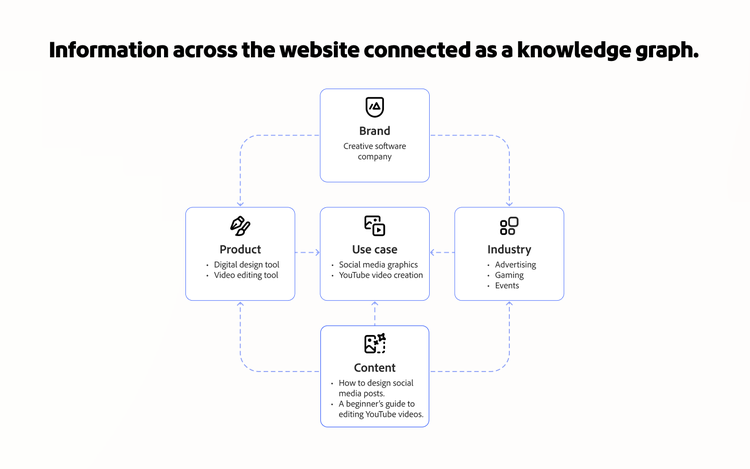
A knowledge graph is a structured representation of information.It can be imagined as a smart, connected map that organises your content into:

A knowledge graph provides more than just basic search signals like words and phrases. It helps LLMs and web crawlers find and connect information across multi-hop retrieval, delivering results with full context.

A knowledge graph showing connections among website entities like brand, product, use case and content, illustrating site structure.

A clear, structured blueprint enables search engines and AI systems to understand and connect information about your brand across digital channels. This can help to earn rich results and improve brand visibility by surfacing your content in a broader range of search features, including:

This is critical because no matter how much content you publish, if it isn’t designed for AI comprehension, your brand risks being overlooked in generative search.

How knowledge graphs change the way websites are structured.

Traditional searches treated the web like a top-down tree — starting from a homepage and branching into categories and individual pages. Search engine optimisation (SEO) was a pillar of traditional digital marketing and website content was largely modelled around:

In today’s AI-driven, zero-click environment, additional strategies and techniques are needed. Generative engine optimisation (GEO) is one of those strategies. GEO is the practice of structuring content so AI-powered search engines can surface content by interpreting intent, context and nuance.To stay competitive, your website needs to be a cohesive system. This cohesive system needs to have a knowledge graph framework, which search engines and AI systems can draw from.

This kind of information architecture powers both SEO and GEO by connecting your brand to clear facts and relationships — keeping it visible, consistent and trusted across search experiences. This matters because the average LLM visitor tends to convert better and is 4.4x as valuable as the average traditional organic search visitor.

The good part is that you don’t need to rebuild everything. By organising your existing content into a unified source of truth, you can easily create clarity and structure at scale. The result is that AI systems can better understand and surface your brand.

What a knowledge graph looks like on a website.

Think of a knowledge graph like a map behind your website, built to store information and guide you through it.

Without this structure, a query like “best tools to personalise customer journeys across different channels” forces the system to search independent pages for tools, then understand personalisation and then end up at multi-channel capabilities. With a knowledge graph, these relationships are already defined, so AI search engines can understand the context and surface relevant results.

The goal is coherence. Every page works together to reinforce a clear, consistent understanding of your business, so both users and AI see a single connected story.

How to build a knowledge graph.

Building a knowledge graph isn’t always a separate technical effort. In many cases, it’s the natural outcome of how you structure, connect and maintain your content over time. The structure should feel clear and intuitive for both humans and machines.

Below are simple steps to get there:

1. Identify your core entities.

Define the key things your business wants to be known for: your brand, products, services, industries and topics.These are your core entities. They become the foundation of your website's content. Each page represents a single, strong idea. Each new piece of content further strengthens this foundation.

However, the key is identifying which entity carries more weight. Cohesive information architecture comes from prioritising what matters the most and organising your site around it.

2. Define how your entities relate to each other.

Once you know your core entities, map how they relate to each other.

These connections give your content meaning. Instead of a collection of isolated pages, you begin to build a system where everything adds context and clarity to everything else.

3. Align website pages around core entities.

Every page should have a clear purpose. It should either represent a primary entity or support and expand on a related one. This creates alignment across your site. Your content shifts from being fragmented to being a single, unified story.

4. Organise content into clear clusters.

Bring related content together. When you organise pages around central themes, you show depth and authority. You make it easier for humans to navigate and explore. And you help AI crawlers and search engines understand what your brand is about. When related content is scattered across unrelated sections of your website, the meaning gets diluted. When it’s grouped, it becomes clear and powerful.

5. Use internal and external links to reinforce relationships.

Links aren’t just for clicking. They create more avenues for users to explore related topics. A product page linking to a use case, an industry page connecting to a solution or a blog linking back to a core topic all reinforce how ideas fit together. This builds a web of relationships that LLMs can interpret and your audience can trust.

6. Maintain consistency across your website.

Clarity comes from consistency. Use the same terminology, naming patterns and structure across your pages, so your entities are easy to recognise and understand. Align this with how your customers think and speak. Research matters here. Even small inconsistencies can weaken how clearly your site is interpreted.

7. Evolve your knowledge graph over time.

Your knowledge graph isn’t a one-time project. It grows with your brand. Each new page should connect back to your core entities and strengthen your existing structure. Over time, this creates a richer and smarter system. And when kept up to date, it acts as a reliable, real-time source. The goal is a better interpretation of your business by both humans and AI systems.

For brands, this foundational infrastructure represents a key competitive advantage in accelerating discovery. And it is even more critical when 86% of AI citations come from brand-controlled sources such as websites and listings.

Where structured data fits.

If a knowledge graph is your strategy, structured data is one of the primary ways to express it. LLMs rely on broad, pre-trained knowledge and often miss the context needed to produce personalised answers. Structured data helps by explicitly labelling entities and relationships so machines can understand them easily.

At the heart of this is Schema.org, which gives search engines a shared vocabulary to understand website content and beyond.Schema mark-up adds structured data on web pages, so that search engines can clearly interpret what your content means.

Some common, widely used tags in Schema mark-up include:

When you apply these formats, you’re clearly telling machines what each element is and how it fits into the bigger picture. This can lead to a stronger brand presence and improve eligibility for rich results, including product snippets, FAQs, reviews and more.

Why knowledge graphs matter for AI discovery and brand visibility.

In AI-driven search, structure is your advantage. When your content is clear, connected and consistent, navigating it becomes much easier. The result is:

1. Increased visibility across search: Website content that uses structured data and has a clear, well-organised flow is easier for AI systems and search crawlers to understand. This makes it more likely to be discovered, indexed and shown in search results.

2. Stronger control over brand narrative: Clear, well-defined entities help ensure your brand is represented the way you intend, consistently across search, platforms and AI-generated answers. It also reduces the risk of misinformation and, to some extent, AI hallucinations.

3. Elevated trust and authority signals: When your content shows strong, logical connections between ideas, it signals credibility, making AI systems more confident in using your content as a reliable source.

At its core, a knowledge graph paves the way for a more discoverable, future-ready digital presence.

Scaling a knowledge graph across teams and systems.

While optimising knowledge graphs for LLMs is the foundational strategy for current websites, keeping them accurate at scale is challenging. Multiple teams create content independently, often using different terminology for the same concepts or covering topics in isolation. Over time, this can lead to both cannibalisation and fragmentation, which can confuse AI systems. Consequently, it may weaken brand visibility and limit opportunities to appear in AI-driven results.

To avoid this, organisations need alignment.And this can be achieved through:

A strong knowledge graph isn’t a one-time effort. It’s a continuous discipline. When teams and systems are aligned, website structure remains intact and meaning stays clear at scale.

The future of brand discovery is being understood.

As AI reshapes how people discover and evaluate brands, structuring website content as connected, meaningful knowledge is the key to building a stronger presence. The brands that stay ahead will be those that make their content easy to find, connect with, and trust. However, while customers increasingly rely on AI-powered discovery tools, just 54% of organisations are preparing to optimise content for them. This gap represents a clear competitive opportunity for those willing to act now.

A website powered by a knowledge graph helps ensure content is not just published, but understood, linked and surfaced in AI-driven experiences. It’s more than optimisation. It’s about making the brand intelligible to both humans and AI bots.

Turn AI-ready content into measurable visibility at scale and within your existing workflows with Adobe brand visibility. Discover how it connects AI visibility insights to content optimisation and measurable business impact.

https://business.adobe.com/fragments/resources/cards/thank-you-collections/generative-ai