Digital experience platforms (DXPs) have long been foundational to how organisations engage customers and operate their digital businesses. However, the next evolution of the web is changing what those platforms need to support.
We are entering the era of the agentic web, where digital experiences are no longer consumed solely by humans navigating pages and apps. Increasingly, they are discovered, interpreted and acted upon by AI assistants and large language models (LLMs) that analyse content structure, performance and semantic clarity. This shift is already visible in user behaviour. According to Adobe Digital Insights, traffic referred from generative AI assistants is accelerating quickly, with AI-driven referral traffic projected to increase 471% year over year during the week leading up to the Super Bowl.
As AI becomes a new front door to the web, organisations must design digital experiences that serve two audiences simultaneously:
- Humans seeking intuitive, high-performance digital experiences.
- AI systems that discover, interpret and surface that content across assistants, search and automated workflows.
As discussed in Adobe’s thought leadership on reimagining brand experience management for the agentic web, DXPs must evolve to support this shift. That evolution requires modern runtime architectures as well as new approaches to building and modernising digital experiences. For many organisations, that journey begins with modernisation.
Navigating the modernisation challenge.
Enterprises have long recognised the value of moving to modern cloud-native DXPs. Yet, modernisation itself has historically been one of the largest barriers.
Migrating complex websites and digital experiences from legacy CMS platforms often requires significant manual effort. Teams must audit thousands of pages, rebuild templates, reconstruct design systems and translate years of accumulated content into a modern architecture.
At the same time, the pressure to modernise is accelerating as organisations prepare for an AI-driven future. Analysts predict that enterprise applications integrating task-specific AI agents will grow from less than 5% in 2025 to 40% by the end of 2026, reflecting how quickly organisations are embedding AI into core business workflows.
These projects can take months or even years, often requiring large implementation teams and significant investment. As a result, many organisations delay modernisation initiatives even when the long-term benefits are clear.
But advances in AI are beginning to change that equation.
How AI-assisted modernisation changes the equation.
Generative AI and agentic systems are enabling a fundamentally different approach to digital experience modernisation.
Modern AI systems can analyse large volumes of unstructured content, including HTML, page layouts and design systems. This allows them to automate much of the mechanical work traditionally involved in site migrations.
Instead of rebuilding pages and components manually, organisations can now use AI agents to:
- Analyse existing sites
- Decompose page structures
- Extract design systems
- Generate reusable components
- Reconstruct experiences in modern architectures
This shift allows teams to rethink modernisation timelines entirely. What once required months of manual work can now be accelerated through AI-assisted development workflows.
This approach is embodied in the Experience Modernisation Agent in Adobe Experience Manager, which helps organisations migrate and modernise digital experiences faster than ever before.
Why Edge Delivery Services is built for the agentic web.
As organisations rethink digital experience strategies for the era of AI, the architecture of their delivery platforms becomes increasingly important.
Many legacy CMS implementations were designed for a web where pages were rendered primarily for human users and search crawlers. These architectures often rely on complex server-side rendering, heavy client-side JavaScript and tightly coupled content models. While effective in earlier generations of the web, they can create challenges for both performance and machine readability today.
Modern AI systems, including LLMs and AI assistants, interact with web content differently. Rather than executing complex client-side logic, they typically retrieve and analyse lightweight HTML responses, evaluating structure, semantics and performance signals to interpret and surface information.
This is where Edge Delivery Services, the latest delivery tier for Experience Manager, introduces a fundamentally different approach.
Edge Delivery Services is built around a block-based architecture that separates content structure, design components and presentation layers. This modular model enables teams to create reusable building blocks that can be composed quickly into high-performing digital experiences.
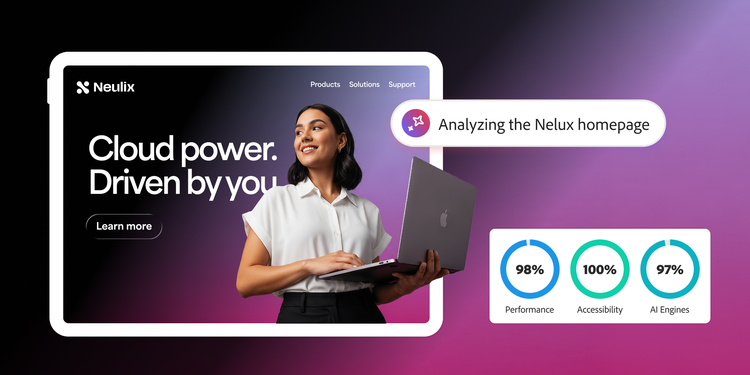
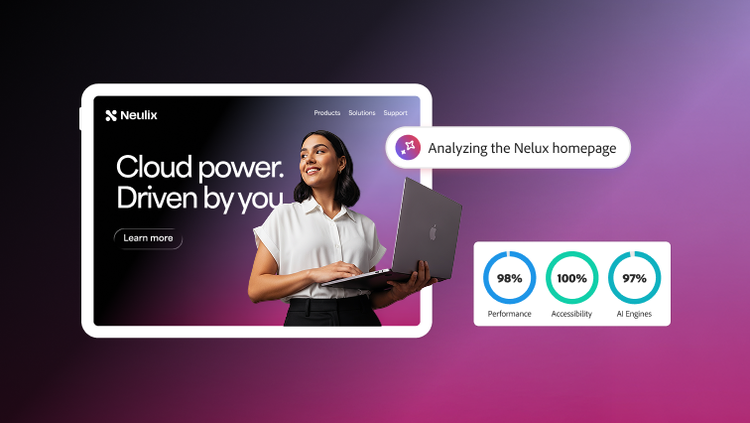
Sites built on Edge Delivery Services consistently achieve exceptional performance and Lighthouse scores, thanks to a delivery model optimised for lightweight HTML, minimal JavaScript and global edge infrastructure.
The architecture also expands authoring flexibility. Teams can choose from document-based workflows or visual editing experiences within Experience Manager.
Just as importantly for the agentic web, Edge Delivery Services produces structured, machine-readable experiences by default, helping both search engines and AI systems interpret and surface content more effectively. Because experiences are constructed from modular blocks, the architecture is particularly well suited for AI-assisted development workflows.
This is where Experience Modernisation Agent comes into play.
Introducing Experience Modernisation Agent.
To help organisations accelerate their journey to modern digital experiences, Adobe has introduced Experience Modernisation Agent in Experience Manager.
Experience Modernisation Agent is part of the broader Brand Experience Agent, Adobe’s agentic system designed to help organisations create, evolve and optimise digital brand experiences across channels.
Within this architecture, Experience Modernisation Agent focuses on modernising existing websites and digital experiences, helping teams migrate from legacy CMS platforms to modern architectures powered by Experience Manager Edge Delivery Services.
At its core, Experience Modernisation Agent uses AI to automate much of the mechanical work traditionally involved in website migrations. Instead of rebuilding sites manually page by page, teams can analyse existing sites, interpret their structure and design systems and generate modern implementations aligned with Edge Delivery Services.
Experience Modernisation Agent includes several key capabilities:
- Site creation and migration. Analyse existing websites and transform their content, styles and structure into block-based architectures compatible with Edge Delivery Services.
- Block development. Generate new components, landing pages and reusable blocks aligned with modern Experience Manager development patterns.
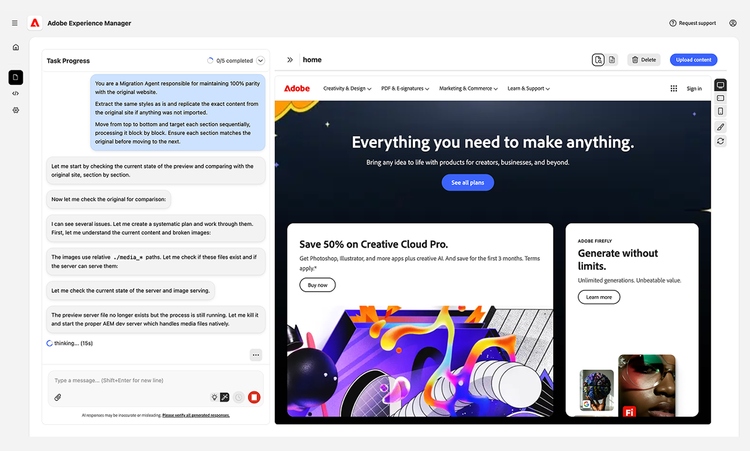
These capabilities are delivered through the Experience Modernisation Console, an AI-assisted, development environment where teams interact with the agent using natural language prompts. The console provides live previews, integrates with GitHub workflows and allows developers to review and control every change before committing updates.
Together, these capabilities dramatically accelerate modernisation initiatives. Instead of months of manual migration work, teams can shift large portions of the process into AI-assisted workflows that produce production-ready results far more quickly.
Organisations can adopt Experience Modernisation Agent in two ways:
- Self-service adoption. Development teams interact directly with the agent through the console to analyse sites, run migrations and generate modern experiences.
- Agentic Outcome Engineer (AOE) delivery model. Adobe experts operate the agent, combining AI automation with human expertise to accelerate delivery while ensuring production-quality outcomes.
What Experience Modernisation Agent supports today.
Experience Modernisation Agent helps organisations accelerate migrations to Experience Manager Edge Delivery Services from a wide range of existing CMS platforms.
Because the agent analyses the structure and content of existing websites rather than relying on platform-specific connectors, it can support migrations from nearly all CMS implementations, including WordPress, Drupal, Sitecore, Shopify and other web publishing systems.
In many cases, the agent can automate a significant portion of the migration process, including:
- Content and page structure analysis. Interpreting the layout of existing pages and mapping them to block-based architectures used by Edge Delivery Services.
- Design system extraction. Identifying typography, colours and styling patterns and translating them into reusable components.
- Block and component generation. Creating modular building blocks aligned with Edge Delivery development patterns. This approach allows organisations to modernise large portions of their digital experiences quickly, giving teams a strong starting point for launching modern, high-performance websites.
As with any modernisation initiative, some elements may still require additional work beyond the automated migration process, such as complex integrations or specialised application features.
See Experience Modernisation Agent in action.
To illustrate how AI-assisted modernisation works in practice, the following demo walks through how Experience Modernisation Agent can migrate an existing website into a modern architecture.
In this example, the agent migrates the Adobe homepage to Experience Manager Edge Delivery Services using a series of simple prompts.
The process begins by prompting the agent to analyse and migrate the page. The agent automatically recreates the page structure, maps content into Edge Delivery blocks and generates a live working version of the site.
From there, additional prompts refine the experience:
- Implementing a carousel component
- Aligning styling with existing brand standards
- Adjusting text and colour treatments
- Refining layout details and spacing
What traditionally requires weeks of co-ordinated development effort is reduced to guided, prompt-based execution, enabling organisations to modernise with speed, precision and production-ready confidence for the agentic web.
Getting started with Experience Modernisation Agent.
As the web evolves toward an agentic future, organisations have an opportunity to rethink how digital experiences are built, delivered and modernised.
With Experience Manager Edge Delivery Services and Experience Modernisation Agent, teams can move beyond traditional migration timelines and adopt AI-assisted workflows that dramatically accelerate modernisation initiatives.
Whether modernising a single site or transforming an entire portfolio of experiences, Experience Modernisation Agent helps organisations accelerate the journey to high-performance, AI-ready experiences built for the agentic web.
Organisations interested in exploring Experience Modernisation Agent can get started in two ways. Developers can experiment directly with Edge Delivery development patterns in Experience Manager Playground. For teams evaluating modernisation initiatives, Adobe also offers a limited-time Try Before You Buy programme that includes 10,000 migration credits for Experience Modernisation Agent. To learn more about the offer and discuss how it could support your modernisation goals, connect with your Adobe account manager.
Peter Parker is a Senior Product Marketing Manager for Adobe Experience Manager, where he leads go-to-market strategy and execution for AI and cloud security. He brings extensive experience in building and marketing emerging technologies, with a passion for helping customers and partners unlock the latest content innovations. Over his career, Peter has worked across the technology stack — from software development, product, to marketing and business strategy — serving industries such as software, fintech, cybersecurity and biotechnology. He holds an MBA from the Smith School of Business and lives in the Bay Area, where he enjoys hiking and photography.