Financial institutions don’t struggle to understand their customers — they struggle to act on that understanding.
At small scale, this is manageable. At millions of customers, it breaks down.
Knowing who a customer is. Understanding what they need. Responding in the moment. These sound basic — but they are extraordinarily difficult to deliver consistently at scale.
AI has been positioned as the solution. And in many ways, it is.
But across financial services, the ambition of AI is outpacing execution. Pilots are everywhere. Impact is not.
The next era of growth won’t be defined by who adopts AI first. It will be defined by who applies it more effectively, where value is actually created: in orchestrated, trusted, real-time customer experiences.
Experience is now the only durable differentiator.
Competing on product is no longer enough. Today, competing on experience is the only business imperative. Yet most financial institutions still operate with fragmented engagement models:
- Batch campaigns instead of real-time intent recognition
- Siloed data across core banking, CRM and service systems
- Disconnected moments across web, mobile, advisor and contact centre
The result? A widening personalisation gap. According to the Adobe State of Customer Experience in Financial Services in an AI-Driven World report, 74% of executives say customers expect personalised interactions — yet only 36% of the customer journey is currently personalised. This gap is most visible in early-stage discovery and research — precisely where future growth is shaped.
Modernisation efforts have improved channels. But without orchestration, personalisation remains episodic, not adaptive. AI must close this gap by turning customer signals into relevant, governed, real-time engagement.
Trust is engineered in real time, not promised in policy.
In financial services, trust is the product. Customers increasingly define trust operationally — not emotionally. They expect:
- Privacy and data protection
- Transparent pricing
- Mobile-first, responsive experiences
- Fast, accurate answers
In fact, 96% of executives say customers value privacy and data protection and 95% say customers expect transparent pricing. AI-driven engagement raises the stakes. Every AI-powered recommendation, explanation or decision must be:
- Secure
- Compliant
- Transparent
- Brand-aligned
By design — not by exception.
Institutions that embed trust into the surface experience — through clear data usage, real-time alerts, contextual recommendations and explainable decisioning — will earn the permission to scale AI deeper into the relationship.
AI is transforming discovery, not just efficiency.
Generative AI is already reshaping how customers research financial products. Search is becoming intent-driven and conversational. Customers increasingly use AI tools to decode complex decisions — from retirement withdrawals to insurance comparisons. The report indicates that 21% of organic search volume is expected to shift to AI-powered platforms within the next 24 months and 86% of firms have considered the impact of AI-based search on their brand.
This is not a marketing tweak. It’s a structural shift. To compete in AI-driven discovery environments, financial institutions must:
- Structure content for machine readability.
- Embed Experience, Expertise, Authoritativeness and Trustworthiness (E-E-A-T) signals.
- Ensure compliance and suitability guidance is contextually surfaced.
Discovery must work inside AI interfaces — and still inspire human trust when it matters most.
GenAI is changing content economics, but scale requires control.
Content has long been a bottleneck in financial services. Regulatory review cycles, brand governance and product complexity slow everything down.
GenAI is changing that. The report shows that 46% of organisations have seen a jump in content production output and 26% report a drop in cost per content piece. Only 8% say they are truly scaling GenAI today.
Why is there a disconnect? Because speed without structure introduces risk. Financial services firms are discovering that while GenAI accelerates output, it can also increase quality control costs and compliance exposure if governance isn’t embedded into the workflow.
In this set-up, the winners will not treat GenAI as a shortcut. They will industrialise it with:
- Modular content systems
- Embedded approval routeing
- Risk-tiered automation
- Real-time validation
AI must enhance customer moments and empower employees — without compromising control.
Agentic AI adoption begins internally.
When it comes to more autonomous systems, financial institutions are proceeding deliberately. 55% prioritise internal operations for agentic AI implementation. This staged approach reflects the industry’s risk posture. Firms are validating governance frameworks, monitoring model behaviour and building AI maturity internally before extending autonomy into customer-facing roles.
This is not hesitation. It is discipline.
AI in financial services is not a technology project. It is a business system transformation that must integrate decision tracking, escalation logic, explainability and compliance alignment from day one.
The governance gap is the most urgent AI risk.
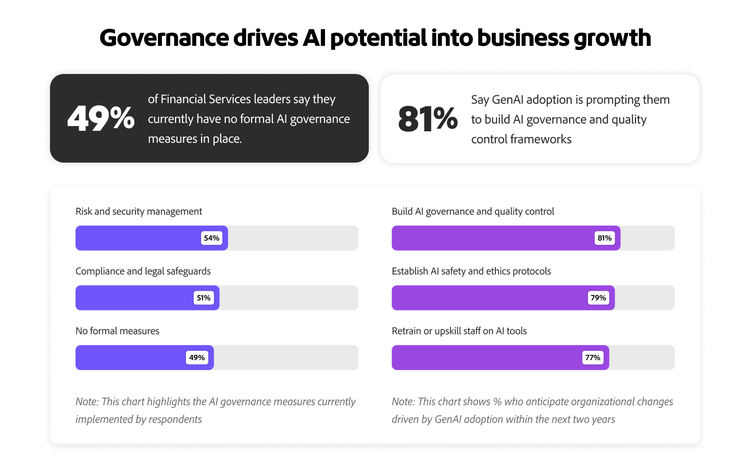
Here is the most surprising and consequential finding in the research: 49% of financial services leaders report having no formal AI governance measures in place today. At the same time, 81% say GenAI adoption is prompting them to build AI governance and quality control frameworks.