The customer journey is rarely a linear, predictable path. Individual customers exhibit diverse and evolving behaviours, preferences and real-time interactions, which necessitate both a foundational strategy and the ability to adapt with agility. Ultimately, customers perceive a single brand. They don’t always know the difference between a digital product and a marketing channel. They expect a personalised and consistent experience across all touchpoints. Customers expect the mobile app to recognise which pages they were browsing on a desktop, which email campaigns they clicked and which items they purchased in-store. They expect brands to know who they are and what they want. This "one brand" perception is powerful. However, it's also a double-edged sword: a single discordant note on one channel can tarnish the overall brand perception, regardless of excellence in other areas. To meet these ever-increasing customer expectations, cross-functional teams must collaborate to deliver a seamless, personalised customer experience (CX) across all digital and off-line channels. This internal alignment around customer personalisation has been shown to make a significant difference to the bottom line.
Gain customer insights with Product Analytics.

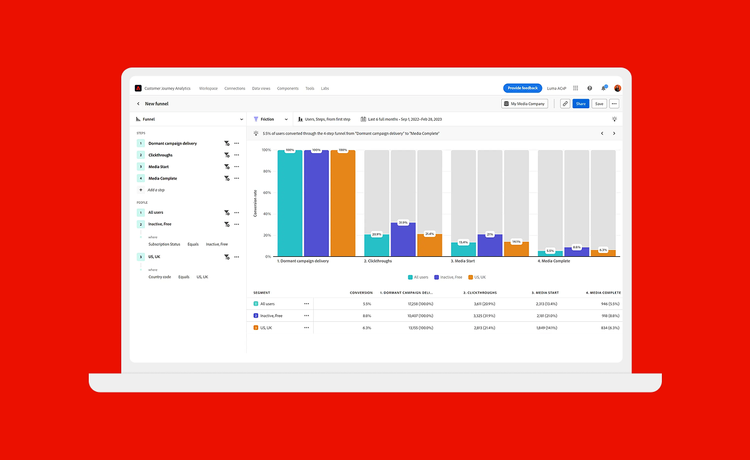
Disconnected data hinders customer understanding.
Despite the vital need for co-ordination, many barriers still stand in the way. Product teams have invested in understanding their customers through various processes, tools and data sources that often differ from those used by the rest of the organisation. Operational silos directly impede comprehensive customer analytics. When data from various touchpoints is not combined and harmonised, it becomes impossible to see the entire customer journey or understand the critical cross-channel affects the customer's perception of the brand. This fragmented view prevents organisations from truly understanding how customers navigate their ecosystem.
This lack of a unified view, born from data silos, is not merely an operational inefficiency; it represents a fundamental barrier to achieving genuine customer-centricity. These silos create significant blind spots in customer journey insights, which in turn directly prevent effective customer journey optimisation (CJO). Customer journey optimisation is the strategic process of improving every interaction a customer has with a brand, from initial awareness to long-term loyalty and advocacy. But optimisation cannot occur in a vacuum; it relies heavily on the foundational insights derived from thorough journey analysis. If a business cannot accurately analyse the complete journey due to fragmented data, its ability to identify pain points, close gaps and make each stage more efficient and personalised is severely compromised. The "dissonance" created by these internal disconnects is not just an internal issue; it is directly experienced by the customer in the form of generic messaging, cumbersome buying processes and an overall disjointed experience — precisely the kinds of interactions that customers no longer tolerate. The inability to create meaningful customer journey insights because of these data disconnects cripples any attempt at strategic customer journey optimisation, ultimately leading to missed opportunities and heightened customer frustration.
How Adobe Product Analytics provides comprehensive customer journey insights.
With the introduction of Adobe Product Analytics, Adobe is empowering product organisations to look beyond their traditional data confines and gain a comprehensive understanding of the complete customer journey. This marks a significant step towards enabling robust customer analytics across the enterprise. While comprehensive customer analytics often examines the entire customer lifecycle, Adobe Product Analytics provides deep, granular insights into the product interaction phase — a critical segment of the journey that has often remained a black box for marketing and CX teams.
Adobe Product Analytics achieves this by offering several key capabilities designed to unify and make sense of product interaction data within the broader customer context. Event-data ingestion allows for the collection of raw data points—the individual "notes"—of product usage at scale. Crucially, the Combined Data View feature enables this product event data to be viewed alongside user attributes and data from other customer sources. This is vital for holistic customer analytics, as it contextualises product behaviour within a larger framework of customer interactions. Furthermore, the Unified Profile capability connects user identities from multiple sources into a single, cohesive customer profile — essential for tracking individual journeys through the product and linking these specific interactions to broader customer analytics efforts.
Adobe Product Analytics offers a suite of features specifically designed to empower product teams to conduct thorough and insightful customer analytics within their domain, moving beyond surface-level metrics to a genuine understanding of user behaviour and experience.
Flexible, real-time analysis for evolving business needs.
The platform enables teams to manage product and user event data, allowing them to correct collection errors and create new events, dimensions or metrics — all on the fly. This is critically important because customer journeys are not static; business questions evolve and the ability to adapt analyses quickly is paramount. This aligns with the principle of adjusting data views and fields directly within the user interface to answer business questions as they arise, without lengthy IT cycles.
Guided and out-of-the-box analyses.
Adobe Product Analytics provides a simplified user experience through Guided Analysis, enabling marketers, product managers and analytics teams to instantly understand their product experience and customer data. Out-of-the-box analyses simplify complex data for non-analysts, allowing them to easily uncover patterns, trends and insights across individual users, cohorts and intricate behavioural segments. This directly addresses the goal of making customer analytics insights more accessible, allowing product teams to quickly self-serve their data needs. Teams can now identify friction points, analyse drop-off rates, conduct path analysis to see how users navigate through the product and perform trend analysis to track behavioural shifts over time — all essential methodologies in customer analytics. This self-service capability means product teams no longer need to wait weeks for a data scientist to run complex SQL queries.
Understand the “why” in product interactions.
It facilitates monitoring, understanding and optimising customer and product user experiences throughout their journey, from pre-purchase to consideration, to post-purchase and ongoing usage. It helps uncover the “why” behind their online and off-line interactions across products and channels, such as how they arrived, where they engaged and what features they used and liked. This resonates deeply with the core aim of customer analytics, which is to illuminate customer behaviours and understand not just what is happening, but why specific steps are converting at high rates or where frustrations are leading to abandonment.
Harness testing metrics for data-driven decision making.
Testing metrics support data-driven decisions. The ability to analyse A/B/n experiments to understand optimal paths for product experiences is a core component of the iterative improvement cycle inherent in robust customer analytics. Insights gleaned from these analyses lead to hypotheses for improvement, which are then tested and measured for impact, creating a continuous loop of learning and refinement.
Leverage product insights for effective customer journey optimisation.
Adobe Product Analytics truly opens the door for cross-functional teams to orchestrate their efforts into a harmonious, unified customer journey. When product, marketing and customer experience (CX) teams align their processes and operate from a shared foundation of data, metrics and customer profiles — a reality facilitated by tools like Adobe Product Analytics feeding into a unified platform — they are collectively empowered to drive substantial growth through superior customer experiences. The outcome is not merely better individual products, but more cohesive and satisfying overall customer journeys — are proven drivers of increased customer satisfaction, enhanced loyalty and sustainable business growth.
The integration of deep product insights into the broader customer analytics framework elevates product interaction data from a purely operational concern (focused on bugs or basic feature usage) to a vital strategic asset for the entire enterprise. This reframes the role of the product team, positioning them as central contributors to the overall CX strategy. When product data informs marketing campaigns, sales conversations and support interactions, the entire organisation benefits from a more comprehensive and nuanced understanding of the customer.
Book a demo now to see how Adobe Product Analytics can help your business leverage product insights to effectively optimise customer journeys.
Recommended for you
Title
Power customer journeys with Product Analytics.
CardDescription
Adobe Product Analytics empowers product teams to better understand, personalise and optimise every step of the customer journey.
cardDate
2025-09-04
cardImage

primaryTag
caas:content-type/blog
Tags
caas:content-type/blog, caas:products/adobe-analytics, caas:topic/data-&-analytics, caas:blog-author/adobe-for-business-team