The case for a component content management system.
Transforming document workflow is integral to an organisation’s digital transformation strategy.


Transforming document workflow is integral to an organisation’s digital transformation strategy.

As content becomes central to digital experiences, managing it efficiently and at scale is critical. A component content management system (CCMS) helps organisations create, manage and deliver structured content across channels while maintaining control, consistency and compliance.
This guide explores the challenges of enterprise content management, the role of a CCMS in modern content strategy and how organisations can streamline workflows, improve knowledge management and scale consistent, personalised content experiences.
Content shapes how enterprises communicate, operate and serve customers. As content grows more complex, the systems behind it become essential for improving efficiency, supporting governance and scaling content delivery. However, enterprise content management can be complicated and expensive, especially for large or complex documents with government-regulated, corporate-regulated or branded subject matter that must be securely delivered via multiple channels and formats.
Digital transformation has accelerated the pace of business by streamlining processes, improving efficiency and supporting up-to-the-minute communication and decision-making. Content consumers expect accurate, relevant and often personalised experiences in real or near real time.
These challenges are even more problematic for businesses that create, publish and depend on large, complex documents or reusable content they must keep current. Ensuring consistency across versions, channels and regions becomes difficult without structured content workflows and centralised governance. Content must reach customers, partners and employees in the right format, at the right time and in the right place for the organisation’s specific corporate and industry requirements. Yet, subject-matter experts, authors, editors, translators, IT and production staff are often geographically distributed.

A critical technology to alleviate these concerns is a component content management system (CCMS). A CCMS manages content at a granular level that is modular, structured, reusable and format-free, letting users build new content assets quickly and with a high degree of control. This approach improves consistency, reduces duplication and supports scalable content operations.
A CCMS centralises content and provides a single platform for managing business documents, especially those that are long, complex, frequently updated, widely translated and highly-regulated. It supports version control, localisation and multi-channel delivery, helping ensure content remains accurate and aligned with brand and compliance requirements.
An important CCMS use case is knowledge discovery and knowledge sharing.
Generative AI can further support knowledge management using a CCMS through automated tagging, metadata generation and enhanced search capabilities.
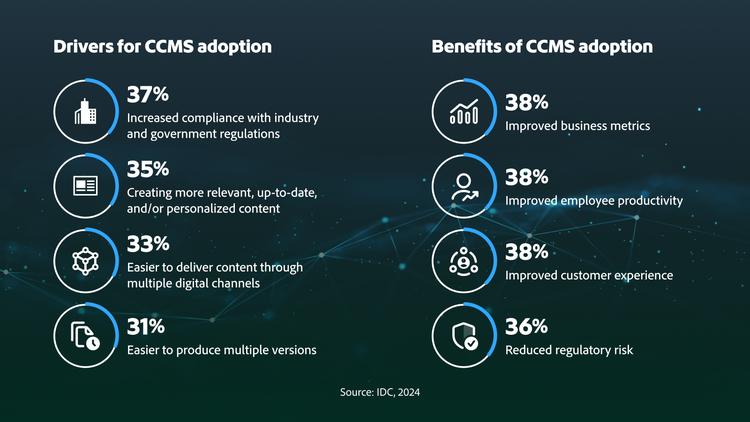
For most enterprises, the payoff of a CCMS shows up in the numbers: faster publishing cycles, lower translation and update costs and fewer compliance gaps. Because content is authored once as reusable components, a single update propagates to every deliverable, format and locale — removing the manual rework that stretches documentation timelines.
In one documented customer example, Briggs & Stratton reduced translation costs by 25% by streamlining translation management and eliminating redundant translations. That shift frees subject-matter experts, editors and translators from duplicated effort so they can focus on higher-value work — which is what makes a CCMS a strategic investment in digital transformation, not just a documentation tool.
A CCMS plays a critical role in this shift by supporting structured content, centralised governance and scalable content operations. A CCMS should be a core consideration in any organisation’s digital transformation strategy, helping teams deliver consistent, compliant and personalised content experiences across channels.
Adobe Experience Manager Guides is a cloud-native CCMS designed to easily manage product documentation, help, support and knowledge content. It empowers IT leaders to drive large-scale digital transformation while helping manage total cost of operation.
Learn how Adobe Experience Manager Guides supports scalable, governed content operations for documentation and knowledge content in this overview video or schedule a demo.