Agile retrospectives – a complete guide

Adobe for Business Team

05-28-2025

Three women having a conversation. Overlaid with a chart showing retrospective results.

More companies are adopting Agile approaches both within and outside development processes. The methodology’s iterative design adds real value for industries that need a project management process capable of delivering more efficiently and effectively.

Retrospectives are one of the most overlooked parts of the Agile process, especially during initial implementation. Yet they’re vital for maintaining communication and efficiency. Teams that run retrospectives see 24% higher responsiveness and 42% greater quality compared to Agile teams that skip this step.

This article covers what an Agile retrospective is, how these meetings can strengthen your existing processes, and how to run one effectively.

In this guide:

What is an Agile retrospective?

An Agile retrospective is a meeting held at the end of an iteration of work – typically a sprint. It gives team members the space to discuss accomplishments and areas for improvement as they plan for the next phase of project work. Team members are encouraged to speak openly about their experiences and reflect on processes, procedures, and tasks, so the broader team can learn and improve over time.

Retrospectives form part of the Scrum framework – the fourth and final meeting outlined in the process. Scrum builds collaboration and communication within and across teams through a series of meetings designed to keep discussions clear and direct. These meetings address both successes and obstacles, helping teams optimise performance as they move forward.

Agile retrospective meetings centre on the tasks completed during the iteration or sprint. The aim is to identify areas for improvement to carry through to the next project phase, and to highlight effective approaches that other team members could benefit from. When applied to Scrum, these meetings also bring together contributors across different teams, enabling knowledge sharing on a wider scale.

Teams using Kanban can also benefit from conducting retrospectives. While retrospectives aren’t an official part of the Kanban workflow, adding one can help contributors find ways to work more effectively as projects progress.

How is an Agile retrospective different from other meetings?

What sets an Agile retrospective apart from other meetings – such as reviews or postmortems – is where it sits within the iterative development or project process. Retrospectives take place at the end of a sprint, or iteration, that forms part of a larger project.

The aim is to refine workflows and approaches while the broader initiative is still in progress. This lets teams adapt and improve efficiency during the work itself – not just once everything is done.

Agile retrospective vs. sprint retrospective

There’s a clear distinction between an Agile retrospective and a sprint retrospective. While the two terms may appear interchangeable, they refer to different stages and processes.

Aspect
Sprint retrospective (Scrum)
Agile retrospective (general)
Framework
Specific to Scrum
Any Agile framework
Timing
End of each sprint
End of sprint, release, or milestone
Focus
Team process improvement for next sprint
Team/process improvement at any point
Attendees
Scrum team only
Any agile team, may include others
Frequency
Every sprint
Flexible

A sprint retrospective is a specific type of agile retrospective that occurs at the end of each Scrum sprint, with a focus on team process improvement.

An agile retrospective is a broad term for any reflection meeting within agile, and isn’t limited to Scrum or sprints.

The importance of Agile retrospectives

Some teams may baulk at the idea of adding another meeting to the agenda, but Agile retrospectives deliver real value. They provide a forum for the kind of idea exchange that most other project management methodologies simply don’t make room for.

Retrospectives encourage team members to speak up and share feedback with a wider audience. This drives the refinement of processes that affect their workflow and their ability to meet the goals set by management.

Even when task breakdowns and priorities come from above, contributors are given the floor in an Agile retrospective. This gives leadership the opportunity to gather input and put changes into practice – creating greater efficiencies for the people doing the work.

Better communication can also surface efficiencies in areas that wouldn’t otherwise be identified by stakeholders who aren’t involved in the day-to-day fulfilment of tasks.

Agile is iterative – meaning projects are tackled in a series of tasks across set time periods – giving teams the flexibility to spot and address roadblocks as they arise. Holding an Agile retrospective at the end of each work interval brings issues to the surface early enough for leadership to make changes before a project is completed.

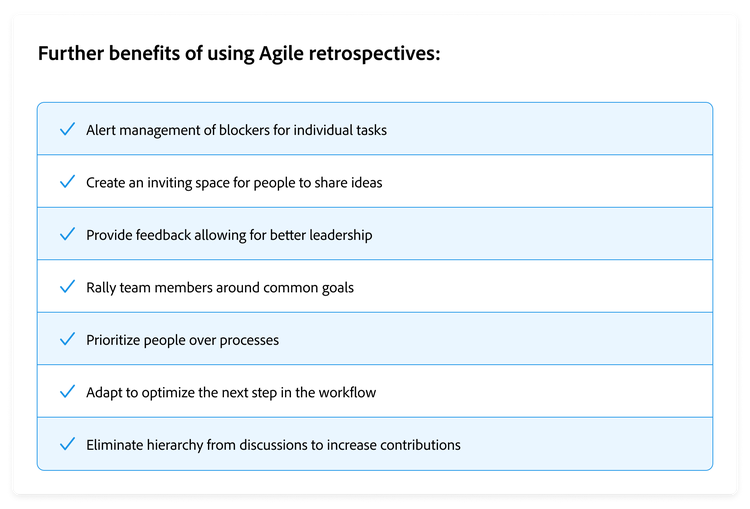
Further benefits of using Agile retrospectives

Chart showing additional benefits of using Agile retrospectives.

Implementing an Agile retrospective delivers better end products by taking advantage of the flexibility Agile brings to the development process or workflow. Leaders can spot roadblocks and concerns before they become major blockers, giving them the chance to provide direction and constructive feedback — all while keeping the project on track.

Conduct an Agile retrospective

Think about the nature of your project work and how often your team moves through different phases of the development or production cycle. Use natural stopping points to schedule a retrospective — typically when teams complete an iteration of their work. This might happen at regular intervals, such as every 2 to 4 weeks, or it might flex around the end point of a particular campaign or rollout.

Once the timing is sorted, make sure to invite everyone involved in the project — so they can share feedback and gain value from hearing their teammates' perspectives. This includes leadership (such as scrum masters and product owners), all individual contributors, and any other stakeholders who stand to benefit from the team’s input.

The Scrum framework offers a clear approach to running a retrospective. The goal is straightforward: identify what worked and what didn’t, then pinpoint areas for optimisation across teams and processes.

Start by focusing on what went well in the iteration — this sets a positive tone for the discussion. Then ask for feedback on what could be improved and what roadblocks the team encountered along the way. Leaders should keep the conversation anchored to a specific time period, typically the iteration (or sprint) that just wrapped up.

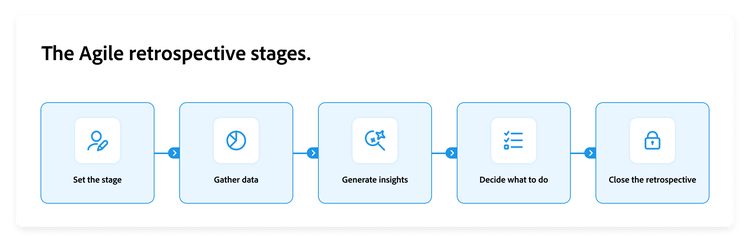
The Agile retrospective stages

Chart showing the stages of Agile retrospectives.
  1. Set the stage. Let everyone know upfront what to expect — and what not to — during the meeting. Encourage all attendees to share their perspectives respectfully, even when flagging pitfalls. If you plan to use a specific type or theme for your retrospective (see below), introduce it here.
  2. Gather data. Outline or revisit the main tasks and goals from the iteration, then ask everyone to comment on their contributions and thoughts. This provides a framework of categories for capturing insights throughout the session.
  3. Generate insights. Let attendees share their experiences and gather their feedback as you go. This can be done through note-taking or more visible methods like whiteboarding. Group similar ideas together to identify themes or areas that need extra attention.
  4. Decide what to do. Define clear, actionable steps to fix or refine processes for better outcomes in the next iteration. Where possible, decisions should be made as a group, with leadership consulting stakeholders on broader directional matters. Keep in mind: the goal of a retrospective is to leave with concrete action items that improve existing processes for the next round of work.
  5. Close the retrospective. Summarise the meeting’s outcomes and outline the next steps for everyone to take, where applicable. Thank everyone for their contributions and encourage them to stay engaged with the process.

Retrospectives are more than fact-finding exercises – they’re collaborative environments where leaders can look to individual contributors for creative solutions.

As the meeting wraps up, invite everyone to contribute their own ideas on how to address the issues raised and what actions could be taken to resolve challenges. Group common items together and look for trends or themes that can be tackled at the same time.

Types of retrospectives

While all Agile retrospectives offer a general forum for encouraging and collecting feedback, many different formats can be applied to team management and workflows.

Leaders may find it useful to draw from different approaches or tailor their format to suit team personalities and needs:

What all these types have in common is a commitment to fostering creative, engaging environments where attendees actively participate in the discussion. Many project managers, scrum masters, and other leaders identify participation as one of the biggest obstacles to running effective Agile retrospectives.

Some team members may feel their input isn’t valued, or that speaking candidly about what didn’t work could have consequences. It’s the meeting facilitator’s responsibility to create a safe, inviting space where everyone feels confident contributing – encouraging engagement, openness, and follow-through.

Barriers to success

1. Low engagement

Your team seems disengaged – they’re offering few suggestions and staying mostly quiet. To re-engage your team, consider different learning styles. Visual and hands-on activities can break familiar patterns and encourage creativity.

2. Lack of trust

Conversation stays surface-level, with no one raising anything negative. To address this, the facilitator should create a space where everyone feels comfortable sharing their thoughts. Reward participation even – or especially – when it raises an issue. Encourage the team to air and address problems early on, before they become bigger. Ask for individual, confidential feedback to uncover any deeper issues.

3. Poor follow-through

Low engagement and lack of trust can also arise when participation doesn’t seem to make a difference. Over time, people stop speaking up. To prevent this, validate and act on the issues raised and ideas offered. Make sure changes happen in the next sprint, or set actionable goals and keep everyone updated on progress.

Tips to succeed

1. Ask team members to come prepared

Be clear about how much preparation is needed and in what format. For example, ask participants to write down their thoughts in a shared document, and let them know whether you want one or two sentences, a paragraph, or some examples. When you offer alternative ways to share input, you’ll be more likely to hear from all your team members – including those who prefer not to speak up in meetings.

2. Stay on task and respect everyone’s time

Retrospectives are a great opportunity to dig deeper into issues, but there’s always a risk that one person or topic dominates while everyone else checks out. Keep the meeting on topic and on schedule with a clear, time-boxed agenda.

3. Mix it up and try new formats

The traditional approach is to ask, ‘What worked, what didn’t, and what will we do next time?’ These are broad questions that can be difficult to answer in a detailed, meaningful way. To encourage more specific, focused conversation, try a new activity or format. Here are some examples:

Get started with Agile today

Retrospectives play a vital role in any Scrum or Agile project management process – they give teams a structured opportunity to reflect on their successes and obstacles in a constructive way.

Leaders can take this feedback and apply changes in real time to help optimise outcomes for the next iteration and improve overall performance. These meetings bring teams together in a positive, productive environment — creating a forum for feedback that flows through to stakeholders for further consideration.

With Agile, teams can deliver better products that meet both their customers' needs and market demands.

Agile approaches enable faster, more efficient project management, with team members working on smaller, clearly defined tasks within set timeframes. The result is the iterative delivery of content, products, or services that reach the market with greater speed, efficiency, and quality.

Agile retrospectives are just one element of a successful project management framework. As leaders put these meetings into practice, they often look for tools to support their broader Agile processes. That’s where Adobe Workfront can help.

Workfront is work management software that supports Agile teams and a range of project management methodologies. Connect people and processes across your organisation for stronger collaboration throughout the entire lifecycle of a project. Whether you’re using Scrum or Kanban, Agile is easier with Adobe.

Take a product tour or watch our overview video to see how Adobe Workfront can bring greater efficiency and ease to your Agile management processes.

https://business.adobe.com/fragments/resources/cards/thank-you-collections/workfront