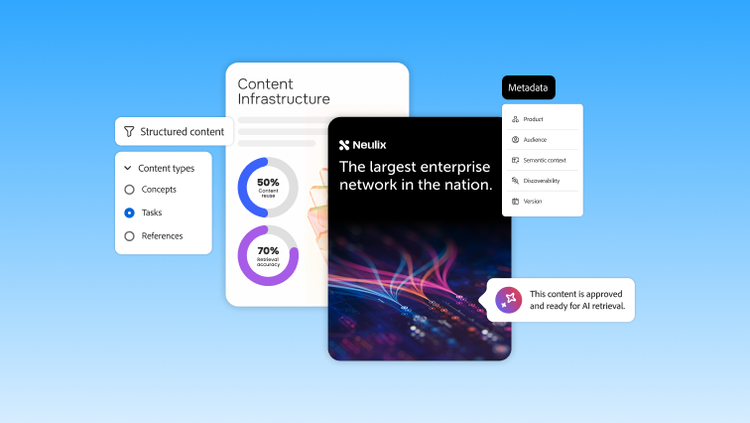
Building the content infrastructure behind trusted enterprise AI: structured authoring, metadata, CCMS and trustworthy retrieval.
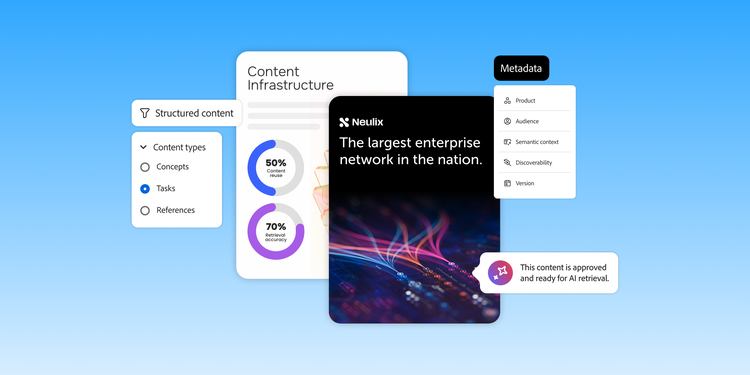
Enterprise AI has a content problem.
Enterprise organisations are quickly investing in generative AI, copilots, intelligent search and automated support experiences. Yet many are still trying to power those systems with fragmented PDFs, duplicated and outdated knowledge, disconnected repositories, inconsistent metadata and publishing workflows built for the past era.
That creates a problem many AI initiatives underestimate from the beginning. AI systems are only as trustworthy as the content they retrieve.
Forbes recently called knowledge management 'the tech world's stepchild' — and argued it may be AI's salvation. That framing captures the urgency precisely.
Most enterprise AI discussions still revolve around models, copilots and retrieval-augmented generation (RAG) architectures. But the real operational challenge sits much further upstream. Enterprise AI depends on governed, structured and reusable content that can be trusted across systems, teams and delivery channels.
The issue is becoming increasingly urgent as product documentation evolves from a post-sale support artefact into a core operational layer powering customer self-service, onboarding, support automation, knowledge retrieval, compliance workflows and personalised digital experiences.
The operational pressure is already visible across the enterprise. Research commissioned by Adobe and conducted by S&P Global found that 87% of respondents struggle managing content throughout its lifecycle, while 68% struggle working across too many disconnected applications and systems. These operational inefficiencies create exactly the kind of fragmented environments that weaken enterprise AI retrieval quality and governance.
Organisations that continue to treat technical documentation as static publishing output may discover that their AI initiatives inherit the same weaknesses already present in their content operations — duplicated information, stale knowledge, inconsistent terminology, weak discoverability and fragmented documentation governance.
The organisations that succeed with enterprise AI will treat documentation differently. They will build AI-ready content ecosystems designed not only for human readers, but also for retrieval systems, semantic search, automation pipelines and AI-driven experiences.
Why AI systems struggle with enterprise documentation.
Large language models (LLMs) perform remarkably well when grounded in trusted enterprise knowledge. The problem is that many enterprise documentation environments were never designed for modern retrieval architectures in the first place.
Legacy documentation systems often contain overlapping PDFs, duplicated procedures across Word documents, inconsistent naming conventions and folder structures, outdated content, uncontrolled copies distributed as final, disconnected repositories and fragmented ownership models. Humans can sometimes navigate these inconsistencies through experience and context. AI systems cannot.
Organisations are increasingly turning to DITA-based structured authoring and component content management systems (CCMSs) to address these foundational gaps — because retrieval quality begins with how content is authored and governed, not just how it is retrieved.
As organisations deploy AI-driven support systems and enterprise copilots, these weaknesses become amplified. Retrieval systems struggle to identify authoritative information. AI-generated responses may blend outdated and current guidance. Similar topics with inconsistent terminology create ambiguity. Long-form documents often contain poorly segmented information that weakens retrieval precision.
The result is not simply reduced efficiency. Instead, it is reduced trust in the answers themselves.
This challenge explains why many enterprise AI initiatives are now shifting focus toward governance, retrieval quality, content architecture and semantic organisation. AI performance increasingly depends on the quality of the content ecosystem feeding it.
The underlying operational strain is already significant. According to Forrester research commissioned by Adobe, 64% of organisations reported struggling to meet modern content creation demands, while 68% cited lack of content reuse as a major challenge. These are not isolated documentation problems any more. They increasingly affect the reliability, scalability and trustworthiness of enterprise AI systems.
AI cannot distinguish authoritative content from redundant content.
One of the most significant weaknesses in enterprise documentation environments is uncontrolled duplication.
Multiple versions of similar procedures, duplicated product information across repositories, conflicting terminology and unmanaged local copies create operational friction long before AI enters the equation. But when enterprise AI systems attempt to retrieve knowledge from these environments, the problem becomes substantially more severe.
AI systems cannot inherently determine which version of a procedure is authoritative, which product specification is current or which content instance should be trusted over another. Without governed source-of-truth workflows, retrieval systems may surface conflicting or outdated guidance.
This is why modern structured content strategies increasingly emphasise centralised content governance, controlled reuse and authoritative publishing pipelines. Organisations deploying AI systems require documentation architectures capable of maintaining consistency across every delivery channel.
According to IDC research commissioned by Adobe, organisations using Adobe Experience Manager Guides identified significant operational benefits tied to centralised content management, reuse and version control, including improved productivity, stronger consistency and better customer experiences.
Modern DITA content management practices address this directly. By enforcing single-sourcing — writing content once and reusing it across multiple outputs — organisations eliminate the duplication that confuses retrieval systems. Content reuse is an efficiency gain and AI governance strategy.
This aligns closely with broader industry findings. Forrester also found that 69% of respondents believed flexible XML-based content structures improved reuse and syndication capabilities, reinforcing the growing importance of structured content architectures in modern enterprise content operations.
Legacy documentation structures were designed for humans, not retrieval systems.
Traditional documentation environments were optimised for linear reading experiences, not semantic retrieval.
For decades, organisations published large monolithic manuals, lengthy PDFs and document-centric knowledge repositories intended for sequential human consumption. While those models served traditional publishing workflows reasonably well, they create significant challenges for AI retrieval architectures.
AI systems consume information differently than humans do. They retrieve smaller semantic fragments, rank relevance dynamically and assemble responses from multiple contextual sources.
That changes the operational requirements for enterprise documentation entirely.
Why a CCMS is foundational to AI-ready documentation.
Long-form monolithic documents often contain excessive context, duplicated or outdated information, inconsistent structure and weak semantic boundaries. Retrieval systems struggle to isolate the most relevant content within oversized documentation blocks.
By contrast, modular, structured content enables organisations to break information into reusable, semantically meaningful components that are easier to retrieve, personalise, govern and reuse across channels.
This is one reason structured authoring and component content management systems (CCMSs) are increasingly becoming foundational technologies for AI-ready enterprises. A CCMS — such as Adobe Experience Manager Guides — is a specialised platform designed to manage structured, reusable content at the topic level rather than the document level. Unlike a traditional CMS, a CCMS enforces governance, versioning and structured authoring workflows that support both human publishing and AI retrieval at enterprise scale.
The new AI-ready content checklist.
AI-ready documentation environments are not defined by chat interfaces or AI integrations alone. They depend on disciplined content operations that support trustworthy retrieval, governance, reuse, scalability and semantic consistency.
The following architectural principles are quickly becoming essential for organisations building trustworthy enterprise AI ecosystems.
1. Structured authoring and modular content
AI systems perform best when enterprise content is modular, semantically organised and reusable.
Structured authoring — whether through DITA XML, topic-based writing or other structured content frameworks — enables organisations to create modular content components that can be assembled dynamically across products, channels, experiences and audiences. This is the foundation of modern component content management and it is increasingly essential for AI-ready enterprises. Instead of managing isolated documents, organisations manage reusable knowledge assets.
“When we help organisations migrate and structure large volumes of enterprise content, the goal is no longer just publishing efficiency. Companies are now thinking about whether their content can support AI retrieval, semantic search, personalisation, compliance and future automation initiatives at scale,” observed Bernard Aschwanden, CEO and Co-Founder of WritemoreAI, on LinkedIn.
The operational advantages are significant.
First, it improves consistency. Shared content components can be updated once and reused across multiple outputs, reducing duplication and lowering the risk of conflicting, outdated information.
Second, it improves retrieval quality. Smaller, semantically coherent topics are easier for AI systems to retrieve accurately.
Third, it supports personalisation at scale. Structured content allows organisations to dynamically assemble experiences for different audiences, product variants, regions and channels without duplicating content.
Forrester research found that organisations increasingly view structured content management as essential for personalisation, scalability and omnichannel content delivery.
The research also found that 57% of organisations expected structured content approaches to improve ROI on content strategy, while more than 80% reported reductions in regulatory, reputational, financial and workforce-related risks after adopting structured content management practices.
2. Metadata that supports semantic retrieval.
Metadata is quickly becoming one of the most important operational layers in enterprise AI.
For years, many organisations treated metadata as administrative overhead. Today, it sits at the centre of retrieval precision, discoverability, personalisation, governance and AI orchestration.
Modern AI systems rely heavily on metadata to understand content relationships, audience relevance, lifecycle status, regional applicability, product associations, compliance constraints and semantic context.
Organisations that lack disciplined metadata strategies often struggle with inconsistent search experiences, poor retrieval quality, weak personalisation and fragmented content operations.
Metadata quality increasingly affects how enterprise AI systems rank, retrieve and contextualise information. Without consistent metadata governance, organisations often create semantic ambiguity that weakens both human search experiences and AI-generated responses.
Strong metadata architectures improve both human and machine understanding of enterprise knowledge.
This includes:
- Product metadata
- Audience metadata
- Regional and legal applicability
- Lifecycle status
- Taxonomy alignment
- Semantic classification
- Relationship mapping
- Version lineage
In structured content management environments, particularly those built on DITA, metadata is not applied after the fact — it is embedded during authoring through structured prologue elements, conditional attributes and subject schemes. This makes DITA content inherently more metadata-rich and AI-ready than unstructured documentation and significantly better suited to AI retrieval architectures.
As enterprises increasingly deploy AI-driven support systems and semantic search experiences, metadata quality becomes directly connected to AI trustworthiness.
3. Intelligent chunking for AI consumption.
One of the most overlooked aspects of AI-ready documentation is chunking strategy.
AI retrieval systems rarely consume entire manuals or long-form documents. Instead, they retrieve smaller content fragments designed to maximise contextual relevance.
Poor chunking quietly undermines retrieval quality.
Oversized chunks reduce retrieval precision and introduce unnecessary context. Undersized chunks may lose semantic meaning or fail to preserve procedural continuity.
Intelligent chunking requires organisations to think carefully about:
- Semantic boundaries
- Procedural cohesion
- Topic granularity
- Reusable content units
- Context preservation
- Retrieval optimisation
This is where structured content models become particularly valuable.
Well-designed, modular topics naturally support AI retrieval architectures because they already separate concepts, tasks, references, warnings, troubleshooting guidance and procedural steps into coherent units.
Leading organisations increasingly recognise that chunking is not simply a retrieval configuration problem. It is a content architecture discipline.
“Large language models do not read documentation the way humans do. They retrieve fragments, relationships and context windows. That means organisations must start designing content for retrieval precision, not just for publishing efficiency,” surmised Aschwanden.
4. Stable IDs, references and traceability.
Trustworthy enterprise AI requires traceable enterprise knowledge.
As organisations deploy AI-driven support experiences, internal copilots and automated assistance systems, the ability to trace generated responses back to authoritative sources becomes increasingly important.
Stable identifiers and governed references help organisations maintain:
- Citation traceability
- Version awareness
- Auditability
- Compliance defensibility
- Content lineage
- Cross-system consistency
This is especially critical in regulated industries where organisations must demonstrate the origin and validity of operational guidance.
Stable references also improve retrieval quality by helping AI systems consistently associate related content across publishing environments.
As enterprise AI adoption expands, explainability and traceability will become increasingly important operational requirements.
5. Version control and authoritative publishing workflows.
AI systems amplify governance weaknesses.
If enterprise documentation lacks disciplined approval workflows, controlled publishing processes, version synchronisation or governance oversight, those weaknesses become exposed through AI-generated experiences.
Organisations deploying AI systems therefore require strong operational discipline around:
- Approval workflows
- Publishing governance
- Version control
- Content freshness
- Review processes
- Role-based permissions
- Auditability
This becomes particularly important as organisations attempt to operationalise AI-generated assistance in regulated or customer-facing environments where outdated or conflicting information can introduce compliance, reputational and legal exposure.
Governed workflows help ensure that AI systems retrieve current, approved and authoritative information rather than stale or incomplete content.
This becomes especially important when documentation supports customer-facing experiences, regulatory guidance, product onboarding or operational procedures.
Structured content management systems increasingly provide the governance foundations needed to support these workflows at enterprise scale.
6. Source-of-truth architectures across channels.
Modern enterprises rarely publish content to a single destination any more.
Product documentation now powers websites, support portals, customer onboarding systems, knowledge bases, APIs, mobile experiences, intelligent search systems, training platforms and AI-driven assistants.
Without centralised governance and reusable source content, organisations often duplicate information across channels. Over time, this creates inconsistency, operational inefficiency and increased compliance risk.
AI-ready organisations instead focus on source-of-truth architectures where governed structured content can be dynamically assembled and delivered across channels from centralised repositories.
This approach supports:
- Faster updates
- Stronger consistency
- Better governance
- Improved personalisation
- Reduced duplication
- More scalable operations
It also creates a cleaner foundation for enterprise AI systems that depend on authoritative, synchronised knowledge.
Why AI-ready content architectures outperform traditional documentation operations.
Organisations modernising content operations often discover that AI readiness and operational excellence are deeply connected.
The same structured content principles that improve retrieval quality also improve reuse, translation efficiency, governance, personalisation, scalability and publishing consistency.
IDC research found that organisations using Adobe Experience Manager Guides achieved significant gains tied to content management efficiency, content reuse, productivity improvements and operational scalability.
Those gains are increasingly important because content environments themselves have become operational bottlenecks. S&P Global Research also identified widespread friction tied to disconnected systems, fragmented workflows, unclear accountability and inconsistent collaboration practises — all of which directly affect enterprise knowledge quality and AI readiness.
Forrester research similarly identified stronger content consistency, personalisation capabilities, omnichannel delivery and reduced operational risk among organisations adopting structured content management approaches.
That convergence matters far more than many organisations realise.
Organisations are no longer modernising documentation environments solely to improve publishing efficiency. They are modernising them because enterprise AI systems now depend on trustworthy, structured, semantically governed content ecosystems.
Faster AI deployment with lower operational risk.
Organisations with governed structured content environments can operationalise enterprise AI initiatives more effectively.
Retrieval systems perform better when content is modular and semantically organised. Metadata improves discoverability and retrieval confidence. Version governance reduces the risk of surfacing outdated guidance. Controlled workflows improve trustworthiness.
Together, these operational capabilities reduce friction during AI deployment while lowering the risks associated with inaccurate or inconsistent outputs.
This is particularly important for enterprises operating in regulated environments where content accuracy and auditability are essential.
Better customer experiences through trustworthy retrieval.
Customers increasingly expect immediate, contextual and trustworthy answers.
AI-driven support systems, intelligent search experiences and enterprise copilots are quickly becoming part of the modern customer experience stack.
But these experiences succeed only when the underlying knowledge architecture is trustworthy.
That trust increasingly depends on whether organisations can maintain authoritative source content, consistent governance, synchronised updates and retrieval-aware architectures across every delivery channel.
Organisations with structured, reusable, semantically governed documentation environments are better positioned to deliver:
- Faster support experiences
- Improved self-service
- Better onboarding
- More accurate retrieval by AI
- Stronger personalisation
- Consistent omnichannel experiences
This directly connects content operations to customer experience strategy.
Scalable personalisation without duplicating content.
Personalisation at enterprise scale requires modularity.
Organisations serving multiple products, regions, regulatory environments, languages or customer types cannot efficiently scale personalisation using duplicated, static documentation.
Structured content models allow organisations to dynamically assemble targeted experiences using reusable content components governed through centralised workflows.
This reduces duplication while improving agility.
The same structured architecture supporting omnichannel documentation publishing and reuse also strengthens AI retrieval quality by preserving consistency across content variants.
The organisations that win with AI will govern content differently.
Enterprise AI is forcing organisations to rethink documentation itself.
Historically, documentation was often treated as a downstream operational requirement created after products were developed.
Today, documentation increasingly functions as operational intelligence powering support systems, onboarding experiences, semantic retrieval, intelligent search, personalisation engines, compliance workflows and AI-driven assistance.
“Most organisations still think of documentation as a publishing problem. AI is exposing that it’s actually a knowledge architecture problem. If your content is fragmented, duplicated or disconnected from governance, your AI systems will inherit those same weaknesses at scale,” said Aschwanden.
This shift fundamentally changes the strategic importance of structured content.
Organisations building trustworthy enterprise AI systems will increasingly require:
- Governed content operations
- Structured authoring
- Semantic metadata
- Modular reusable topics
- Controlled workflows
- Source-of-truth publishing architectures
- Traceable references
- Retrieval-aware content design
The competitive advantage will not belong solely to organisations with the largest models or the most visible AI initiatives.
It will belong to organisations with the most trustworthy enterprise knowledge.
AI readiness begins long before the model.
Many organisations still approach enterprise AI initiatives primarily as technology projects.
In reality, successful AI systems depend heavily on upstream content architecture decisions.
Structured authoring, metadata governance, intelligent chunking, stable references, reusable content models and source-of-truth workflows all directly influence retrieval quality, personalisation, explainability, scalability and organisational trust.
As enterprise AI adoption accelerates, organisations that modernise their documentation ecosystems will be significantly better positioned to operationalise trustworthy AI experiences.
The future of enterprise AI will not be built solely on models.
It will be built on governed, structured, semantically organised enterprise knowledge.
The AI-ready content checklist for enterprises.
Organisations evaluating their documentation readiness for enterprise AI initiatives can use the following checklist as a practical assessment framework.
Structure and modularity
- Is content authored in reusable, structured components — such as DITA topics — rather than monolithic documents?
- Can content be dynamically assembled across channels, products and audiences?
- Are semantic topic boundaries clearly defined?
- Is duplicated content minimised across repositories?
- Can individual topics be updated independently without rewriting entire documents?
Metadata and taxonomy
- Is content consistently tagged with product, audience, lifecycle and regional metadata?
- Does taxonomy remain consistent across repositories and delivery channels?
- Can AI systems reliably identify relationships between content assets?
- Are metadata standards governed centrally?
- Is content enriched with semantic classifications that improve discoverability?
Retrieval and chunking
- Is content optimised for retrieval systems rather than only linear reading?
- Are content chunks semantically coherent and context-preserving?
- Can retrieval systems isolate authoritative answers efficiently?
- Are procedural topics segmented appropriately for AI consumption?
- Is chunking strategy aligned with reusable content architecture?
Governance and traceability
- Are authoritative publishing workflows enforced consistently?
- Can generated AI responses be traced back to governed source content?
- Are versioning and approvals synchronised across delivery channels?
- Are auditability and compliance requirements built into content operations?
- Are stable identifiers maintained across reusable content components?
Source-of-truth operations
- Does the organisation maintain centralised reusable source content?
- Are local copies and unmanaged duplicates minimised?
- Are updates propagated consistently across experiences and platforms?
- Can content owners clearly identify authoritative versions of information?
- Is governance maintained across every publishing channel?
AI readiness
- Is the organisation using a DITA CCMS or structured authoring platform that supports governed publishing, version control and retrieval-aware content design?
- Can enterprise AI systems distinguish authoritative content from obsolete content?
- Is documentation retrieval-aware by design?
- Is content structured to support explainability and trustworthy AI responses?
- Can AI systems retrieve modular content with sufficient context and precision?
- Does the documentation architecture support scalable personalisation, automation and semantic search?
Frequently asked questions (FAQs)
What is AI-ready content?
What is a CCMS and why does it matter for AI?
How does metadata improve AI retrieval quality?
What is intelligent chunking for AI documentation?
Recommended for you
https://business.adobe.com/fragments/resources/cards/thank-you-collections/generative-ai