Without entity linking:
"How many customers are in nyc?"
Without entity linking:
"What audiences include specialData?"
Siddhartha Sahai and Zifan Liu
06-16-2026
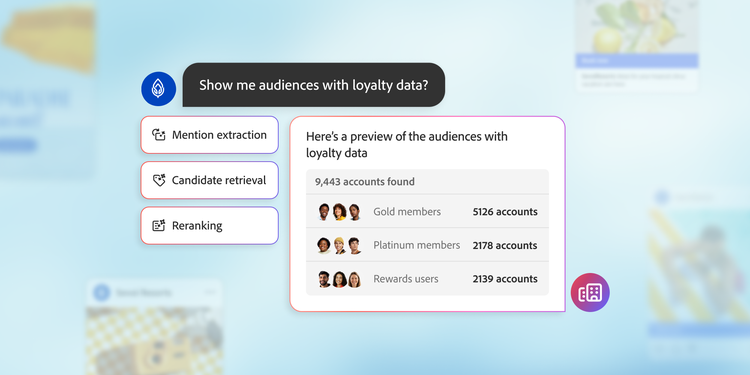
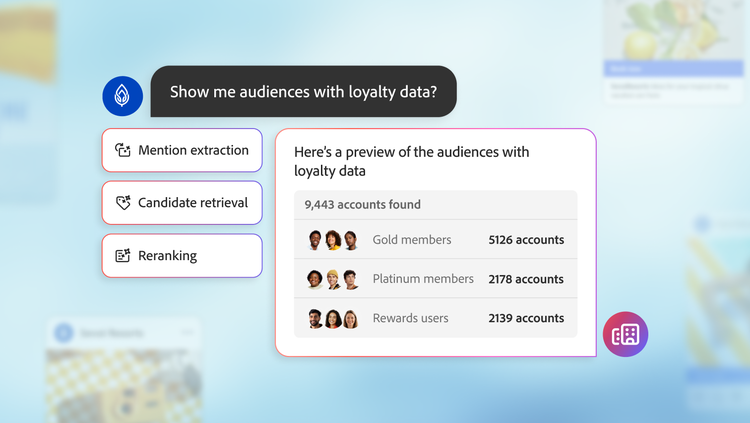
Imagine a marketer asking their AI assistant: "Show me audiences with loyalty data?" The question is perfectly natural but also deeply ambiguous — "loyalty data" could refer to a loyalty programme tier, loyalty points or any number of related fields buried somewhere in a complex customer schema. The system needs to understand the customer's context as well as their data. In this case, entity linking resolves "loyalty" to specific schema fields — loyalty.tier and loyalty.points — to return the right audiences.
Getting these questions right isn't just about language understanding. It requires connecting the words a user speaks to the actual entities — objects, records, schemas — that exist in their data. Large language models (LLMs) are probabilistic systems; they predict likely responses based on patterns in training data. But enterprise users don't want ‘likely’. They want exact. That gap — between a model's probabilistic nature and the deterministic precision enterprise work demands — is where entity linking lives.
Entity linking (EL) is the task of identifying mentions of entities in text and mapping them to their canonical representations in a knowledge base or data store. It's a well-studied problem in natural language processing (NLP): research systems like TagMe and BLINK demonstrated how text spans can be matched to entries in structured knowledge bases using a combination of search and neural models. In industry, systems like Google Knowledge Graph and Microsoft's Bing use entity linking to power search and question answering at scale.
In the context of AI assistants, entity linking serves as the semantic grounding layer — anchoring what users say to what they mean in terms of real objects in their data. EL is more than just a useful NLP technique — it is foundational infrastructure required to transform responses delivered by AI assistants from unreliable to trustworthy.
LLMs are remarkably good at understanding natural language, but they cannot reliably resolve ambiguous references on their own. An abbreviation like "ca" could mean California or Canada. A term like "specialData" might refer to a deeply nested field in a customer schema: customer.specificFormat.specialData. Without EL, an LLM might guess, hallucinate or simply fail to retrieve the right information.
At Adobe, we've encountered this challenge across multiple products.
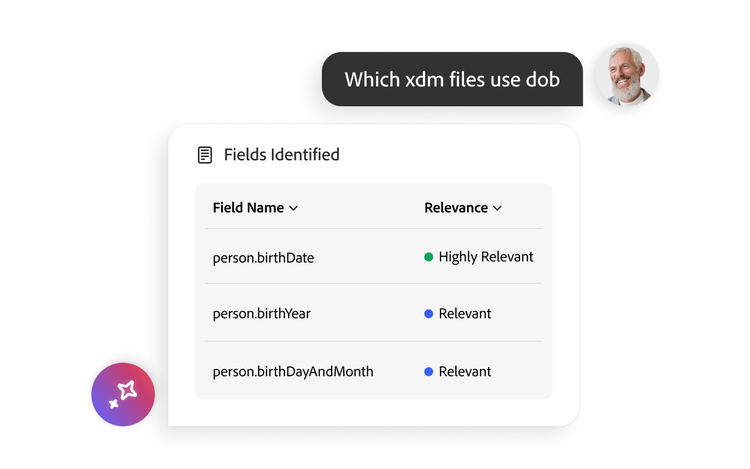

Without EL, around a quarter of all user interactions in AI Assistant — the ones that contain specific entity mentions — would be at risk of returning incomplete or irrelevant answers.
While entity linking is considered a solved problem in public knowledge bases like Wikipedia, where entities are stable, well-documented and globally understood, there are still significant challenges in enterprise environments:
These constraints make a naive lookup approach unworkable and require a more principled, multi-stage architecture.
Entity linking in our systems is implemented as a three-stage pipeline, with flexibility at each stage so that different downstream applications can choose the approach best suited to their query complexity and latency budget.
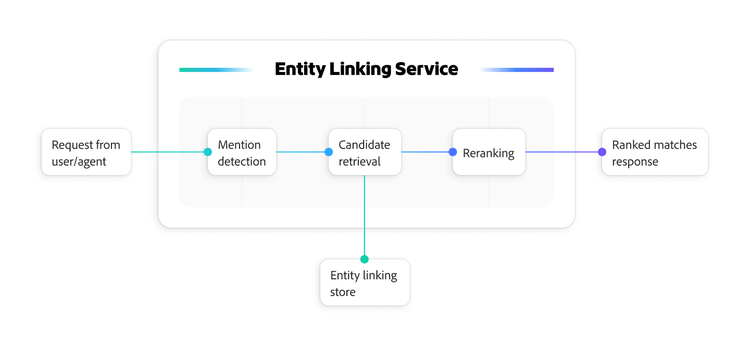
Stage 1 — Mention extraction identifies spans in the input text that are likely entity references. This can be done through n-gram enumeration (exhaustive but broad), NER-based span detection (faster, model-guided) or LLM-based prompting (highest precision for complex inputs).
Stage 2 — Candidate retrieval pulls potential matches from an entity store. Three modes are available:
Pre-filtering at this stage also narrows the candidate set based on metadata — including the user's permissions — so governance constraints are enforced before any ranking occurs.
Stage 3 — Reranking scores and orders candidates using heuristics, a contextual in-house model or LLM prompting, depending on what the query requires.
The underlying entity store uses a partitioned database with a primary-replica architecture. Each entity namespace is stored in a separate partition, enforcing data isolation and RBAC rules. The database is hydrated by daily ingestion jobs that pull from various APIs, transform the data and generate vector embeddings for semantic search. As new entity types are onboarded, their catalogues are registered through these same ingestion jobs.
The service itself runs as a stateless service on Kubernetes, scaling horizontally to meet demand. Real-time dashboards track latency, error rates and memory utilisation. Alerts notify on-call engineers when service-level agreements are at risk and hourly sanity tests catch issues proactively. When a dependency fails, the service degrades gracefully — returning a best-effort answer rather than an exception.
The most direct measure of the value of entity linking is what users don't have to do: They don't have to remember exact field names, match the system's capitalisation or know how their organisation's schema is structured. They can ask naturally and the system figures out what they mean.
Here are two concrete illustrations of what that looks like in practice.
Without entity linking:
"How many customers are in nyc?"
Without entity linking:
"What audiences include specialData?"
With entity linking:
"How many customers are in New York City?"
With entity linking:
"What audiences include customer.specificFormat.specialData?"
In the first case, the system recognises an informal geographic abbreviation and resolves it to the canonical place name. In the second, it identifies a partial field reference and expands it to the fully qualified schema path — something a user would otherwise need to look up manually. In every case, the user gets a precise answer rather than a probable one. That shift from probabilistic to deterministic is the missing link that makes up the foundational infrastructure for trustworthy enterprise AI. This also makes Adobe Experience Platform and applications more accessible to business users who do not know the underlying systems or data model, rather than primarily serving more technical users already familiar with how the data is structured.
Similar resolution happens in Brand Concierge when a user refers to a product by a casual name or abbreviation and the system maps it to the right product card from the catalogue.
Building a robust, generalisable EL pipeline across multiple products and agents required significant iteration. Here are a few insights after facing challenges and outages that battle-hardened our service:
If building generative AI at an enterprise scale excites you — explore the latest highlights and career opportunities at the Adobe Experience Platform AI site.
Kun Qian, Guang-Jie Ren, Namita Krishnan, Huong Vu and Yunyao Li contributed to this post.
https://business.adobe.com/fragments/resources/cards/thank-you-collections/generative-ai