Best practices for a data-driven operating model (DDOM) transformation.
05-21-2025

Many companies aim to be more customer-focused, but delivering on that promise is often easier said than done. Even with the best intentions, poor experiences can make customers harder to retain. In 2024, consumers pointed to poor communication and service issues as the top reasons for bad experiences — and 53% of those experiences resulted in reduced spending. These outcomes underscore the importance of customer-centric thinking, especially when using consumer data to guide strategy and improve customer data integration.
In 2016, we saw an opportunity at Adobe to better align our business with our customers’ needs. Enter our data-driven operating model or DDOM — a way of working that centres the business around the customer journey and drives the business toward strategic objectives with informed insights.
DDOM has been remarkably successful in driving efficiency and value for our Adobe Creative Cloud business and helping us to deliver a better customer experience. Still, attaining the data-driven insights necessary was a considerable feat. Collaboration with IT was crucial to our success. This means that even in workstreams overseen by IT, such as data integration, the business still serves as an important contributor. From our experience, we learnt that every company should consider a few areas of collaboration. Here are three best practices that will help to make your data integration and DDOM transformation as impactful as possible:
1. Make customer data integration seamless with a top-down, bottom-up approach.
For many companies, data is scattered throughout the organisation, siloed among teams and overwhelming in its scale. A collaborative top-down, bottom-up approach can help you to achieve balance. Starting from the top, we looked at our customer journey stages to determine the most important business questions and which KPIs could lead us to answers. The business side has the closest view of the customer journey, so they spearheaded this effort.
IT then identified the data assets generated throughout the customer journey that contributed to the business KPIs. This bottom-up element required IT to map out these data assets and their sources and document the level of effort required to integrate each source. The IT organisation gained a sense of which quick wins to pursue and which sources would require more resources and effort. That information would prove useful in developing a roadmap for data integration.
This top-down, bottom-up approach isn’t limited to a single function — it can be adapted across many industries. In retail, integrating point-of-sale systems, CRM platforms, inventory management tools and marketing campaigns helps teams better understand customer behaviour and optimise real-time sales performance. Finance teams can bring together data from banking systems, trading platforms and customer databases to support trade analytics, pre-trade decision-making and sentiment tracking. Marketing organisations benefit from connecting CRM data, ad performance metrics and social media engagement to build more targeted campaigns and deepen customer connections. Meanwhile, ecommerce businesses use integrated data from warehouses, delivering providers and payment gateways to provide accurate order tracking and streamline the fulfilment process.
To make these efforts sustainable and scalable companies should:
- Invest in data integration and literacy training.Tailor programmes to specific roles so employees understand the types of data they work with, how it connects to business outcomes and how to make data-informed decisions.
- Establish clear data integration standards.This includes selecting the right integration methods and tools, implementing strong data quality controls and designing for scalability, security and compliance from the start.
- Communicate the value of data-driven thinking.Use real business examples and storytelling to make the case across the organisation. Share success metrics and show how data-backed insights improve customer experiences and business results.
- Create incentive structures that reward data-driven behaviours.Recognise individuals or teams who use integrated insights to improve outcomes, whether that’s increased efficiency, better campaign performance or stronger customer loyalty.
2. Create accessible reporting experiences tailored to business personas.
A single source of truth will have minimal impact unless sufficiently adopted, however. Our IT organisation understood this and our CIO strongly believed in empowering everyone in the business, regardless of function or technical expertise, to explore the data firsthand. Our IT organisation adopted a customer-centric approach to developing different reporting experiences tailored to various personas, with the business serving as its primary customer.
IT interviewed several business stakeholders to gain a deeper understanding of persona needs and collaborated with product designers to address those use cases within the reporting experiences. This process resulted in several different tools — from a centralised dashboard that everyone in the business can use to track performance to specialised reporting instruments for data scientists with more complex questions. By tailoring these experiences to the business audience, IT made it easy and intuitive for everyone in the organisation to explore the data.
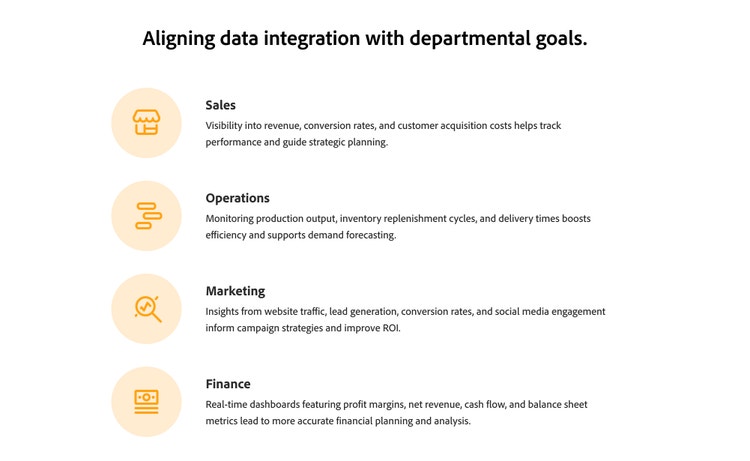
It’s important to include other key stakeholders, such as data and analytics teams, marketing, sales and finance, when developing reporting experiences. These teams often work with different levels of data complexity and require reporting that supports their specific goals.
By defining clear KPIs with these internal audiences in mind and aligning them to business objectives, companies can increase adoption, data exploration and insight-driven decision-making throughout the organisation.
3. Provide an accountability structure to preserve your newly unified data.
Once DDOM has been introduced to the wider business, the growing number of users may potentially reintroduce the issue of differing interpretations. To combat this, a data governance strategy should emphasise cross-organisational accountability.
At Adobe, each DDOM KPI is assigned a VP sponsor, a business steward and a technical steward. The VP sponsor serves as the representative of his or her KPI and is held responsible for reaching KPI targets. The business steward manages the KPI’s definition and usage and the technical steward manages the transformation and accuracy of the data feeding into the KPI. With these cross-organisational owners, the business covers any questions about what a KPI means and IT covers any questions about the data behind the KPI. This eliminates confusion or conflicting interpretations of the data.
How a DDOM can improve data governance strategies.
A strong DDOM framework naturally supports and enhances enterprise-wide data governance. By aligning data accountability with strategic business outcomes, DDOM ensures that governance is more than just a checklist — it’s part of how teams work, communicate and make decisions. Clear KPI ownership makes it easier to enforce data standards, protect sensitive information and stay compliant across teams. And because DDOM supports strong customer data integration, organisations gain more consistent, reliable insights across the entire customer journey.
Build trust with data quality management.
Well-structured data is important, but high-quality data is what builds real trust. Data quality management includes profiling for accuracy, cleansing duplicate or incorrect entries, enriching records with relevant attributes, validating consistency and monitoring quality over time.
This ensures that KPIs remain meaningful and actionable, especially as data volumes and users grow. DDOM helps by embedding quality checks into everyday workflows and assigning accountability across the organisation. When customer data integration and quality management go hand in hand, your insights and decisions become more effective.
Get started with a data-driven operating model.
At its core, DDOM is designed to break down the silos that hold organisations back — whether they’re data silos, functional barriers or disconnected teams. By aligning insights, systems and people around the customer journey, companies can move with greater clarity, speed and impact.
Get the most from DDOM by using Adobe Customer Journey Analytics to turn data into actionable insight. Customer Journey Analytics gives decision makers and teams a real-time view of the entire customer journey — across channels, touchpoints and moments that matter. This shared insight helps align decisions, streamline collaboration and unlock more impactful outcomes. Paired with Adobe Campaign, teams can use those insights to drive engagement and deliver the personalised, timely experiences customers expect.
Learn more about Adobe Customer Journey Analytics.
Learn more about Adobe Campaign.
Recommended for you
https://business.adobe.com/fragments/resources/cards/thank-you-collections/generic-dx