The most successful commerce organisations don’t treat conversion as a one-off initiative. Instead, they treat it as a continuous discipline — one that evolves as customer expectations, channels and competitive benchmarks change.
Across industries, top-performing digital shop fronts share some common traits. They’re all designed to reduce friction, increase relevance and adapt. They continually measure performance, test what works and optimise every step of the customer journey.
This matters hugely. Because even marginal improvements in conversion rates can deliver disproportionate returns. Optimised, top performers achieve 2-3x higher conversion rates than average. The difference isn’t the volume of traffic — it’s the on-site experience.
In this blog, we’ll look at five strategies leaders use to create high-converting shop fronts and outline how best to put them into practice.
The merchants behind leading shop fronts understand a few universal truths of conversion:
- Fast experiences keep customers engaged.
- Rich, personalised content builds brand confidence.
- Relevant product discovery increases basket size.
- Friction-free checkouts protect buyer intent.
The following data reinforces this approach at every turn:
Instead of reacting to these realities and firefighting every new issue that pops up, high-performing brands design their shop fronts around them.
The challenges of modern commerce.
Modern commerce leaders are balancing growth, efficiency and experience — often across fragmented systems and teams. As a result, even well-resourced organisations struggle to optimise conversion consistently. They face challenges such as:
- Inconsistent performance across devices. Mobile accounts for most e-commerce traffic, but desktop conversion rates remain higher. Leading brands close this gap by prioritising performance and usability across devices.
- Experience quality. Customers expect visually rich, engaging shop fronts. But producing high-quality assets, creating multiple variations for channels and audiences and managing them at scale is time- and resource-intensive.
- Personalisation at scale. As product catalogues grow, so does the need for intelligent, LLM-optimised product discovery. Great shop fronts make it easy to find relevant products with no extra effort.
- Checkout efficiency. Despite strong intent, many customers abandon their purchases at checkout. Simplified checkout flows are a hallmark of high-converting shop fronts, protecting buyer momentum.
Five strategies used by high-converting shop fronts.
1. Highly performant, mobile-friendly shop fronts.
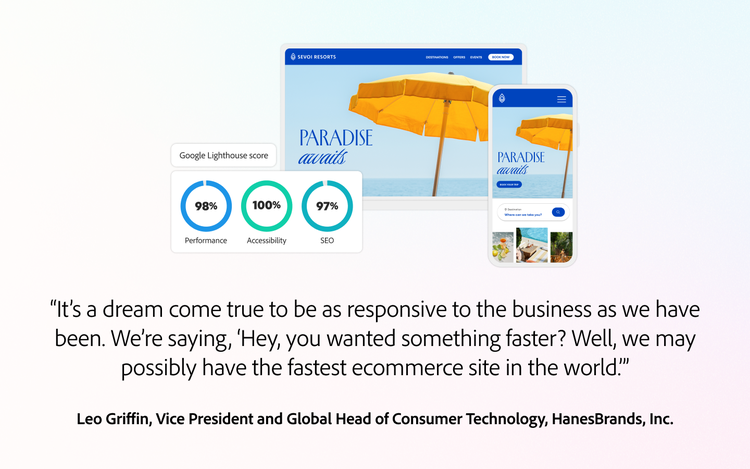
Top performers invest in performance as a growth lever, not a technical afterthought. Google research shows that as load time increases from 1-10 seconds, the probability of a visitor bouncing increases by over 120%. High-performing brands consistently achieve very high Lighthouse performance scores — typically in the 95-100 range. These brands:
- Deliver responsive, performance-optimised shop fronts by adopting edge-first delivery architectures that minimise latency by design.
- Design mobile-first user experiences by building adaptable front-end frameworks that prioritise performance, accessibility and consistency across devices.
- Use SEO and performance collaboratively by structuring content and rendering logic so discoverability and speed reinforce, rather than compete with, each other.
- Treat speed and reliability as non-negotiables by implementing continuous performance monitoring and optimisation as a core discipline, not a periodic fix.
Slow load times and clunky navigation frustrate users, particularly on mobile devices where experiential expectations are highest. Fast, lightweight experiences reduce friction at the very start of the buying journey.
This results in lower bounce rates, stronger engagement and higher conversion — without increasing acquisition spend.
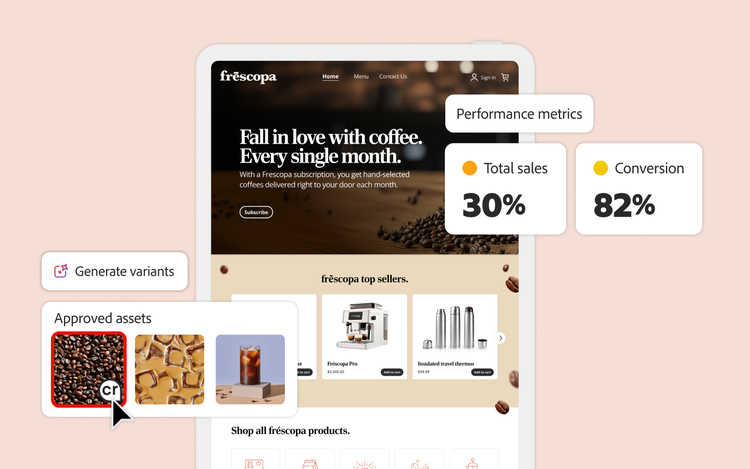
Top-performing shop fronts understand that conversion depends on buyer confidence as well as information. When customers can clearly see, understand and trust what they’re buying, they move faster. In fact, high-quality imagery can increase sales by up to 30%. So, top performers:
- Use clear, detailed imagery and video to showcase products by leveraging GenAI to create and adapt high-quality assets at scale.
- Embed 360-degree views and immersive experiences by integrating modular, reusable media components that can be deployed instantly across channels.
- Streamline the process from asset creation to delivery to keep teams moving quickly by using AI-powered tagging, metadata enrichment and automated workflows to reduce manual effort and eliminate asset duplication.
Ensure experiences feel premium, engaging and on-brand, not static or generic — by applying AI-driven brand governance, smart content variation and optimised delivery.
Brands operating at pace bring content to market faster — as much as 82% faster in some cases, enabling them to stay ahead of trends and keep experiences fresh and relevant. This results in greater shopper confidence, improved conversion rates and fewer returns.
3. Optimise content for shoppers through continuous experimentation.
High-performing shop fronts don’t rely on assumptions. Instead, they treat content as a dynamic performance lever — one that must adapt to shopper behaviour in real time. Generative AI and structured experimentation now make it possible to test, refine and scale variations quickly, without slowing execution. In fact, organisations that embrace AI-driven experimentation report conversion rate increased by ~20%. Top performers:
- Continuously optimise product messaging and visuals by using GenAI to generate and iterate content variations at scale.
- Embed experimentation into everyday operations by running ongoing A/B experiments, rather than tying optimisation to periodic redesigns.
- Let performance data guide decisions by combining AI-assisted variation with structured measurement frameworks.
This results in faster iteration, data-driven decisions and continuous optimisation without increasing operational overhead.
4. Personalisation of search and recommendations.
High-converting shop fronts make relevance the default experience. They use personalisation to help customers find what they want faster. And it works — companies that personalise well generate 40% more revenue than the average. Those top performers consistently:
- Personalise search results and recommendations in real time by applying AI models that analyse intent signals and dynamically adjust product visibility.
- Leverage browsing behaviour, buying history and contextual data to continuously refine relevance based on evolving customer patterns.
- Reduce discovery friction by surfacing relevant products earlier in the journey, deploying predictive algorithms to proactively present high-probability options.
Some brands have seen engagement jump by as much as 70% simply by refining web content and optimising SEO and relevance — showing that tailoring experiences to visitor needs can dramatically change outcomes.
This results in higher relevance, improved customer satisfaction and increased order value.
5. Fast and efficient checkouts.
Top performers recognise checkout as a moment of peak value. Which makes sense, when you know that improving checkout UX alone can lift conversion by ~35%. When top performers streamline the final step, they:
- Design simple checkout flows with fewer, clearer steps by streamlining form logic and removing unnecessary steps.
- Offer several payment options as standard by integrating flexible, standards-based payment frameworks that adapt to regional and behavioural practices.
- Maintain momentum at checkout by securely storing customer details and preferences.
- Clarify delivery costs and options upfront, using real-time pricing and logistics integrations to eliminate last-minute hesitation.
This results in reduced friction, higher completion rates and better conversion of existing demand.
Build your best shop front.
What distinguishes high-converting shop fronts isn’t a single feature. It’s more about how these strategies work together.
- Performance enables discovery.
- Discovery supports personalisation.
- Personalisation builds confidence.
- Confidence accelerates checkout.
Together, they create a seamless, efficient and relevant experience. That experience converts in the moment and ensures customers return time and again.
Design for e-commerce evolution.
High-converting shop fronts are built through sustained investment in performance, clarity, relevance and reduced friction across the entire customer journey. The strongest brands treat these areas as interconnected capabilities. They improve speed to reduce bounce. They use richer content and personalisation to build confidence. And they streamline checkouts to protect intent. Together, these actions compound over time, turning incremental improvements into meaningful conversion gains.
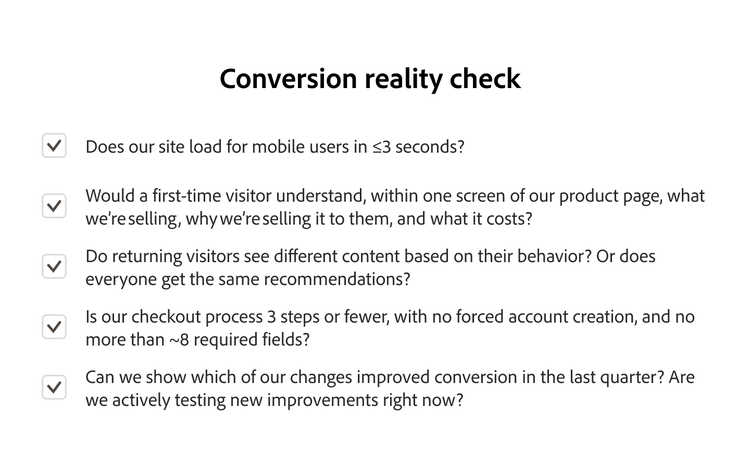
Check whether you’re ticking every conversion box using the checklist below.
Adobe Commerce as a Cloud Service supports continuous site improvement. It combine high-performance delivery with built-in personalisation, experimentation and measurement so teams can keep learning what drives conversion and act fast.
To see how this approach translates into real results, explore how Canon USA increased conversion rates by 150% year over year by modernising its digital commerce experience with Adobe Commerce and Adobe for Business.