How to navigate a non-linear customer journey.

The traditional marketing funnel served enterprises for decades, with awareness leading to consideration and consideration leading to purchase. Today, customer behaviour is far less predictable. B2B journeys often involve 50 or more interactions across channels and stakeholders, with enterprise deals stretching 12 to 18 months as different members of the buying committee engage at different stages.

This article helps enterprise leaders master the "messy middle" with practical customer journey map models that help simplify and enable effective messaging to customers.

In this article, you’ll learn:

The problem with the linear marketing funnel.

Marketing textbooks teach the five-stage customer journey: awareness, consideration, decision, purchase and loyalty. This model assumes customers move predictably from one stage to the next, like travellers following a well-marked highway. However, the reality at enterprise scale looks nothing like this.

A left-to-right diagram showing the 5 stages of the customer journey.

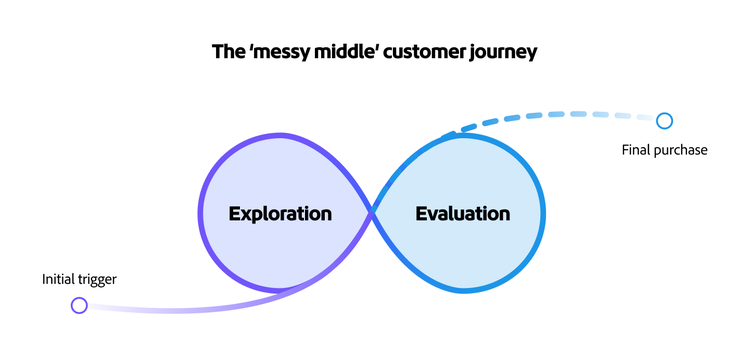
Google's research team coined the term "messy middle" to describe the interactions between a customer's first trigger and their final purchase decision. Customers can loop endlessly between exploration and evaluation. They might discover your brand through a LinkedIn ad, research competitors on their phone during lunch, read reviews on a third-party site, forget about you for two weeks, see a retargeting ad, visit your website from a desktop, call your sales team and finally convert through a partner channel.

Diagram of the “messy middle” customer journey showing a loop between exploration and evaluation from initial trigger to final purchase.

Clear buyer journey stages become complex when customers interact across dozens of touchpoints. A B2B prospect might engage with your content for 18 months before ever speaking to sales. A retail customer might visit your store to examine a product, then purchase from a competitor's website because they offered free delivery.

Traditional customer journey stages fail to capture this complexity for three critical reasons:

  1. Cross-channel behaviour creates blind spots when data lives in silos.
  2. Multiple research visits mean customers revisit earlier stages repeatedly rather than progressing linearly.
  3. Post-purchase engagement often determines whether a customer becomes a long-term advocate or quietly churns.

Enterprise leaders who attempt to define or limit customer behaviour in linear models miss critical optimisation opportunities. Organisations that embrace the messy middle and build systems to understand it gain a strategic advantage.

Customer journey map models for enterprises.

Acknowledging complexity is the first step. Visualising and strategising for it requires practical tools. Customer journey mapping needs models that are sophisticated enough to capture non-linear paths while still remaining actionable across teams.

The following three models address distinct enterprise contexts. Each provides a framework for documenting the messy middle within specific business models.

Model 1: The B2B buying committee journey.

B2B purchases rarely involve a single decision-maker. Enterprise deals typically include several buyer personas with different priorities, timelines and interactions. This model maps the buyers’ journey across three primary stakeholder types.

  • The user. They represent the person who interacts with your product daily. They care about functionality, ease of adoption and how the solution affects their workflow. Their journey often begins with peer recommendations or industry content.
  • The IT buyer. They evaluate security, integration requirements and technical specifications. They enter the journey later, typically after “the user” has already expressed interest and their concerns can derail deals that seemed certain.
  • The executive sponsor. They control budget approval. They may never interact with your product directly but need to understand business impact and return on investment (ROI).

Mapping these parallel journeys reveals where customer journey stages overlap and where they diverge. You might discover that deals stall when “IT buyers” lack technical documentation or that “executive sponsors” need case studies from similar enterprises.

To create customer journey maps for B2B buying committees, document each persona's entry point, information needs at each stage and the handoffs between stakeholders that either accelerate or delay decisions.

Model 2: The omnichannel retail journey.

Retail customers move fluidly between channels in ways that make traditional attribution models nearly useless. This model captures the looping paths characteristic of modern consumer behaviour. Consider a typical customer journey: A social media ad creates initial awareness. The customer downloads your mobile app to browse products during their commute. They visit a physical store to examine items in person. They leave without purchasing. They then complete the transaction on their laptop three days later, after receiving an abandoned basket email.

This model visualises these transitions as a continuous loop rather than a linear progression. Key mapping elements include channel entry points, cross-channel triggers that move customers between touchpoints, friction moments where customers exit the journey and re-engagement techniques that bring them back.

Lifecycle marketing strategies depend on understanding these patterns. Without visibility into how customers move between mobile, desktop, physical shops and customer service interactions, personalisation efforts remain fragmented and ineffective.

Model 3: Digital subscription lifecycle.

Software as a Service (SaaS) and streaming subscription businesses face unique customer journey stages that extend far beyond the initial conversion. This model maps the entire subscription lifecycle from first touch through long-term retention. The journey begins with “free trial signup”, where customers enter with varying levels of intent and product knowledge. “Email onboarding” sequences guide new users toward activation milestones. “First feature use” represents the critical moment when customers experience a core value.

The model then tracks ongoing engagement patterns, identifying “usage dips” that signal churn risk. These warning signs might include decreased log in frequency, reduced feature adoption or support ticket patterns indicating frustration. Finally, the “renewal offer stage” captures the decision point where customers either commit to continued subscription or exit. Mapping touchpoints across this entire lifecycle reveals opportunities for intervention before customers reach the cancellation page. Maintaining customer journey data transparency across these touchpoints ensures that product, marketing and customer success teams share a unified view of subscriber health and engagement.

The analytics challenge: You can't map what you can't see.

Models provide structure, but they remain theoretical exercises without the data to populate them. This is where most enterprise journey mapping initiatives fail. Customer interactions happen across mobile apps, websites, call centres, physical locations, email, social media and partner channels. Each system captures its own slice of customer behaviour. The mobile app knows what products customers browse. The call centre knows what questions they ask. The website knows what content they consume. But no single system knows how these interactions connect.

This fragmentation creates an inability to act across channels. You might identify that customers who visit the pricing page convert at higher rates, but you may not see that many of those visitors contacted your sales team first. You might notice that app users churn less frequently, but you cannot connect that insight to the onboarding emails that drove web or mobile app adoption.

The buyer journey stages become impossible to accurately analyse without connected data sources when you have millions of customers interacting across dozens of touchpoints. Marketing optimises campaigns based on incomplete information. Product teams build features without understanding how customers use them. Customer success intervenes too late because warning signs appear in systems they cannot access.

Effective customer journey orchestration requires breaking down these silos. Until enterprises can connect cross-channel interactions into a single analytical framework, even the most sophisticated journey maps remain educated guesses rather than actionable intelligence.

Optimise non-linear journeys with Adobe Customer Journey Analytics.

The linear funnel worked when behaviour was predictable, but today’s "messy middle" requires a unified view. Adobe Customer Journey Analytics addresses the data silo problem by stitching every interaction — web, mobile, call centre and IoT — into a unified customer profile.

This visibility transforms how enterprises handle three critical areas:

  1. Visualising real, non-linear journeys. Rather than assuming customers follow predefined stages, you see actual behaviour patterns. You discover that your highest-value customers typically engage with educational content for months before ever viewing pricing or that customers who start on mobile but convert on desktop have significantly higher lifetime value.
  2. Identifying hidden friction. You can identify hidden friction points where customers drop off between channels. Perhaps customers who call support after visiting your website convert at half the rate of those who find answers through self-service. Or mobile app users who receive push notifications at certain frequencies show dramatically different retention patterns.
  3. Connecting the full lifecycle. You can analyse the entire customer lifecycle from first touch to long-term loyalty. Lifecycle marketing strategies become data-driven rather than assumption-based. You understand not just which channels drive acquisition, but which customer journey stages predict long-term value.

By unifying these touchpoints, the messy middle stops being a challenge and becomes your greatest opportunity for differentiation. When you can see every interaction in a single interface, you can finally optimise for the reality of the modern buyer.

See it in action. Watch the overview video to see how you can visualise complex, cross-channel customer journeys in a single interface.

Let’s talk about what Adobe can do for your business.

Get started