6. Implement a trusted AI and agentic foundation.
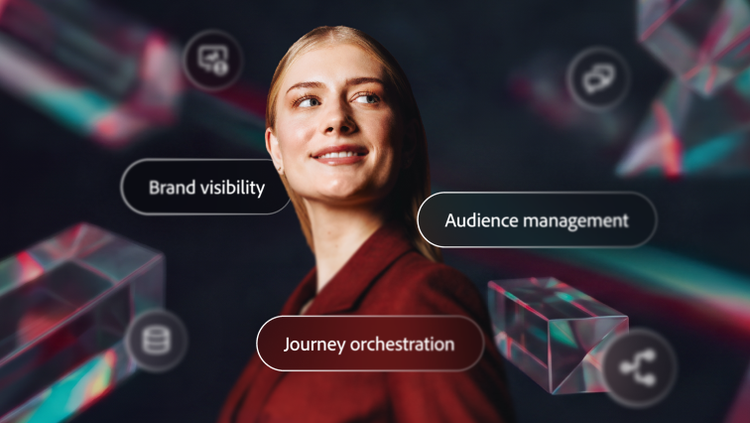
Brand visibility, customer engagement and the content supply chain can all be strengthened independently. Many organisations are doing exactly that, only to discover they've improved individual capabilities rather than create connected customer experiences. Customer experience orchestration depends on a trusted agentic foundation that brings those capabilities together into one coordinated system. This foundation enables AI to work in two ways. First, as coworkers that collaborate with marketers to orchestrate, optimise and govern customer experiences. Second, as autonomous AI agents that execute tasks within enterprise guardrails. Together, they ensure every action is grounded in trusted data, governance and human oversight.
This foundation starts with data. Whether supporting marketers as AI coworkers or executing workflows as autonomous agents, AI can only act on a shared, accurate view of the customer if the underlying data is unified, governed and accessible. However, data integration remains the single biggest transformational challenge, with only 4% of organisations reporting fully integrated, accessible data.3
Unifying data is the prerequisite for customer experience orchestration, giving coworkers and autonomous agents the shared context they need to work together. Coworkers help marketers orchestrate campaigns, customer engagement and operations, while agents execute approved tasks at speed and scale. Throughout, marketers remain responsible for strategic direction, human oversight and accountability.
To build a trusted agentic foundation, marketing leaders should:
- Unify customer data so every agent operates from the same, accurate and real-time view of the customer.
- Encode brand, governance and commercial rules into how agents operate, so decisions remain on-brand and on-policy by default.
- Design for human oversight, with people setting the strategy and exercising judgement while agents execute at speed and scale.
Without this foundation, agents work against each other rather than with each other. With it, customer experience orchestration becomes possible at enterprise scale.
This is the real shift. AI is no longer something that sits on the side generating insights. It's embedded directly into the experience workflows where journeys are designed and delivered, so it doesn't just inform teams but actually helps them to execute. The agents doing that work are powered by models built specifically for customer experience and content use cases, with the flexibility to incorporate different models as needed.
But the same property that makes the foundation powerful, agents acting independently across millions of decisions, is what turns governance from a policy choice into a structural requirement. At low volume, governance is a document. At enterprise scale, it has to be infrastructure.