The blueprint for sales success in the AI era.

Lisa Croft

08-11-2026

I’ve worked alongside sales teams for years, and I've watched this space transform. Not long ago, sales leaders invested significant time and effort manually crafting value propositions for every customer and opportunity. Today, AI is increasingly being adopted across the sales cycle, with the expectation that it will streamline and simplify much of that process. But despite how deeply AI has made its way into sales, in practice, it still falls short of delivering the expected business value.

While 8 out of 10 companies are using generative AI, more than 80% see no bottom-line impact. This gap, in many ways, reflects a deeper structural issue in the sales stack.

Sales has always been a fast-moving, execution-sensitive function, where ideas evolve in real time, inputs come from multiple stakeholders, and even minor details can make or break a deal. But the document layers, like proposals, pitch decks, and statements of work (SOWs), where the core sales work happens, often remain disconnected. When you deploy AI on top of these fragmented document workflows, instead of accelerating execution, it creates yet another step to toggle between.

The real problem here is integration, or the lack of it, which ends up diluting the impact of widespread AI adoption. When workflows remain siloed, even the most advanced tools only add noise. And that’s why, when you look at conversion rates, deal velocity, or win quality, the needle doesn’t move in the way you’d expect.

Value doesn’t come from having AI, but from how seamlessly it is woven into the entire system. At Adobe, we don’t view AI as an add-on, but a native part of the workflow. Because real impact comes from driving consistency and precision across the document ecosystem, which is the operational backbone of sales.

Let’s explore how it all comes together — but first, let’s understand where teams actually hit roadblocks.

What slows momentum in sales?

In sales, you navigate an ever-growing volume of content. Client briefs, past proposals, market insights, and internal inputs are all spread across different tools and formats. Finding the right information at the right moment takes effort, and stitching it all together takes even more. I’ve seen the same issue surface in business after business — productivity loss in sales is consistently tied to content sprawl, constant context switching, and cognitive overload.

Moreover, even routine tasks, like building presentations, consume disproportionate time. Research shows that 58% of non-creative employees spend up to 29 hours a week creating visual content independently.

This means even a small miss in the cycle of searching, filtering, and assembling inputs can set off a domino effect across the deal, slowing momentum right where it matters most.

Redefining the sales rhythm with AI-powered workflows.

The real impact of AI shows up when it closes gaps in existing document workflows, and Adobe Acrobat Studio does exactly that. Its AI capabilities cut across different layers of sales work, bringing everything together into a connected, streamlined experience.

Here’s what it looks like in practice:

  1. Faster information discovery and comprehension.
    In sales, client materials arrive scattered and unstructured, and you spend more time assembling and interpreting information, than building strategy. Even strong teams struggle to articulate a clear differentiator because insight generation is so manual.

    AI-powered tools in Adobe Acrobat Studio change this dynamic by quickly bringing everything into a single, unified view. They summarize client materials, surface actionable insights, and provide trustworthy, source-backed answers, helping you move from information to direction faster. In fact, Adobe Acrobat AI Assistant can summarize a product brochure and turn it into a presentation and an email in under 12 minutes, compared to 46 minutes using traditional methods.

    How this typically plays out: Let’s say your team is preparing for a large enterprise banking pitch where it doesn’t have to dig through shared drives or past decks anymore. The system connects past proposals, RFPs, and notes, surfaces priorities like compliance and risk, and helps shape a focused narrative in minutes.

  2. Effective collaboration across multiple stakeholders.
    When multiple stakeholders are involved in shaping a deal, collaboration rarely stays straightforward. Instead, it becomes fragmented inputs, multiple versions of proposals, and conflicting feedback scattered across channels. Momentum drops, and so does quality.

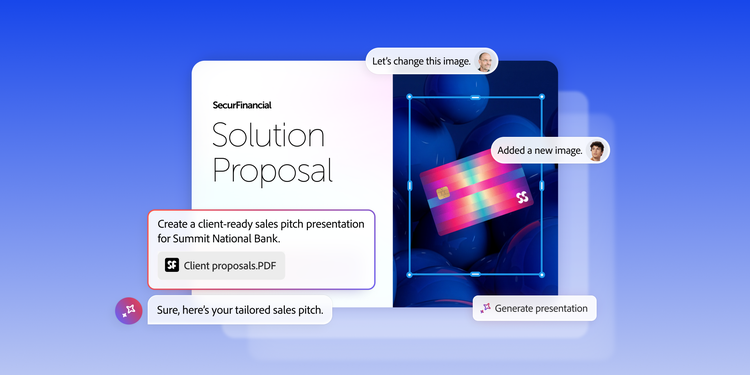
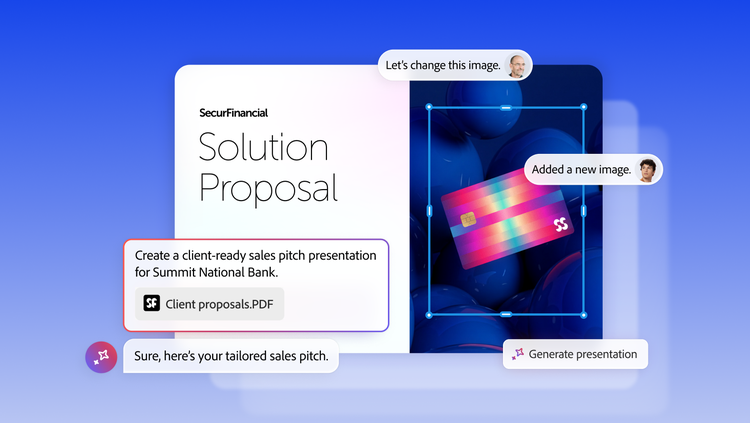
    PDF Spaces in Adobe Acrobat Studio addresses this in a practical way. By centralizing pitch development in its shared workspace, it aligns stakeholders around a shared goal, making messaging iteration visible and efficient for everyone involved.

    How this typically plays out: In the middle of an active deal, your account managers, pre-sales, and legal teams can work on a single draft in real time, rather than sharing feedback across emails and chats. Pricing, messaging, and terms can evolve in one place, ensuring the final proposal is cohesive and client-ready.

  3. Rapid creation of on-brand client proposals.
    Even when your team has clarity and alignment, execution is where things often bottleneck. Creating polished, on-brand proposals takes time, and under pressure, consistency suffers. In the real world, this limit scalability for even high-performing teams.

    Adobe Acrobat Express integration and the Generate Presentation feature help here by removing the need to start from scratch. Ready-to-use templates ensure speed and easy customization, without compromising quality. This also helps you leave a stronger impression on clients. Consistency at scale remains one of the most underappreciated levers of success in sales, while personalized customer experiences can drive a 6%–10% increase in revenue.

    How this typically plays out: As deals near closure, your team can quickly build tailored presentations using templates, while staying aligned with the client’s requirements and context.

The takeaway is simple — tools don’t transform sales, integrated workflows do.

Furthermore, as much as capabilities matter, one thing that is non-negotiable in this space is trust. Enterprise teams need systems that are transparent, compliant, and secure, and Adobe Acrobat Studio is built on that very foundation. Explore our use case guide for more detailed insights on how your sales team can maximize its potential.

Tangible wins for sales teams with Adobe Acrobat Studio.

You thrive in sales when your workflow is truly connected, when information isn’t scattered, and every touchpoint stays visible and in sync. At that point, the impact of AI is incremental and ripples across the entire motion in the form of:

  1. Time efficiency.
    The biggest unlock comes from a centralized workspace with self-service access. When you’re not chasing information across tools, you can reclaim more time for business-critical work.
  2. Customer expansion.
    When AI-enabled workflows take on repetitive heavy lifting, they free you to focus on strategy. This enables you to manage more accounts per quarter, without stretching capacity.
  3. Reduced follow-ups.
    Clarity changes everything. When content is interactive, well-structured, and grounded in verified sources, it leads to fewer clarification emails and more forward momentum.
  4. Stronger credibility.
    With validated insights and citation-backed responses, you don’t just sound like a vendor. Instead, you show up as a trusted advisor, accelerating confidence in every deal.

From intelligence to engagement, Adobe Acrobat Studio brings every aspect of sales together into a single, streamlined workflow, with the potential to drive up to 357% ROI for enterprises.

AI is rewriting the sales advantage.

Gartner predicts that by 2027, 95% of sales research workflows will begin with AI, up from less than 20% in 2024. But that’s only part of the story. AI maturity in sales isn’t defined by who has the technology, but by who has rewired their operating model around it. The competitive advantage lies in how effectively you operationalize this shift.

This is the new dividing line in sales performance. Instead of rebuilding systems or disrupting the ongoing flow of work, it all comes down to closing gaps in the most critical document layers of the sales stack, where most issues creep in. That’s how you turn AI into a workflow advantage, and ultimately, a measurable driver of revenue.

Learn what Adobe Acrobat Studio can do for your sales team.

https://business.adobe.com/fragments/resources/cards/thank-you-collections/acrobat