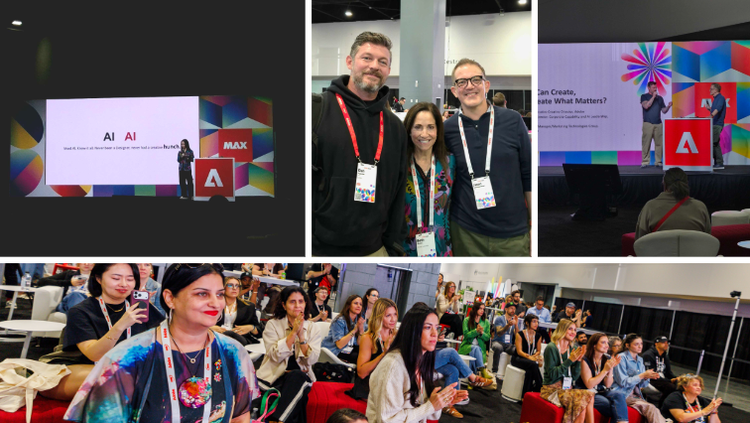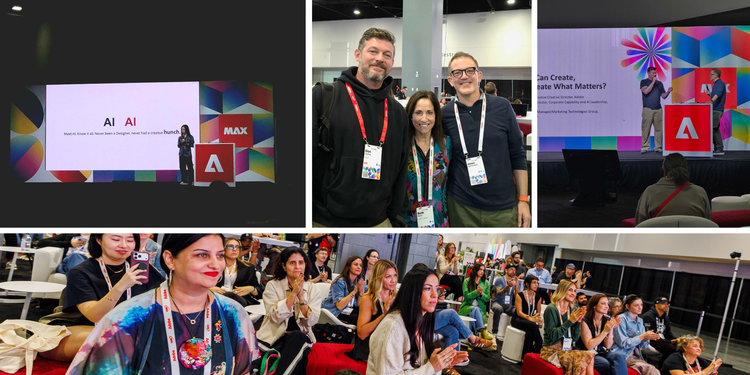
Adobe MAX is a blast. Speaking personally, it’s also a blast from the past, an opportunity to connect with the 18-year-old me who spent hours pushing pixels in Adobe Photoshop to create merch and flyers for my hardcore punk rock band. Today’s creatives are in a similar place, but instead of experimenting with Photoshop, they’re defining how AI will shape the future of their industry.
The journey will take a lot of courage, a dash of reckless abandon, and a willingness to explore uncharted territory. But at the same time, we can't abandon our humanity, our empathy, or our responsibility to our planet and our people. If anything, AI is making taste and judgment more important than ever for brands that want to tell stories that matter.
Few MAX moments drove this point home like the TED-inspired talks I hosted with creative leaders from Procter & Gamble and Colliers Engineering & Design. On top of sharing tips on how brands can use AI to produce work with impact, both speakers reminded us that while the technology has empowered everyone to create, we must lead with humanity to create something with emotional weight.
Beth Mason, Senior Design Director, Procter & Gamble (P&G)
Adobe Illustrator had just come out when Beth was in design school. The emotion she felt then is the same one she has felt through every major advance in design technology since – optimism.
Her team at P&G started working with Adobe Firefly two years ago and were immediately blown away by AI’s ability to take the grunt work off their plate, giving them more time to focus on doing the creative work they love. But, as Beth cautioned, that doesn’t make AI creative on its own.
“AI is a pretend creative,” Beth explained. “Yes, it’s a know-it-all, but it doesn’t know the future or have original thoughts.” Appealing to Harry Potter fans, she likened the technology to Hermione Granger, an overly keen student who’s read and memorized all the textbooks and can answer the teacher’s questions before they even finish them.
In other words, AI knows everything that was. People can draw on both knowledge and emotion to intuit what could be. That’s why the first two days of every P&G brainstorm are analog – no keyboards allowed. “It’s just paper, whiteboards, and walls of gloriously bad ideas,” Beth explained. “We stay low-res until the idea is brave enough to survive.” Creatives do the hard work of coming up with an original idea, and AI is pulled in to do grunt work like asset variations and other repetitive tasks that can – and should – be scaled.
In that spirit, Beth’s parting words for the next generation of creatives had nothing to do with AI or technology. “To build a creative career, be fearless,” she told the crowd. “Nothing will take you further than following your passion.” That’s a sentiment we can all get behind.
The insight that stayed with me: Design is a telescope that gives us clear vision. AI is a kaleidoscope that disperses, adds color, and reformulates that vision in new and unexpected ways. That’s where its creative power lies.
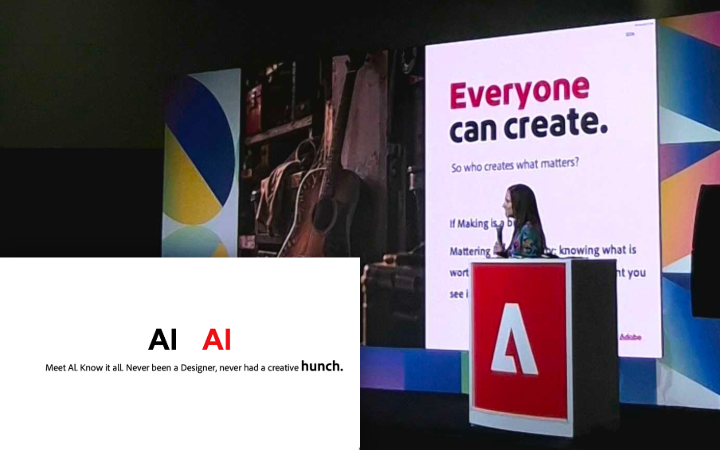
Image source: Beth Mason
Jason Babcock-Stiner, Senior Manager, Marketing Technologies, Colliers Engineering & Design
After editing a photo of his family dog Max, and showing it to his kids, Jason expected them to respond with oohs, aahs, and validation. But as soon as they learned he had used AI for part of the job, they lost all interest. Their reaction was cutting, but it also led Jason to a profound realization about what makes creative work authentic. “Authenticity isn’t a trait you possess, or something you claim on your socials,” he told the MAX crowd. “It’s something you actively negotiate with your audiences.”
That holds for independent creators and major brands alike. Colliers Engineering & Design designs everything from hospitals and universities, to hotels, restaurants, dams, and bridges. It’s also growing fast, going from 800 employees in 2020 to over 3,500 today. To empower all its teams to create, the firm can’t just use AI to scale production. It must also help produce authentic work with impact.
That raises another challenge – authenticity means different things to different people. To illustrate his point, Jason invited us to imagine recounting the story of their first date to their mom, and then to their best friend. The sea of knowing smiles in the audience said it all: the authenticity we negotiate with a parent figure is completely different than the one we negotiate with our closest confidant.
AI adds even more complexity to this equation. Some brands successfully use AI-generated content to build deep connections and trust with their audiences, while others spend fortunes creating beautiful AI experiences that fail because they don’t feel authentic.
What can we do in the face of this variability? The answer will vary for every brand, admits Jason, but every creative’s goal should be the same: to understand the threshold at which their audiences might decide they’re no longer authentic. “It’s not necessarily about sounding human,” he said in closing. “It’s about building meaningful connections with your audience and being unmistakably you along every step of the journey.”
The insight that stayed with me: Authenticity is not about who or what created something. It’s about whether your work carries the emotional weight, design intent, and transparency to connect with people in their particular context.
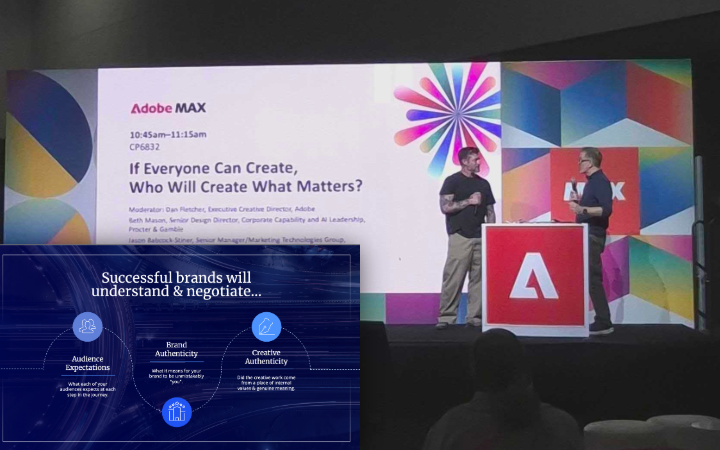
Image source: Jason Babcock-Stiner
When AI first started making waves at Adobe, I wasn’t worried. I was excited because I understood that creativity and technology are complementary forces. Creativity comes from a deep, messy, strange, weird place. To borrow one of Jason’s lines, it has emotional weight. AI sits on top of that, making it easier for brands to share this emotional weight with more people, and reach them in the unique ways that matter to them.
I think back to the 18-year-old me using Photoshop to make flyers that conveyed the sound of our band. The tool was never the point. What mattered was that the work felt like us. Beth and Jason said it in their own ways: AI can multiply the work, but only people can make it unmistakably theirs. Nobody can predict the future, but by tackling these big questions together, we can make choices that put human ideas first, and draw on technology to amplify them, spread our message further, and bring even more people together.
Keep the ideas coming. Explore more perspectives on creativity and AI from our Day 1 and Day 2 talks at Adobe MAX.
Recommended for you
https://business.adobe.com/fragments/resources/cards/thank-you-collections/generic-cc