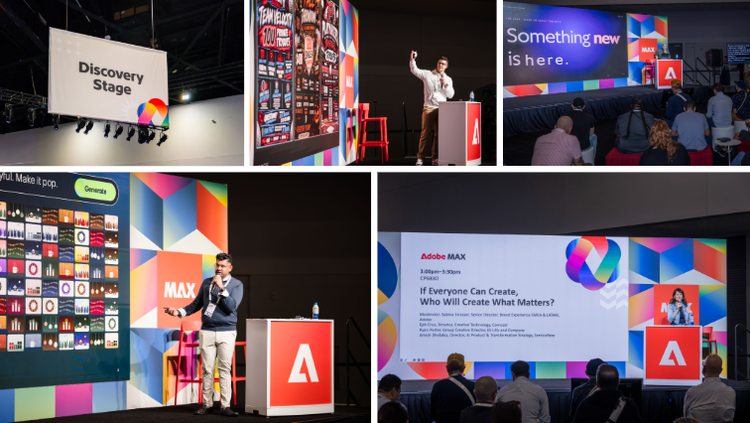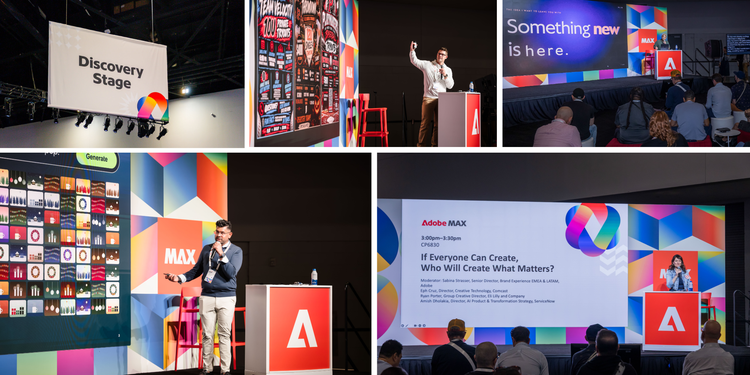
Originality. Taste. Human judgment. The best creative work has always been shaped by these three forces.
In the age of AI, when everyone has the power to create and the world is overflowing with content, brands’ ability to preserve the human element of their work and make people genuinely feel something is the ultimate competitive advantage. Adobe’s VP of Creative, Resh Sidhu, said it best: “As the volume of content grows, the ones that stand out will be the brands that know what they believe, what they should create, and what they should leave alone.”
Few understand this notion better than the visionaries who joined us at Adobe MAX this year to help navigate this moment of change and uncertainty. Though they had just eight minutes to speak, each Adobe customer who took the stage for the TED-style talks made their mark with surprising advice and passionate convictions on how we can tackle the existential question we face as brands, creators, and digital artists today. If everyone can create, who will create what matters?
Eph Cruz, Director of Creative Technology, Comcast Xfinity
Eph opened his session with a bold but vulnerable statement: “It’s OK to not be OK.”
Like many creators, his first reaction to AI was fear, anger, loss, and guilt. But once he let himself grieve and started looking at AI-created content more closely, he realized he was seeing things that defied categorization and that the spirit of human creativity was prevailing, just in new ways. “I’ve been in this game for 20 years and I know this feeling. It’s the feeling you get when a new genre is being born.”
Naturally, Eph cautioned that not everything new is worth creating. Every brand has access to the same AI tools. What differentiates them is the ability to listen and understand customers. When brands combine that listening with their unique creative taste and judgment, they stop scaling sameness and start scaling understanding.
That’s where AI comes in, helping them share the same intent in 100 different formats, at 100 different moments, for 100 different audiences.
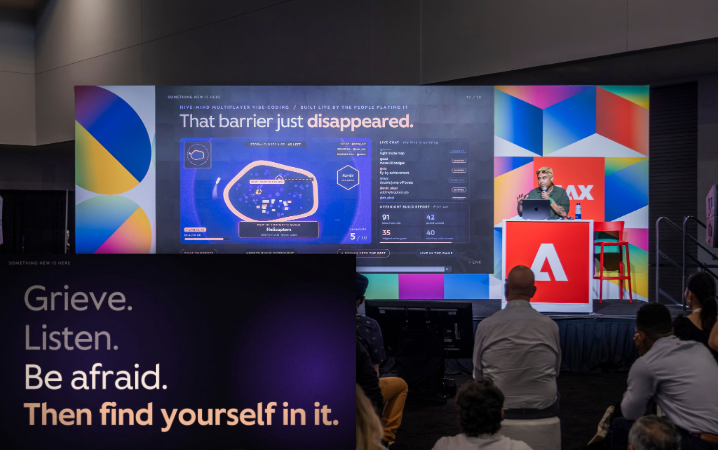
Image source: Eph Cruz
Eph closed with the same vulnerability he opened with, assuring creators at MAX that if they’re not a little afraid, they’re probably not doing it right, and adding that visionary leaders are those who have the courage to go first even while they’re scared. Because the reality is that craft doesn’t die, it changes shape. We’ve seen this throughout history, from the printing press, to photography, to recorded music, to the internet. The artforms that came before didn’t die; they simply gained company.
After hearing Eph, the uncertainty we all feel as creators suddenly felt more like an opportunity to embrace the future and bring our humanity with us.
My top takeaway: “New genres don’t erase old ones. They make the world bigger. There’s room for the hand-crafted and the AI-native. Room for the purist and the experimenter.” And they’re not separate camps. The same creator can be the purist on one piece of work and the experimenter on the next.
Ryan Porter, Group Creative Director, Eli Lilly and Company
As a travel baseball dad, Ryan follows every travel baseball program within 100 miles of his house. After noticing that multiple teams had created almost identical promotional flyers, the challenge of AI creation became clear: AI-generated content may be fast, and it may be polished, but it’s also interchangeable.
How do you stand out in this sea of sameness? Through original ideas, taste, and craft. Ryan reminded us that the designer’s job is to try something new or, at the very least, take on creative projects from a fresh perspective, adding that execution is getting cheaper by the day. Vision isn’t.
This principle is crucial in highly regulated industries. For a medicine company like Eli Lilly, efficiency is valuable, but authenticity and human judgment cannot be compromised. That’s why Ryan and his team are committed to leading with authenticity and building trust with their audiences. When it comes to AI, that means using the technology for time-consuming work like market research, automation, and other repetitive tasks. The goal is not to eliminate the human touch, but to make more space for it.
My top takeaway: “Being in that creative pocket is the single best feeling in the world as a designer. That’s what I want from AI. More time to ideate, and more time to focus on craft.”
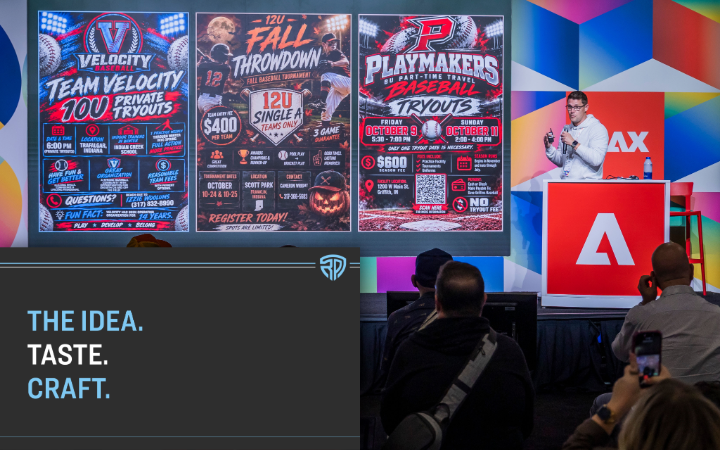
Image source: Ryan Porter
Amish Dholakia, Director, AI Product & Transformation Strategy, ServiceNow
When Amish asked Adobe Firefly to generate hero images for an upcoming ServiceNow holiday campaign, he prompted AI to create something that was warm and joyful, and to make it pop. Firefly obliged – literally – rewarding him with 120 different options, all of which were good. To choose the best image, however, he had to ask himself a different question: which one of these matters most?
For Amish, AI didn’t take away the hard part of creative work. It moved it from scale to judgment. According to Kantar, only 6% of creator content does the dual job of grabbing their audience’s attention and building their brand. AI has solved for the challenge of producing more, faster. Instead of asking themselves what else AI can do, the question Amish and ServiceNow are focusing on is what people can do that AI can’t.
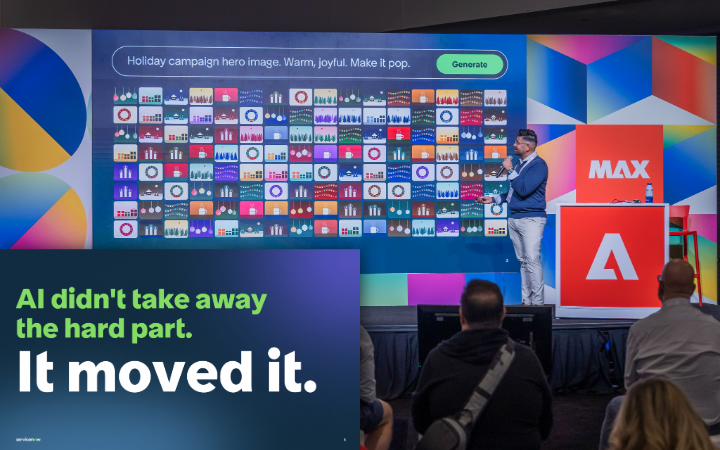
Image source: Amish Dholakia
So, his team mapped out the eight steps of their creative process, moved six of those over to AI agents – including production – and applied their creative talents to the two steps only humans can shape: intent and narrative. “Agents can write copy all day. Narrative is the point. It’s what we mean and why anyone should care,” Amish told the MAX crowd, adding a final piece of advice that summed up the spirit of his session: “Give AI the making, you keep the meaning.”
My top takeaway: “If we judge creative work by output, then AI wins. If we judge it by whether anyone would miss it, people win.”
Despite hailing from different backgrounds and industries, all three of our Adobe customer speakers share a similar vision for the future. One where brands use AI to bring more speed, scale, and possibilities to their creative work, and apply their originality, taste, and judgment to making that work matter.
Because ultimately, the future of creativity won't be defined by how much we can make with AI. It will be defined by what we choose to create with it – and why.
Keep the ideas coming. Explore more perspectives on creativity and AI from our Day 2 and Day 3 talks at Adobe MAX.
Recommended for you
https://business.adobe.com/fragments/resources/cards/thank-you-collections/generic-cc