
Marketing teams need to know and understand their potential customers. Otherwise, they risk being ignored. Understanding who your business serves is essential. In this post, we’ll define what a target market is, outline steps to identify yours, and share advanced segmentation strategies to help your business better understand its customers.
This post will cover:
What is a target market?
A target market is a specific group of potential customers that a business aims to reach with its products or services. This group may share common characteristics such as age, gender, income level, education, interests, or geographic location that make them more likely to be interested in and purchase from a business.
Defining a target market is an essential part of developing a marketing strategy.It helps businesses focus their efforts on people who are most likely to buy their products or services. Understanding the needs and preferences of a target market allows companies to tailor their messaging, products, and pricing strategies to appeal to those customers and ultimately increase sales and profitability.
For example, a retailer selling women’s clothing would want to target women based on age, income levels, and geographic locations — factors that influence purchasing behavior. Once they understand who they are serving, they can present the clothing options that align with their target audience’s purchasing habits.
Define your target market.
The identification of a target market is a core business strategy, the foundation upon which successful enterprises are built. This process typically starts with demographic and geographic segmentation:
- Demographic segmentation: Divides the market based on objective characteristics like age, gender, income, occupation, and family status.
- Geographic segmentation: Groups customers by physical location, such as country, city, climate, or population density.
Steps to define your target market:
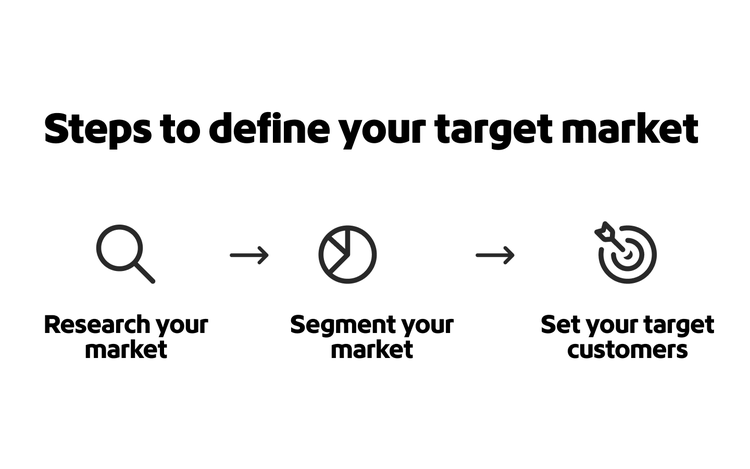
- Research your market: The first step is understanding as much as you can about who you are serving. When you better understand your audience and what they care about, you can adjust your marketing and product offerings to resonate with them.
- Segment your market: The process begins by dividing a broad market into smaller, homogeneous groups or segments based on shared characteristics.
- Target relevant customers: The business evaluates the attractiveness of each segment and selects one or more to enter. This is where a business defines its primary target market — the main focus of its resources — and potentially secondary target markets.
Advanced target market segmentation strategies.
To identify a target market accurately, marketing teams must segment different types of customers within a target audience. Understanding the psychographics (the "why") and the behaviors (the "how") of the customer are helpful, but the most powerful and actionable targeting strategies are those that combine these dimensions. This creates a holistic, multi-dimensional view of the ideal customer.
Psychographic segmentation
Psychographic segmentation focuses on the "why," grouping people based on intrinsic traits like attitudes, values, interests, lifestyle choices, and pain points. This is where brands build deep emotional connections and foster loyalty.
For e.g., a defined target, such as "busy professionals with children who value sustainability and healthy eating," is far more actionable than a simple demographic profile.
Behavioral segmentation and purchase intent.
Behavioral segmentation explains the "how" by categorizing customers based on their past actions and interactions with a brand. As past behavior is a strong predictor of future action, this is invaluable for driving conversions. Key variables include purchasing habits, usage frequency, brand loyalty, benefits sought, and digital engagement.
B2B vs. B2C target market segmentation.
When marketing to other businesses (B2B), the same segmentation principles apply. However, the focus shifts to company traits instead of individual consumer habits. This approach generally uses two types of data:
- Firmographics: These are the basic facts about a business, similar to demographics for people. These includes the company's industry, size (by number of employees or revenue), and location.
- Buying behavior: This looks at how a company makes purchasing decisions. It considers their buying process, budget cycles, and decision-makers — whether it's the CEO, a department head, or a purchasing manager.
By combining this data, you can create a clear B2B target market. For example: "Small service businesses with fewer than 50 employees who need technical support but can't afford a full-time IT expert."
Adobe Real-Time CDP unifies and activates your target audience.
The journey from a planned strategy to tangible, valuable business results requires a technological foundation that manages complex customer data. Segmentation can provide businesses with a roadmap to reach relevant customers. However, execution at scale remains a formidable challenge. Adobe Real-Time Customer Data Platform (Real Time CDP) unifies, understands, and activates a target audience.
Harmonize Data with Adobe Real-Time CDP
Adobe Real-Time CDP helps solve data fragmentation by unifying and harmonizing known and anonymous data from all online and offline sources. This data is stitched together into a persistent, and continuously updated person or account profile for each customer or account. Using advanced identity resolution, Real-Time CDP connects data from a customer's laptop, smartphone, and in-store purchases into one cohesive 360-degree profile, supporting B2C, B2B, and hybrid B2P models.
Advanced audience segmentation with Adobe Real-Time CDP
With a unified profile, Adobe Real-Time CDP empowers marketers to apply segmentation at enterprise scale. The platform's intuitive rule builder allows marketers to define nuanced audience segments with granular precision. Beyond basic rules, Real-Time CDP offers sophisticated capabilities:
- Sequential and dynamic Segmentation: Define audiences based on an ordered sequence of events or use variables to create flexible, scalable segments.
- AI-Powered insights: Real-Time CDP moves beyond descriptive segmentation ("what customers did") to predictive segmentation ("what they are likely to do"). It can generate custom propensity scores for each profile (e.g., likelihood to convert or churn) and identify new look-alike audiences.
Activate segments with Adobe Real-Time CDP
Adobe Real-Time CDP's true power lies in its ability to activate these precisely defined segments in real time across a vast ecosystem of channels, including both Adobe and non-Adobe destinations. For example, brands can use Adobe Real-Time CDP to find more of their ideal customers with embedded applications like Real-Time CDP Collaboration. Real-TIme CDP Collaboration helps brands work with partners of their choosing, such as another brand or publisher, to audience insights, activate audiences and track closed loop measurement to continuously enrich customer knowledge and engagement impact. This transforms marketing into an intelligent, real-time conversation with each customer.
Book a demo or watch an overview video to see how Adobe Real-Time CDP can help identify a target market for your business.
Recommended for you
https://business.adobe.com/fragments/resources/cards/thank-you-collections/rtcdp