Customer engagement strategies: Examples, campaigns, and platforms.
11-19-2026
Brands that build deliberate customer engagement strategies tend to outperform those that treat communication as a one-way broadcast. The difference can show up in retention rates, purchase frequency, and lifetime value.
In this article, you’ll learn:
- What is customer engagement?
- What is a customer engagement strategy?
- Why does customer engagement matter for business outcomes?
- What are the most effective customer engagement strategies?
- How do customer engagement campaigns work?
- How does customer engagement drive retention?
- How do you compare customer engagement platforms?
- What customer engagement solutions are available, and how do you choose?
What is customer engagement?
Customer engagement describes the sum of voluntary interactions a person has with a brand across every touchpoint. Opening an email, using a loyalty app, browsing a product catalog, contacting support, or leaving a review: each of these customer interactions contributes to a cumulative picture of how actively a person participates in a brand relationship. Engagement is distinct from customer satisfaction because it measures active participation, not passive sentiment. A customer can be satisfied with a product yet never interact with the brand again.
Three roles shape engagement: marketers design the touchpoints, customer experience (CX) leaders measure whether they produce loyalty and revenue, and technology teams make behavioral signals visible across channels. Without shared Key Performance Indicators (KPIs), marketing can optimize for open rates while CX tracks Net Promoter Score (NPS) and Information Technology (IT) tracks data-pipeline latency. As a result, all three teams may declare success while customers receive contradictory messages.
Engagement is the process; retention is the outcome. Brands that conflate the two often optimize for vanity metrics like open rates while ignoring whether customers return to buy again.
What is a customer engagement strategy?
A customer engagement strategy is a cohesive plan for earning ongoing, voluntary interaction from prospective and existing customers through curated experiences before, during, and after a purchase. Individual campaigns chase a single goal; the strategy sets the rules that every campaign, channel, and team follows. A successful customer engagement strategy is measurable and responsive to customer needs: it defines what success looks like and adapts when customer behavior changes.
In practice, a customer engagement strategy answers six questions:
-
Who are we engaging?
Audience segments defined by lifecycle stage, value, and behavior, grounded in research into customer needs and pain points.
-
What outcome are we driving?
Goals such as repeat purchase, product adoption, renewal, or referral, each with a KPI that maps to revenue or retention.
-
Which channels and content should we use?
The mix of email, web, mobile app, social, support, and in-person touchpoints the audience actually uses, and the content each one carries.
-
What signals trigger engagement?
The behaviors, events, and thresholds that start, pause, or stop a conversation.
-
What data powers it?
A unified customer profile that lets every channel act on the same, current view of the customer.
-
How will we measure and adapt?
The metrics, feedback loops, and testing cadence used to refine the plan.
A customer engagement strategy is the planning layer of engagement marketing. Engagement marketing is the practice of interactive, two-way brand communication; the strategy determines where, when, and for whom that practice runs.
Why does customer engagement matter for business outcomes?
Keeping an engaged customer generally costs less than winning back a lapsed one or acquiring a new one, though the difference varies by industry and business model. That makes engagement a direct lever for margin, because retained revenue reduces the acquisition spend needed to hit the same goals.
Engagement compounds over time. A customer who interacts across email, a mobile app, and in-store often shows higher purchase frequency than a single-channel customer, and repeated positive interactions raise the psychological cost of switching to a competitor. A meal-kit subscriber who only receives delivery confirmations has a limited relationship with the brand; one who also uses the recipe app, rates meals, and refers friends has built habits that make cancellation feel like a loss.
Each function uses engagement signals differently: marketing uses them to prioritize prospects who visit pricing pages or attend webinars, sales uses them to time outreach around activity spikes, and service uses them to flag churn risk when engagement declines. Each needs its own KPIs, but all draw from the same customer engagement metrics.
What are the most effective customer engagement strategies?
The eight customer engagement strategies below apply to both business-to-consumer (B2C) and business-to-business (B2B) brands. Most organizations start with two or three and add others as their data and teams mature.
Personalize every interaction with real-time data.
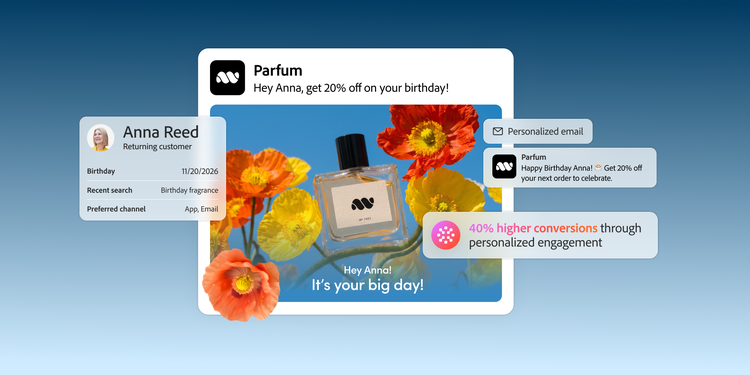
Tailoring content, offers, and timing to individual behavior rather than broad segments is one of the highest impact approaches available. Personalization works when it reflects what the customer is doing now: recent browsing, purchase history, stated preferences, and current context. It fails when it relies on stale data. A customer who has already purchased an item in-store and then receives an abandonment email for it is likely to feel surveilled, not served. As a result, real-time data synchronization is a prerequisite rather than a nice-to-have.
A home-goods retailer, for instance, can replace a generic weekly newsletter with content blocks that change for each subscriber: recently viewed categories, items back in stock in their preferred size or color, and care tips for their last purchase.
Keep messaging consistent across channels.
Customer communication strategies must deliver a coherent experience whether the customer is using email, Short Message Service (SMS), a mobile app, or a live chat window. Consistency does not mean identical messaging across every channel. It means that the value proposition, the offer terms, and the brand voice remain aligned, even when the format adapts to the channel's constraints.
For example, a customer who receives a 15%-off email and then sees a 10%-off banner in the app may lose trust in both the offer and the brand. Sharing one offer catalog and one customer profile across channels prevents that conflict, and it lets a service agent see the same promotion the customer is calling about.
Trigger engagement from real-time customer events.
Event-triggered engagement responds to what a customer just did: abandoning a cart, browsing the same category repeatedly, reaching a loyalty threshold, or becoming inactive after weeks of activity. Because the message arrives at the moment of intent, trigger-based engagement tends to outperform calendar-based sends. A cart-abandonment reminder sent while intent is fresh is generally more effective than one sent a day later.
Picture a travel brand that sees a customer search the same route three times in a week. It can send a fare alert for that route, then suppress further alerts as soon as the customer books.
Sequence journeys by lifecycle stage.
Matching the engagement tactic to where the customer is in their lifecycle prevents the common mistake of treating all customers the same. New customers need onboarding and education that shorten time to value. Active customers need loyalty rewards and relevant upsell opportunities that deepen the relationship. Lapsing customers need win-back journeys, ideally with a channel shift. If a customer has stopped opening email, an SMS or in-app message may reach them where email no longer does.
In practice, a subscription box company that notices a customer has skipped two consecutive months might send an SMS with a personalized offer based on past purchase preferences, rather than another generic "We miss you" email.
Use offer decisioning to choose the next best action.
When a customer qualifies for several offers or messages at once, offer decisioning determines which one they see. Decisioning logic weighs eligibility rules, the customer's likelihood to respond, business priorities such as margin or inventory, and contact-frequency limits, before selecting the next best action for that moment. The goal is to deliver fewer, more relevant interactions rather than have every team push its own message.
Consider a bank customer who has just opened a checking account and is eligible for a credit card, a savings promotion, and a mobile banking tutorial. Decisioning can lead with the tutorial because early digital adoption may matter more than an immediate cross-sell. It can then hold the credit card offer until the customer has an established deposit history.
Provide proactive service and support.
Engagement does not come only from marketing. Reaching out before a customer has to ask, whether with a delivery delay notice, an outage update, a renewal reminder, or a usage tip, turns potential frustration into a moment of trust. Proactive service can also reduce inbound support volume because the customer already has the information. Pair outreach with easy self-service options and with context that carries over between channels so customers never have to repeat themselves.
When an airline detects a missed connection, it can push rebooking options to the traveler's app before they reach the service desk. The agent who takes a follow-up call can see the same itinerary and options.
Build loyalty programs and communities.
Loyalty programs reward repeat behavior with points, tiers, or exclusive access, while communities invite customers to contribute reviews, beta-test features, or help one another. Both increase emotional investment and make switching to a competitor feel like a loss. In B2B, engagement must reach the whole buying group, because several people within the customer's organization need to feel connected to the product, not only the person who signed the contract.
A software-as-a-service (SaaS) company that invites power users into a private feedback community gains product insights and a cohort of advocates who are less likely to churn. A B2B vendor can apply the same loyalty principle with certification badges, early access to new features, or support tiers tied to product usage.
Close the loop on customer feedback.
Responding visibly to every survey, support ticket, and NPS response is one of the most underused customer engagement strategies. Customers who see their feedback acted upon are more likely to engage again and tolerate future service failures. The most common failure is collecting feedback and never responding, which teaches customers that their input does not matter.
Even a single low score is an opportunity: a hotel chain that emails a guest after a low satisfaction score, explains the corrective action taken, and offers a goodwill gesture which can turn a detractor into a potential promoter.
How do customer engagement campaigns work?
A customer engagement campaign is a time-bound, goal-specific sequence of coordinated messages designed to move a defined customer segment toward a measurable behavior. That behavior might be a purchase, a feature adoption milestone, a referral, or a renewal. Campaigns differ from always-on engagement programs as they have a start date, an end date, and a discrete success metric.
Every effective campaign has four components:
- Defined audience segment. The campaign targets a specific group based on behavioral, demographic, or lifecycle criteria. "All customers" is not a segment.
- Trigger or schedule. Messages are sent based on a customer action (a trigger-based campaign) or a predetermined calendar (a batch campaign).
- Message sequence. Which message goes out on which channel, in what order, and with what wait conditions between steps.
- Success metric tied to a business outcome. The metric should map to revenue, retention, or adoption, not to a vanity metric like impressions.
For example, a SaaS company might run a 30-day onboarding campaign: an in-app welcome with a guided product tour on day 1, a tutorial email for the feature most correlated with long-term retention on day 3, a push notification celebrating a usage milestone on day 7, and a check-in email offering a live session with a customer success manager on day 14. Each step is triggered by the previous behavior rather than a fixed schedule, so a customer who finishes the tour in the first hour gets the tutorial a day early.
Channel mix matters. Customer engagement campaigns that combine emails, push notifications, and in-app messaging often outperform single-channel campaigns because they reach customers at different moments of receptivity. Match the channel to the message: a time-sensitive flash sale warrants a push notification, a detailed product comparison belongs in an email, and a contextual upsell works best as an in-app message.
Measure the engagement rate for each message, drop-off points in the sequence, and the primary conversion event. Then optimize where customers disengage rather than focusing only on the final conversion rate. For example, if 40% of recipients open the first email but only 10% click through to the tutorial, the problem is the email content or the tutorial's perceived value, not the campaign structure.
How does customer engagement drive retention?
Retention is the measurable result of sustained engagement over time. A customer who engages regularly is generally less likely to churn than one who has gone quiet for a month, which makes engagement frequency one of the most actionable leading indicators of renewal intent.
Churn prediction using an engagement score is where a retention strategy becomes proactive rather than reactive. Organizations that assign a composite engagement score, weighted across email opens, login frequency, feature usage, and support contact, can identify customers whose scores are declining before they cancel. For example, a score that drops from 80 to 45 over three weeks signals a problem that a customer success manager can investigate before it results in churn, rather than a cancellation notice that arrives without warning.
Digital customer engagement channels such as mobile apps, in-app messaging, and push notifications can lift retention further by building habits that email alone cannot: a banking app that surfaces personalized spending insights every Monday creates a weekly touchpoint that, over time, becomes a switching cost.
How do you compare customer engagement platforms?
A customer engagement platform is software that unifies customer data, automates multichannel messaging, and measures interaction outcomes in a single environment. Platforms differ from point solutions, such as email-only or SMS-only tools, in their ability to orchestrate journeys across channels from one interface.
Use these core evaluation criteria for any customer engagement platform comparison:
A practical way to compare options is by platform tier:
In any customer engagement software comparison, also confirm real-time segmentation, journey-level A/B testing, controls for the General Data Protection Regulation (GDPR) and the California Consumer Privacy Act (CCPA), and native analytics. Any capability that needs an add-on should be included in your total cost of ownership.
What customer engagement solutions are available, and how do you choose?
Customer engagement solutions span four categories:
- Platforms orchestrate journeys end-to-end, from data ingestion and segmentation to message delivery and measurement.
- Analytics tools focus on measuring app engagement, engagement scores, and channel performance without necessarily delivering messages.
- Data infrastructure, primarily Customer Data Platforms (CDPs), unify identity and behavioral data across sources so that other tools can act on a complete customer profile.
- Services include agencies and consultants who implement the technology and train internal teams.
The right starting point depends on where your organization's gap is. If your channel data is siloed and you have no unified customer profile, start with a customer data platform before investing in a new engagement platform. A sophisticated messaging tool built on fragmented data will produce sophisticated but inaccurate messages. Adobe Real-Time Customer Data Platform, for instance, unifies data from every source into AI-powered customer profiles and audiences for real-time B2C and B2B use cases, giving downstream engagement tools the unified profile they need to personalize accurately.
If your primary gap is measurement, meaning you can send campaigns but cannot tell which interactions drive retention, prioritize customer engagement analytics and engagement metrics tools before adding channels.
If your gap is orchestration, meaning you have unified data but cannot automate multi-step journeys, evaluate platforms with a strong journey builder and real-time trigger capability. Adobe Journey Optimizer lets brands use customer actions and business events as journey triggers. A customer abandoning a cart, reaching a loyalty threshold, or going days without a login can each trigger a tailored journey across channels such as email, push, SMS, in-app, and web, with governance controls for frequency, fatigue, and send prioritization. Its decisioning capabilities rank personalized offers using AI models or business rules, so each customer receives the most relevant offer at that moment.
Finally, match the solution's complexity to your team's operational capacity. A team running a handful of campaigns per quarter is unlikely to get full value from an enterprise orchestration platform, and overbuying technology while underinvesting in the people who operate it is a common failure mode.
Frequently Asked Questions
What is the difference between customer engagement and customer experience?
How do you measure customer engagement?
What is a customer engagement platform used for?
How does AI improve customer engagement?
What is a good customer engagement strategy for B2B companies?
B2B engagement strategies, often run through account-based marketing, engage the whole buying group rather than a single contact. Effective tactics include personalized content journeys mapped to the buying stage, account-level engagement scoring that aggregates behavior across all contacts, and post-sale customer success sequences that drive product adoption and support renewal conversations.
See how Adobe Journey Optimizer orchestrates personalized engagement across email, push, SMS, in-app, and web, and how Adobe Real-Time Customer Data Platform unifies data from every source into real-time customer profiles and audiences that power those journeys.
Recommended for you
https://business.adobe.com/fragments/resources/cards/thank-you-collections/rtcdp