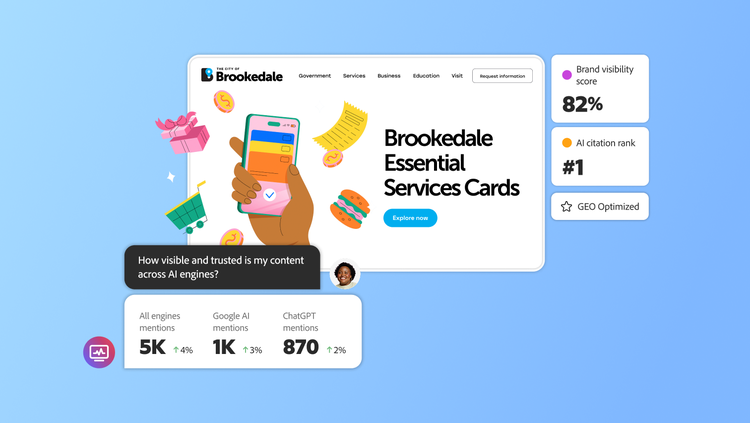
Generative AI is reshaping how citizens search for government information, services, and resources. Instead of clicking through search results, many now rely on AI-generated summaries that answer questions immediately — often without ever visiting an agency website. So even if your homepage ranks #1 on Google, citizens may never visit it.
Online visibility today has moved beyond search engine optimization (SEO). It requires using generative engine optimization (GEO), so AI tools can accurately and effectively utilize content and keep it front and center in citizen searches.
Defining generative engine optimization.
GEO is the practice of structuring content so it can be easily understood, discovered, and cited by the large language models (LLMs) that power AI systems such as OpenAI, ChatGPT, Microsoft Copilot, Google Gemini, and others.
By making GEO part of their content strategy, government agencies can ensure their information is visible to the AI agents in AI-generated answers on Google, ChatGPT, Perplexity, and other major platforms. This will ensure citizens who interact with these platforms receive clear, direct, and accurate answers grounded in up-to-date information from trusted government sources.
What does that look like in action? Take this hypothetical use case where a resident needs to replace their lost Supplemental Nutrition Assistance Program (SNAP) benefits card.
To figure out how to replace their card, the person opens a search engine like Google and gets an AI-generated answer that tells them what to do. If the state agency’s content isn’t AI-readable and authoritative, the model may give the wrong steps, mix up guidance across states, or send the person to third-party sites that monetize confusion and omit accessibility options.
With GEO, the agency intentionally structures and publishes content so generative systems can reliably extract the correct, jurisdiction-specific answer and present it cleanly.
To do this, the agency could take a few key measures.
- Create a single canonical “Lost or Stolen EBT Card” page that is plainly written and scoped to the state with a clear “Last updated” date.
- Add an answer-first structure at the top: “If your EBT card is lost or stolen, call X or log in to Y. After reporting, you can request a replacement.”
- Use the kind of structured elements that are favorable to generative systems, including short FAQ blocks, step-by-step lists, eligibility exceptions, and edge cases.
- Publish consistent machine-readable data, including consistent headings and stable URLs.
- Align supporting pages and PDFs so there’s no conflict. Generative systems get confused by contradictory versions of documents living in multiple places.
Now that the broad process of GEO has been laid out, it’s important to understand how we got here and why citizens are having such a tough time getting the right information. It has a lot to do with that first step the person in the scenario above took. They relied on AI-generated suggestions rather than clicking through links that would have led them to the agency's website.
The rise of 'zero click' and the decline of organic search traffic.
Instead of starting their journey with a traditional web search or going straight to an agency website, more citizens are turning to AI tools to get clear, immediate answers — without clicking on a single web link. In 2024, an estimated 60% of web searches ended without a click.
This rise in 'zero-click' searches indicates that users are finding the information they need in the AI snippets that appear directly on the results page — so they don’t feel the need to click through to the source website for more information. As a result, many sites are seeing a downward trend in organic search traffic, with Gartner predicting a 25% drop in organic traffic by the end of 2026 and a 50% drop by 2028.
This means your agency website is no longer citizens’ first touchpoint for information about your agency, and simply publishing content on your homepage is no guarantee that citizens will ever see it in their online research. Moving forward, GEO will be critical in making sure content remains discoverable to citizens, even as they increasingly rely on AI summaries as their main source of information. And it may have more profound impacts than agencies realize.
The potential impacts of using — or not using — GEO.
A generative AI interface synthesizes information from multiple reputable sources and compresses it into a single answer or a short, ranked list. The sources it cites see a major benefit from this visibility, but everyone else is effectively invisible to the citizen. This creates a significant disparity, because even small visibility advantages can turn into disproportionate gains in traffic, conversion, and trust. For example, a 10% increase in generative AI citation share today can lead to as much as a 30% rise in service enrollments tomorrow. This is because a bigger citation share increases visibility, builds credibility that strengthens citizen trust, and provides faster, more personalized pathways to relevant programs.
Without the right optimization strategy, government agencies can expect to see sharp drops in their content visibility within a year. Not only will this make it harder to combat the spread of misinformation — it will also limit citizens’ access to clear and accurate information, which degrades service quality and can erode credibility and public trust. For this reason, it’s incumbent upon agencies to embrace GEO as a way of ensuring public information remains timely, trusted, and readily accessible to citizens.
Adopting the right GEO strategy and solution.
Improving AI search visibility means organizing content so LLMs will recognize, select, and cite it as an authoritative source. An effective GEO strategy will help agencies optimize their content based on the attributes that LLMs prioritize. These include:
- Conversational, question-based language. The verbiage should directly answer queries citizens are most likely to ask.
- Clarity and factual accuracy. Content should be factual, clear, and written in plain language to minimize misinterpretation by LLMs.
- Structured content. Using headings, bullet points, short paragraphs, and FAQs makes content easier for LLMs to parse and summarize.
- Built-in provenance. An abundance of verifiable content like official reports, research-based facts, and statistics allow AI to accurately cite information. It also signals that your website is a go-to source for rich information.
- Continually refreshed content. LLMs are more likely to recognize recent content as more relevant.
- Backlinks from reputable sources. When other trusted websites link to your content as an authoritative source, LLMs are more likely to view your content as credible and surface it in their answers.
Adobe Brand Visibility, formerly Adobe LLM Optimizer, can help agencies hit all these marks to ensure their information is both visible and accurate in AI-driven search environments. In one powerful, standalone solution, Brand Visibility proactively detects opportunities to make information more discoverable to LLMs and optimizes content accordingly. In this way, it supports a sound GEO strategy by giving agencies the tools and insights to enhance visibility, manage reputation and drive engagement with their content across all major AI platforms. With Brand Visibility, your government agency can:
- Track mentions, citations, sentiment and rankings across all platforms so you can ensure your agency’s services and policies are represented positively and accurately.
- Monitor agentic traffic to understand how LLMs interact with your website, which pages they access the most, and how to optimize content based on this behavior.
- Track how AI-generated citations drive traffic to your website, helping you measure the impact of your GEO strategy.
- Receive tailored recommendations and seamlessly deploy optimizations for restructuring content to improve readability and public sentiment across platforms.
By making Adobe Brand Visibility part of their GEO strategy, digital teams will — enhance public trust by mitigating misinformation and promoting authoritative content; improve accessibility by ensuring citizens can easily find accurate, up-to-date information; support a more data-driven content strategy; and keep agency content future-ready, ensuring it stays visible and impactful as generative AI evolves.
Navigating the new era of search.
GEO isn’t just an evolution of SEO — it’s a reinvention of how online content reaches people, and an opportunity for local governments to build trust, authority, and influence in their communities. With Adobe Brand Visibility, government digital teams can confidently navigate the era of AI-driven discovery, ensuring their services and resources are seen, trusted, and utilized by the communities they serve.
Learn how Adobe Brand Visibility can help elevate your agency’s GEO strategy.
Brian Chidester is the head of industry strategy for the public sector at Adobe and host of The Government Huddle Podcast from GovExec. Previously, he served as industry vice president for global public sector at Genesys and has held leadership roles with OpenText, Arrow ECS, and S&P Global. Chidester holds a B.S. in Communications Studies from Liberty University. He is a board member for the University of South Florida Muma College of Business, an advisor to the G20 Global Smart Cities Alliance at the World Economic Forum, and a member of the Forbes Technology Council.