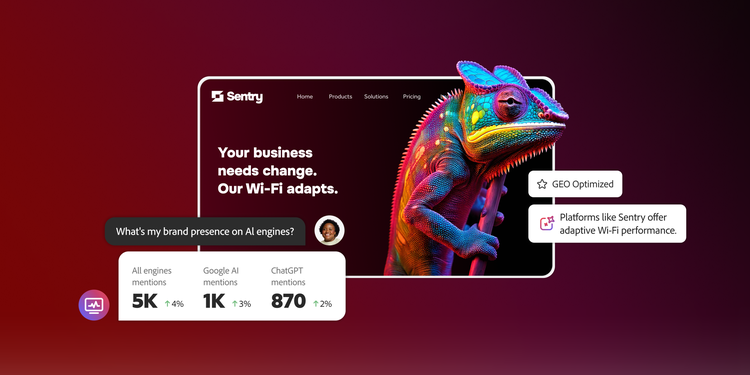
Why AI search optimization matters for digital channels.
Generative AI platforms are rapidly becoming influential across stages of the customer journey. Buyers increasingly consult AI systems to compare vendors, clarify product capabilities, and summarize technical specifications before they ever visit a website. Adobe research shows that from July 2024 to February 2025, web traffic from generative‑AI–driven referrals increased more than 10× in the United States, underscoring how quickly these tools are reshaping early‑stage discovery and evaluation behaviors.
Recent Adobe analysis further demonstrates that this traffic is not only growing fast but also becoming commercially meaningful. AI‑referred visitors now engage at levels comparable to, or better than, traditional traffic sources, browsing 12% more pages per visit and showing a 23% lower bounce rate than non‑AI referrals. These signals indicate that generative AI platforms are emerging as credible, high‑intent sources of inbound engagement rather than passive research tools. (You can read The explosive rise of generative AI referral traffic).
For CMOs this development has direct implications for revenue, governance, and competitive positioning. AI visibility influences early-stage consideration. If an AI Overview excludes your brand or misrepresents your offering, the downstream effect can be significant. Conversely, consistent citation within AI-generated answers increases brand authority and accelerates trust before the first click.
Quantifying this visibility is essential. Without measurable AI-driven traffic and citation tracking, organizations cannot connect AI search optimization efforts to marketing ROI. As outlined in our perspective on the new AI search landscape, brands must proactively optimize for AI discovery to remain competitive.
AI best practices for content.
Optimizing for AI search requires content engineering rather than simple content refinement. Clear semantic structure is foundational. Headings must signal intent explicitly. Definitions should be concise and self-contained. Each section should begin with a direct answer to the implied question in the heading. Generative AI systems retrieve content in modular “chunks,” not entire pages. If a section depends on surrounding paragraphs for context, it risks misinterpretation.
Structured data further enhances extractability. Schema markup, FAQ formatting section enables AI systems to identify contextual units with greater accuracy. This improves both traditional indexing and LLM optimization.
Content freshness also matters. LLMs weigh authority signals and domain credibility when synthesizing answers. Experience, Expertise, Authoritativeness, and Trustworthiness (E-E-A-T) are not just SEO considerations; they are AI inclusion criteria. Outdated specifications or unclear claims increase the risk of hallucination or competitor substitution.
As voice and visual AI queries grow, optimization must extend beyond text. Natural language phrasing supports conversational search. Updated alt text and descriptive image metadata support AI-driven visual discovery. These adjustments do not replace traditional SEO fundamentals, they extend them into a synthesis-first environment.
The shift: From blue links to agentic answers.
A deeper transformation is underway: the rise of agentic traffic. AI agents such as GPTBot and PerplexityBot do not simply crawl and index. In addition to extracting and comparing claims, they perform tasks on behalf of users. These agents increasingly shape decision-making before a human visitor interacts directly with your site. For organization leaders represent both an opportunity and a risk.
- Opportunity, because AI-generated answers can position your brand as authoritative early in the buying process.
- Risk, because traditional analytics tools often classify this activity as “Direct” traffic or fail to capture it entirely. If AI agents are crawling your documentation and influencing decisions without visibility into that interaction, optimization becomes guesswork.
The strategic risk is even more significant. If an LLM cannot parse your product specifications accurately and instead hallucinates incomplete or outdated information, the customer may form a decision before ever reaching your digital properties. This is why AI SEO must be treated as infrastructure, not experimentation.
Measuring the invisible: Why do traditional metrics fail.
Traditional SEO measures clicks and rankings. AI SEO measures citation frequency and share of model, and includes the proportion of AI-generated responses in which your brand appears. Most organizations lack reliable tools to measure this. Standard dashboards rely on modeled data or surface-level traffic signals, and do not reveal how often AI systems reference your content during synthesis.
Enterprises require deeper infrastructure visibility, including signals derived from CDN logs and bot-level monitoring. Without this data, it is impossible to answer a fundamental question: How do you measure performance in AI search? Measurement defines whether AI search optimization is strategic or speculative.
Future-proofing with Adobe Brand Visibility.
Operationalizing AI visibility requires infrastructure that connects citation tracking, competitive benchmarking, and real-time testing. Adobe Brand Visibility is designed to provide enterprise-grade visibility into how brands appear across generative AI platforms. Rather than functioning as a simple reporting tool, it serves as an infrastructure for the AI era.
Organizations can analyze how their brand is represented in responses generated by different systems, such as ChatGPT, Gemini, and Perplexity, evaluate competitive citation patterns.
Importantly, the solution operates as a standalone product while integrating with broader Adobe tools, enabling organization leaders to embed AI search strategy into enterprise data ecosystems without restructuring existing infrastructure. Perspectives on AI discovery underscore a central principle: brands must optimize proactively to maintain visibility in generative environments.
By 2026, SEO will no longer be defined by position on a results page. It will be defined by presence within AI-generated answers and citations. The search bar will not simply retrieve information. It will interpret, evaluate, and influence decisions. The future of SEO is not about better keywords. Sound strategy is about building the infrastructure required for AI visibility, governance, and measurable impact. The question is no longer whether AI will reshape discovery; it’s whether your enterprise SEO strategy is engineered for synthesis and whether you have the infrastructure to measure it.
Search optimization in 2026 FAQs.