This blog kicks off a series from Adobe and IBM Consulting automotive experts, unpacking three critical themes and exploring insights from Adobe’s October 2025 whitepaper, State of Customer Experience in Automotive in an AI-Driven World.
The automotive industry has always been a story of reinvention — from the assembly line to electrification, from connected vehicles to the rise of mobility services.
Now, another shift is underway. Artificial intelligence is changing not just how cars are designed and built, but how consumers discover, evaluate, and connect with brands.
In an era when AI systems are curating what people see, read, and trust, the first impression of your brand might no longer come from your website or a showroom; it might come from what an algorithm says about you.
For automakers and their marketing leaders, that raises a critical question — how do you make sure your brand shows up accurately and convincingly when AI becomes the customer’s first point of contact?
AI is changing automotive brand discovery.
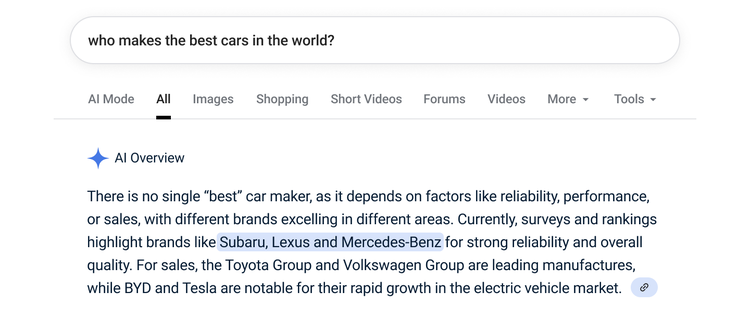
Let’s start with a simple online query — who makes the best cars in the world?
A subjective question, of course. Among the various auto manufacturers today, you could make a solid case for Rolls-Royce, Ferrari, or Bugatti. These manufacturers produce cars that practically demand superlatives, such as the luxurious Rolls-Royce Spectre, the F1-inspired Ferrari 849 Testarossa, or the insanely powerful Bugatti Tourbillon.
Yet, if you ask Google this question, the response from Gemini doesn’t feature any of these manufacturers. Instead, it highlights the reliability and quality of Subaru, Lexus, and Mercedes-Benz, as well as the sales success of Toyota and Volkswagen. Additionally, it emphasizes the electric vehicle (EV) focus of Tesla and BYD.
Why AI answers differ — and why it matters.
Surprised? As automotive industry experts, we were too; but as search geeks, we weren’t. Welcome to the new normal, where AI-generated answers often prioritize relevance over aspiration, and that can lead to omissions which may be surprising to brands.
In response, as the Adobe whitepaper highlights, the joint practices of Answer and Generative Engine Optimization (AEO/GEO) are rapidly emerging as critical marketing practices — where automakers compete for the attention of LLMs, not consumers, to secure a spot in one of these 100-word summaries.
Before we go any further, let’s define our terms of reference. A generative engine creates original content based on prompts — think ChatGPT drafting a blog or Claude creating code — while an answer engine, like Google Gemini, retrieves and synthesizes existing information, summarizing the web into concise answers.
So, whilst GEO influences how AI tools like ChatGPT and Perplexity use your content to generate original responses based on indexed web content (directly influencing what an LLM thinks and says), AEO focuses on becoming the source for direct answers in featured snippets, knowledge panels, and AI Overviews.
Such summaries are becoming rapidly ubiquitous. For example, in January 2025, bmw.co.uk triggered Google AI Overviews from 1,284 unique keywords. By October 2025, the number of keywords jumped to 7,134, an increase of 450% in under a year. (Source: research by IBM and Profound, 2025). Adobe’s report predicts that as many as one in five auto searches will be AI-powered by the end of 2027.
How does the content get there in the first place? According to Google, their models use a framework known as EEAT which stands for Experience, Expertise, Authoritativeness, and Trustworthiness. A brand’s own website and reliable media will score highly, while websites with AI-generated content of dubious provenance will be ignored, at least in theory.
However, it won’t happen automatically. It’s not as simple as ‘create some good content and let the AEs and GEs do the hard work.’ Just as with SEO for content, brands need to work consciously and continually to ensure their sites are seen by LLMs as the most relevant sources for any given query.
According to the State of Customer Experience in Automotive in an AI-Driven World, 2025, “FAQs, configurators, vehicle pages, and ownership guides must be structured for machine readability, not just visual appeal.”
Of course, this applies to all consumer brands, but it is critical in the automotive sector, where retention often falls below 50%. Automakers’ flagship sites, packed with videos and configurators, mean very little if a competitor answers the buyer’s question first. If you fail to capture this ‘critical micro moment of intent’, you may lose your one chance to capture or retain that customer.
The impact is real and measurable. A recent study of 300,000 keywords found that the presence of an AI overview in search results correlated with a 34.5% lower average clickthrough rate (CTR) for the top-ranking page.
Imagine if an auto brand decided to ignore this trend and stick with its traditional click-to-visit-to-lead-to-sale funnel. Let’s say they previously had 1 million unique visitors per year from organic traffic and a 2% conversion rate. That would mean getting 600 fewer leads per month, or possibly 60 lost sales per month, handed to the competition. In other words, catastrophic.
However, there’s opportunity here, too. AI-driven SEO and search marketing can positively influence a brand’s ability to attract new customers. If you’re on the right side of the equation — like Subaru, Lexus, and the brands mentioned above — you can influence buyers who previously ignored you. The rules of the game have fundamentally changed.
Winning in the age of AI search: AEO/GEO strategies.
So, what can automotive brands do to seize the opportunity and mitigate the threat? The rise of AI-powered search isn’t a passing trend — it’s a fundamental shift in how customers discover and evaluate brands. The good news is that those who act now can turn disruption into an advantage. We’d recommend three immediate actions:
- Develop a holistic AEO/GEO strategy that aligns with the EEAT framework, including agreement on target searches.
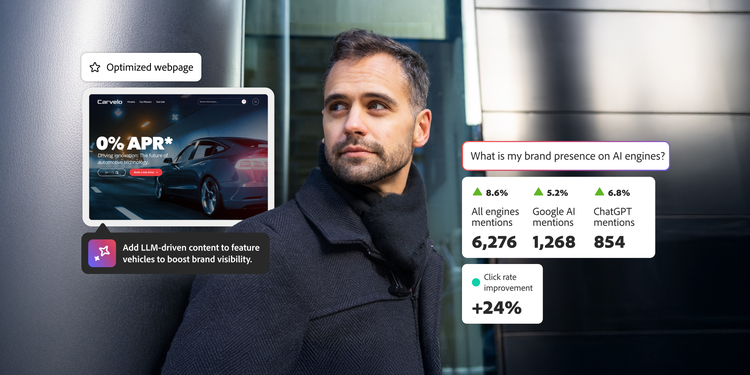
- Evaluate a platform like Adobe LLM Optimizer to facilitate the programmatic consumption of your content by LLMs.
- Review your media and influencer strategies to ensure they are consistent with your AEO/GEO approach.
The brands that master this new playbook won’t just keep pace — they’ll set the standard for customer experience in an AI-driven world. Ready to lead? Let’s make it happen.
Neerav leads Industry GTM strategy for automotive at Adobe, and is responsible for driving strategy, messaging and growth in our automotive segment. In this role, he partners with Adobe leaders to shape and coordinate Adobe’s go-to-market for the industry, as well as advise our largest global customers on their digital transformation needs. Prior to joining Adobe, Neerav worked in the automotive industry, leading global teams across strategy, product development, and product management.
Russell is a member of IBM’s Industry Diamond community, driving IBM’s global Automotive strategy relating to Customer Experience. With over 10 years of experience in the Automotive industry, he has delivered major transformation projects for global automakers, whilst authoring several whitepapers and addressing audiences at IAA, CES, and Goodwood Festival of Speed.