At Adobe Government Forum, we announced an important milestone for federal agencies — Adobe Experience Manager Edge Delivery Services now supports deployments requiring FedRAMP (Federal Risk and Authorization Management Program) authorization.
For agencies modernizing citizen, veteran, and military-facing websites, this removes a long-standing tension between innovation and compliance. Teams no longer must choose between moving fast and operating inside trusted federal security boundaries. With Edge Delivery Services, they can do both.
Federal digital transformation is accelerating. Agencies are under pressure to improve service delivery, strengthen security posture, reduce operational overhead, and demonstrate long-term efficiency. At the same time, constituents expect intuitive, responsive digital experiences that match what they encounter in the private sector. Edge Delivery Services was designed for this moment.
Modern architecture built for federal requirements.
Edge Delivery Services delivers a modern and responsive user experience and CDN-based architecture that shifts delivery closer to the edge. This approach reduces infrastructure complexity, improves performance, and minimizes the application threat surface.
With FedRAMP, agencies can now quickly deploy this architecture in environments that meet federal compliance requirements.
The result is a foundation that is:
- Secure and compliant by design
- Enterprise-ready and scalable
- Tailored to modern development workflows
- Flexible enough to support a range of mission needs
This isn’t simply an incremental improvement to legacy content management system (CMS) models. It represents a structural shift in how federal websites are modernized, delivered, and operated.
Reframing the CMS conversation in government.
For years, enterprise CMS solutions in government have carried a perception challenge — they’re expensive to license, expensive to support, complex to maintain, and heavily dependent on systems integrators.
Edge Delivery Services changes that equation.
Rather than requiring significant infrastructure investment upfront, agencies can rightsize their deployment based on actual traffic and usage patterns. The content request model aligns cost with demand, making it easier to begin with a focused deployment and scale over time.
Just as importantly, the architecture reduces operational overhead. Agencies gain a modern foundation designed for long-term efficiency and adaptability, without compromising on compliance or security.
Modern authoring for mission-critical moments.
Technology architecture matters. But in government, operational agility matters just as much.
During a panel discussion at the Adobe Government Forum, one example resonated strongly — updating a website during an emergency. Consider a military base preparing for severe weather. A public health agency issuing urgent guidance. Or a transportation authority announcing immediate closures.
Historically, publishing those updates often required submitting a ticket to a systems integrator, waiting for a developer, navigating HTML-based templates, and managing complex workflows. In a crisis, those delays were more than inconvenient — they were operationally significant.
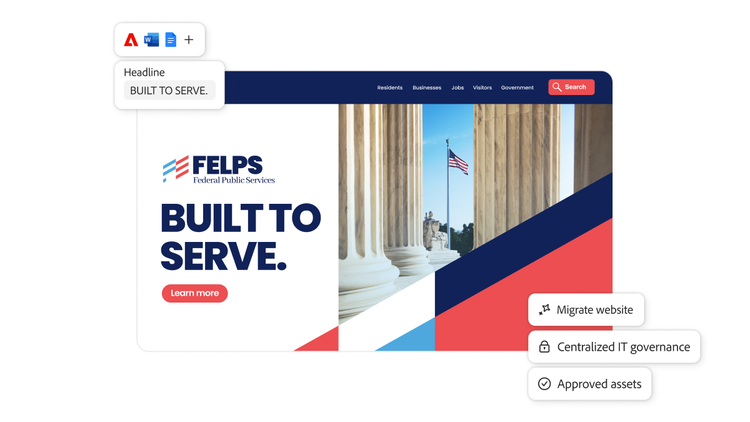
Edge Delivery Services expands authoring options to reduce that friction. One option is document-based authoring, which allows authorized staff to create and update content using familiar tools like Microsoft Word. Communications leads can update a structured document, trigger publishing, and see changes reflected quickly, without requiring HTML expertise or backend access.
Importantly, document-based authoring isn’t a replacement for traditional authoring models. It’s one option among several.
Agencies can choose:
- Document-based authoring for broader contributor access
- Traditional Adobe Experience Manager authoring interfaces
- Headless integrations for structured content delivery
- Hybrid approaches depending on mission requirements
This flexibility empowers agencies to expand publishing access, reduce dependency on external development resources, and maintain governance and compliance standards.
The goal isn’t simplification for its own sake. It’s modern authoring aligned to mission velocity.
AI-powered modernization in weeks, not months.
Modernization has historically required large, multiyear rebuilds led by systems integrators. That model is increasingly difficult to justify in environments focused on efficiency and measurable outcomes.
At Adobe Government Forum, we demonstrated how AI-driven modernization can accelerate that journey.
Adobe Experience Modernization Agent enables agencies to transform existing sites from platforms such as Drupal, WordPress, or other legacy CMS solutions into Edge Delivery Services in a fraction of the traditional timeframe.
Instead of starting from scratch, agencies can:
- Migrate and modernize existing content rapidly.
- Reduce reliance on large-scale rebuild cycles.
- Shorten time to value.
- Establish a scalable foundation for future growth.
This creates a lower-friction entry point into modernization and allows agencies to pursue transformation in manageable, outcome-driven phases.
Why this matters now.
Federal agencies are operating in an environment of heightened scrutiny around operational efficiency and long-term cost management. There’s an increasing focus on empowering agencies to take greater ownership of their digital infrastructure while still meeting stringent compliance requirements.
At the same time, site factory models — where organizations manage large portfolios of .gov or .mil properties — are growing in importance. These environments demand scalable, modular, and repeatable deployment models.
Edge Delivery Services, now supporting FedRAMP requirements, provides a pathway that unlocks these possibilities:
- Start with a single site.
- Accelerate migration using AI.
- Rightsize based on usage.
- Expand across additional properties.
- Engage partners where ongoing run and operate support is needed.
This modular approach mirrors how successful platforms enter and grow within federal ecosystems, beginning with focused use cases and expanding as value is demonstrated.
A new chapter for federal digital experiences.
FedRAMP support for Edge Delivery Services marks more than a compliance milestone. It signals a new chapter in how federal agencies can approach web modernization.
It’s secure. Scalable. Modern. Flexible in how teams author and manage content. Accelerated by AI-driven migration.
Federal agencies no longer must choose between compliance, performance, and agility. They can move forward with all three.
To explore how Edge Delivery Services can support your modernization journey, connect with your Adobe Public Sector representative to assess your current environment and identify a path forward that’s best for your organization.
Peter Parker is a senior product marketing manager for Adobe Experience Manager, where he leads go-to-market strategy and execution for AI and cloud security. He brings extensive experience in building and marketing emerging technologies, with a passion for helping customers and partners unlock the latest content innovations. Over his career, Peter has worked across the technology stack — from software development, product, to marketing and business strategy — serving industries such as software, fintech, cybersecurity, and biotechnology. He holds an MBA from the Smith School of Business and lives in the Bay Area, where he enjoys hiking and photography.