Powering the future of public sector with AI-driven citizen experiences.
Public sector organizations are entering a pivotal moment in digital transformation. Modernization is no longer defined by infrastructure upgrades alone. It is measured by how efficiently, equitably, and transparently agencies serve citizens across an increasingly digital-first landscape.
To understand how prepared the industry is for this shift, Adobe commissioned Incisiv to survey 543 public sector leaders across nine global markets, with 53% at the VP level or above. The research reveals a growing gap between what citizens now expect from digital government and the foundations agencies have in place to deliver it — particularly across personalization, trust, data integration, and AI readiness.
Citizen expectations are outpacing personalization readiness.
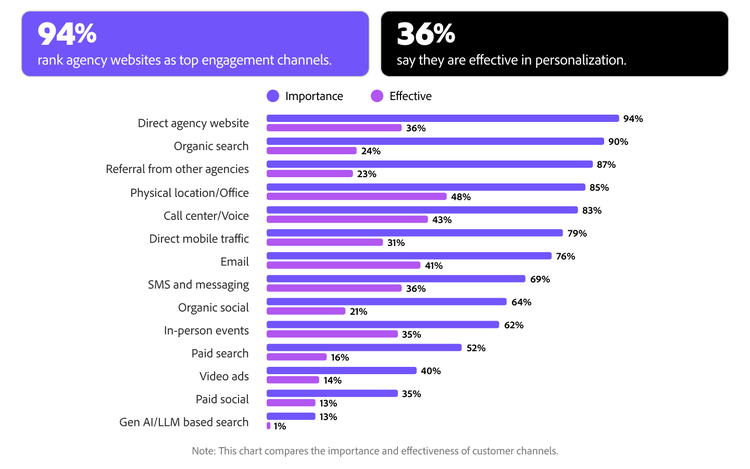
Citizens increasingly rely on digital channels to access essential services — from tax filing to benefit enrollment — yet personalization across these experiences remains limited. Although agency websites are ranked as the most important engagement channel by 94% of leaders, only 36% say these sites are effective at delivering personalized experiences. The same disconnect appears across organic search, mobile, and referral channels, weakening service discovery at the moments that matter most.
This imbalance highlights a structural challenge — while agencies understand which channels matter, personalization capabilities have not been operationalized within them. As generative AI-based search emerges, these gaps will only widen unless contextual relevance becomes embedded into the digital foundation rather than layered on as an afterthought.
Trust is now the prerequisite for digital service success.
In the public sector, trust is no longer assumed — it must be continuously earned. Nearly all leaders say privacy and data protection are now the top citizen expectations, while 96% report that citizens demand transparent access to information.
Yet fragmented platforms and inconsistent consent frameworks undermine even the most well-designed services. When citizens cannot clearly see how their data is used or protected, confidence erodes. In government, the impact of this erosion extends beyond a single interaction — it weakens institutional credibility across agencies.
Embedding secure document workflows, standardized identity management, and transparent privacy language directly into experiences is no longer optional. Trust must be clearly visible, not implied.
Citizens share data when the value is clear.
While hesitation around advanced technologies remains, the research reveals that citizens are far more willing to share data when the outcome is tangible. Nearly 79% of leaders say citizens will share information to improve service speed and efficiency. Similarly, high willingness is reported for smoother application processes, faster response times, and improved citizen support.
By contrast, lower willingness is seen for generative AI chatbots and agentic services when benefits are not clearly explained. This confirms that the core challenge is not technological risk, but narrative clarity. Agencies that communicate purpose — explaining what data is used, why it matters, and how it benefits the citizen — can transform skepticism into confidence.
Personalization fades beyond the point of service.
Citizen journeys are rarely linear. The research reveals that more than 10 interactions typically occur before a service request is completed. Despite this complexity, only 17% of agencies say the service request phase is personalized, and just 8% report any personalization during retention or follow-up.
This transactional mindset sends a clear signal to citizens — once a form is submitted, the relationship ends. For agencies built on trust and continuity, this represents a missed opportunity. Post-service follow-ups, renewal reminders, and contextual guidance can become powerful levers to reinforce trust and extend engagement beyond the transaction.
How organizational design is holding back citizen experience.
Despite growing demand for citizen-centric digital services, most agencies still organize information around internal departments rather than how citizens actually navigate government. Only 3% of public sector organizations are currently structured around the citizen journey, even though 10% say this is the ideal state.
This function-first model fragments content, creates duplication, and prevents teams from seeing the full citizen context across services. As a result, personalization remains limited, outreach is inconsistent across agencies, and opportunities to proactively guide citizens to relevant programs are routinely missed.
Shifting to journey- and geography-aligned operating models is foundational to citizen-first service delivery. Agencies that realign teams, content, and platforms around real-world citizen pathways are better positioned to deliver relevant, connected experiences at scale.
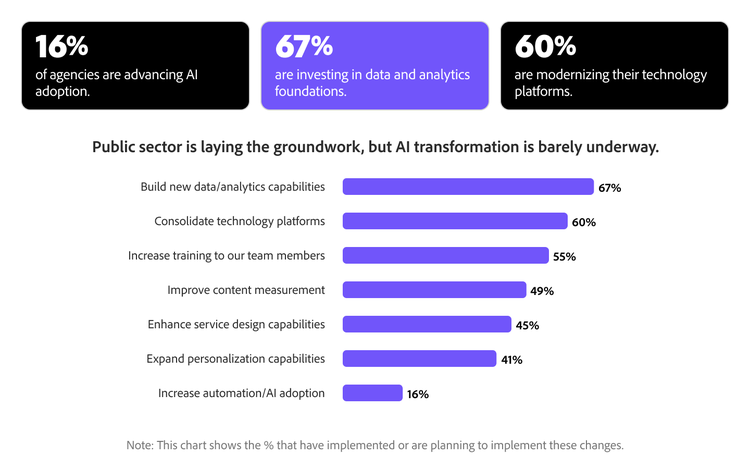
Public sector leaders are committing to modernization. While 67% cite budget constraints as the top challenge and 34% highlight difficulties integrating legacy and new systems, agencies are still pushing forward. Two-thirds are strengthening data and analytics foundations to prepare for more advanced digital services.
This reveals a critical dynamic — agencies are building the foundation for AI, but not the runway for takeoff. As a result, only 16% of agencies say they are advancing AI platforms today, leaving most stuck in preparation mode rather than activation.
The path forward is not more pilots but a tighter alignment between modernization and deployment. Agencies that connect data and analytics investments directly to AI use cases, integration plans, and governance frameworks will be best positioned to turn foundational progress into measurable citizen impact.
The road ahead: Building AI-ready citizen experiences.
To close the gap between rising citizen expectations and operational reality, public sector leaders must focus on three priorities:
-
Unify citizen data to enable contextual personalization:
Break down fragmented data environments to create a connected view of citizen interactions across agencies, channels, and lifecycle stages — enabling intent-driven personalization beyond static portals.
-
Make trust visible across every interaction:
Standardize consent, simplify privacy language, and ensure citizens can clearly see how their data is used, protected, and governed across digital services.
-
Govern AI with integrity, not just compliance:
Embed validation workflows, transparent logic, and accountable review structures into all AI-generated content so automation never outpaces public trust.
The future of public sector service delivery will be defined not by digitization alone, but by how responsibly and intelligently governments connect with their citizens.
Explore the full report to see how agencies are modernizing citizen services and scaling AI responsibly in an AI-driven world.