The non-funnel shopper: Why 86% of shoppers make unplanned purchases every month.

This post will cover:

Summary of key findings.

  • The impulse economy: About 86% of shoppers make unplanned online purchases every month, and nearly one in five respondents spend over $1,800 annually on these buys.
  • Fast-acting industries: Consumers in the beauty and health or wellness sectors are the most likely to make purchase decisions within minutes or seconds due to impulsivity.
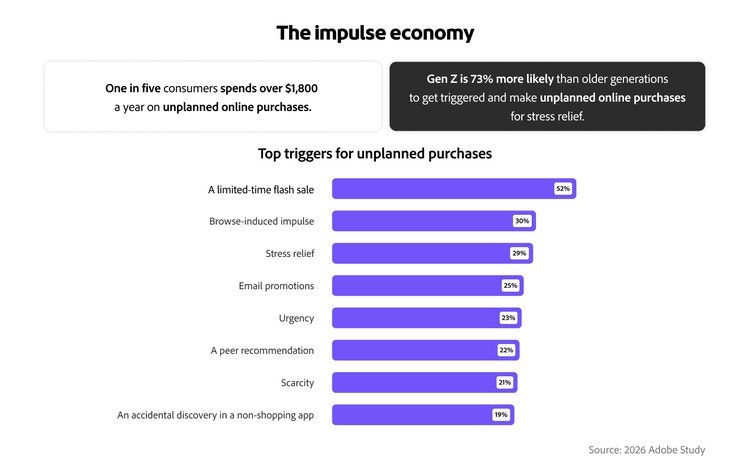
  • The stress relief trigger: Gen Z respondents are 73% more likely than older generations to be triggered and make unplanned online purchases for stress relief.
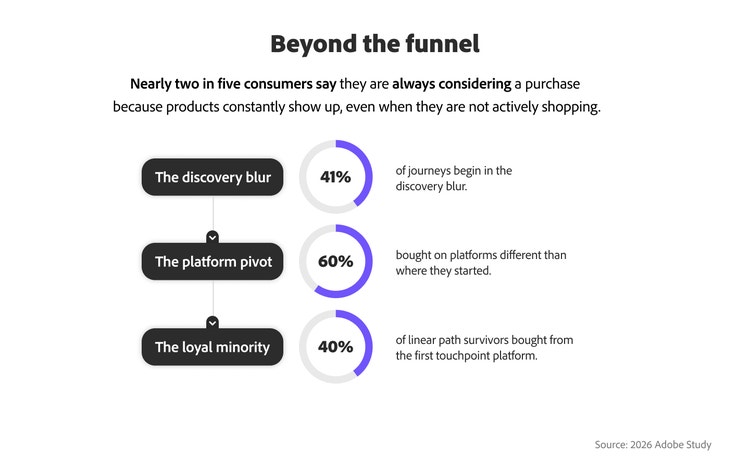
  • Blurred discovery paths: Product discovery is becoming a blur as 41% of shoppers no longer recall their first touchpoint, and 60% of those who do remember switched devices, digital channels, or platforms before buying.
  • Conversion via engagement: More than seven in 10 shoppers make a purchase after first discovering a product through organic content on platforms like YouTube, Instagram, and TikTok.
Connecting with the modern shopper.

You weren’t planning to shop, but you bought something anyway. That’s now the norm — 86% of shoppers say they make unplanned online purchases every month, often discovering products while scrolling, streaming, or browsing social media.

Impulse buying isn’t the exception — it’s the default. People are discovering products in everyday digital moments, often on platforms not designed for shopping. If brands don’t connect quickly, the opportunity disappears just as fast.

To understand what’s driving this shift, Adobe surveyed over 1,000 shoppers on how they discover and act on unplanned purchases. What we found challenges everything brands think they know about the path to purchase and points to a clear opportunity for those willing to rethink how they use customer analytics.

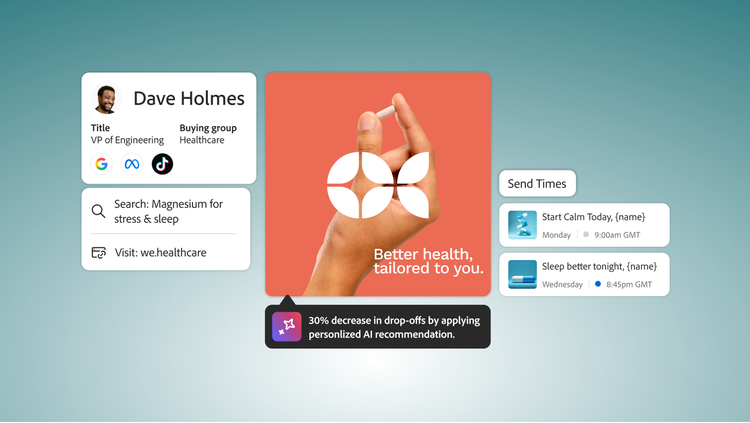
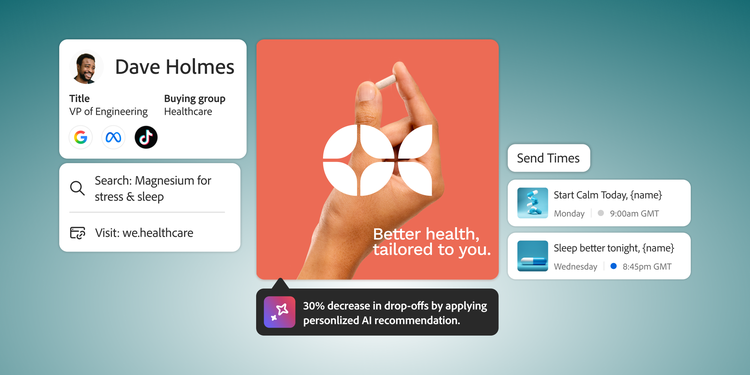
Reaching the non-funnel shopper requires more than great products and well-timed ads. Brands need visibility across fragmented journeys, especially when 41% of shoppers can’t recall where their journey began. Adobe Customer Journey Analytics helps connect those interactions across channels, turning scattered discovery into a clear view of what actually drives purchase.

Turning impulsive buyers into loyal customers.

Turning impulse purchases into long-term loyalty starts with understanding what triggered the purchase in the first place, not just where it happened. When marketers can connect those moments across channels, it becomes much easier to create experiences that feel relevant and give shoppers a reason to come back.

Infographic showing top triggers for unplanned purchases, led by flash sales (52%) and stress relief (29%).

These triggers highlight a key shift: purchases are driven less by need and more by context, emotion, and timing.

Impulse buying is now a dominant behavior. More than one in five shoppers make five or more unplanned purchases each month, often within minutes of discovery. Some categories are much more likely to spark those quick decisions than others. Below are the top impulse-buy categories, where shoppers were most likely to complete a purchase within minutes or seconds of discovering an item:

  • Beauty: 48%
  • Health and wellness: 37%
  • Media: 35%
  • Apparel: 33%
  • Toys and games: 25%
  • Software: 15%

Gen Z shoppers are 73% more likely than older generations to say stress relief drives impulse purchases, and are 20% more likely to respond to limited-time flash sales. These patterns show how different groups of audiences respond to specific triggers — an insight brands can use to act in the moment, not after it passes.

For brands trying to make sense of that behavior, the bigger challenge is connecting signals across channels. When 41% of shoppers cannot remember where their journey started, marketers need a better way to understand what happened between discovery and purchase. Adobe Customer Journey Analytics helps bring that earlier discovery phase into focus, giving teams a clearer view of how interactions across social media, apps, and other touchpoints build toward action.

When brands connect behavioral, digital, and customer analytics, they can do more than track discovery — they can understand what drives it. That visibility makes it easier to re-engage shoppers and turn one-time purchases into long-term loyalty.

The path to purchase is no longer linear, and brands that treat it that way will miss key moments. Brands must connect interactions from the non-commercial platforms where discovery often starts, such as YouTube and Instagram, and then use digital analytics to understand how those moments influence purchase. With a stronger view across channels, marketers can build omnichannel strategies that keep their brand relevant along the unplanned path to purchase.

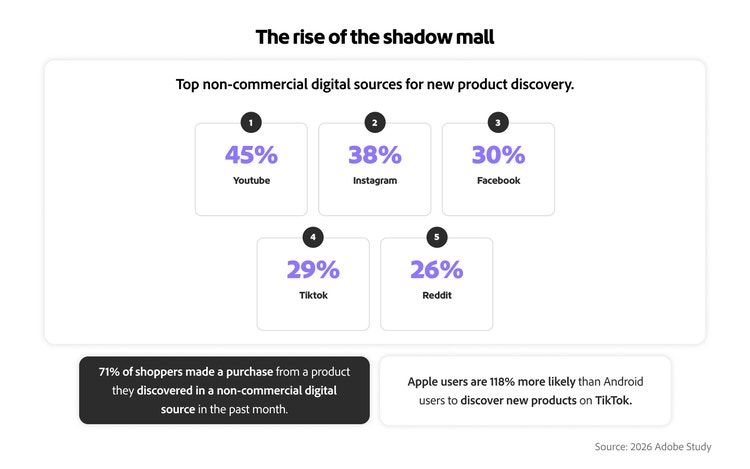
Infographic showing top non-commercial digital sources for product discovery, led by YouTube (45%) and Instagram (38%).

Discovery varies widely by platform and audience.

Men are more likely to discover products on YouTube, while women favor Instagram. TikTok shows the strongest generational divide, with usage jumping significantly among Gen Z.

These behaviors play a big role in buying decisions — 71% of shoppers said they bought a product they first found through a non-commercial digital source like a video, social post, or an unexpected recommendation. This reinforces that discovery is happening outside traditional commerce environments, and brands need to show up there. Brands aren’t just competing on their own sites — they’re competing wherever shoppers pay attention.

Adobe Customer Journey Analytics is built to handle that kind of fragmented discovery. With report-time processing, teams can stitch together interactions across platforms, see how the journey unfolds, and adjust their view as new data comes in. Combined with stronger digital analytics and omnichannel marketing strategies, it becomes much easier to track where discovery is really happening.

The challenge is that many shoppers don’t have a clear sense of their own path. In fact, 41% of shoppers were unable to recall where their journey began, and while first-touch data may exist in a marketer’s tech stack, it rarely tells the full story. The interactions between discovery and purchase, especially those happening across social platforms and non-owned channels, are where traditional methods fall short. Customer and behavioral analytics help fill those gaps by connecting early touchpoints to eventual conversions and showing how interest builds across devices over time. The result is a more complete picture that supports better decisions across both consumer programs and B2B marketing analytics, especially when journeys are anything but linear.

The new digital shopping reality.

The traditional sales funnel no longer reflects how people actually shop. Many people are now discovering products as they scroll across different platforms and channels. As journeys fragment across platforms, 60% of shoppers end up buying somewhere different from where they started.

Infographic showing the fading traditional funnel, as 60% of consumers buy on platforms different from where they started.

Nearly half of consumers (45%) say always-on shopping feels overwhelming. As exposure increases, so does fatigue, making relevance more important than frequency. When people are constantly exposed to product suggestions, brands need to understand when engagement is building and when it’s breaking down.

Below are the most common steps consumers take to avoid digital shopping suggestions when overwhelmed:

  • Ignore the suggestions: 58%
  • Unsubscribe from marketing emails: 47%
  • Turn off notifications: 35%
  • Use ad blockers: 28%
  • Limit screen time: 25%
  • Avoid specific apps or websites: 24%

When shoppers feel overwhelmed, they don’t just disengage — they actively shut brands out.

Women are 11% more likely than men to unsubscribe from marketing emails, while men are 33% more likely to use ad blockers. When segmenting by generation, Gen Z is 35% more likely than older generations to limit screen time, with more than 3 in 10 Gen Z shoppers doing so when they’re overwhelmed by suggestions.

This is why the shift from high frequency to high relevance matters.

Adobe Customer Journey Analytics helps teams identify early signs of fatigue like declining click-through rates, drop-offs after repeated touchpoints, or rising unsubscribe rates across a segment, and adjust engagement before customers disengage.

When paired with tools like Adobe Real-Time CDP and Adobe Journey Optimizer, teams can act on those signals, timing outreach more effectively and adapting journeys in real time.

Mastering the platform pivot.

Brands that win will be the ones that can make sense of fragmented, unpredictable journeys. When the majority of shoppers buy on a different platform from where they started, siloed tracking is not enough. Marketers need a stronger view across channels, and that is where customer analytics, digital analytics, and omnichannel marketing become much more useful. Together, they help teams understand how discovery turns into action and where brands need to show up along the way.

Impulse purchases are emotional and moment-driven, not planned or convenient. With nearly half of consumers saying the always-on digital experience can be overwhelming, it’s important that interactions feel relevant and organic, meeting consumers in the moments that matter.

Behavioral analytics can help teams spot when engagement is starting to drop, while customer analytics makes it easier to understand what signals still point to real intent. That gives marketers a better chance of reaching people with messaging that feels timely instead of repetitive. For teams working across longer, more complex buying journeys, the same visibility can also strengthen B2B marketing analytics.

See how Adobe Customer Journey Analytics helps brands turn fragmented journeys into actionable insight — watch the overview video.

Methodology.

This article is informed by proprietary research conducted by Adobe. The study surveyed 1,003 consumers across the United States, providing a 95% confidence level with a ±3% margin of error. Respondents were asked about shopping decision-making. As with all self-reported data, results may reflect personal perceptions and experiences that could differ from actual behaviors.

Let’s talk about what Adobe can do for your business.

Get started

I'm the Adobe Assistant. How can I help you today?

1