In today’s data-driven landscape, brands are under pressure to deliver personalized experiences based on a customer’s previous interactions — without compromising on scale, governance, or agility. The integration of Adobe Real-Time CDP and Amazon Redshift is a game-changer, allowing enterprise marketers and data teams to bridge this gap.
How does Adobe Real-Time CDP access Amazon Redshift data?
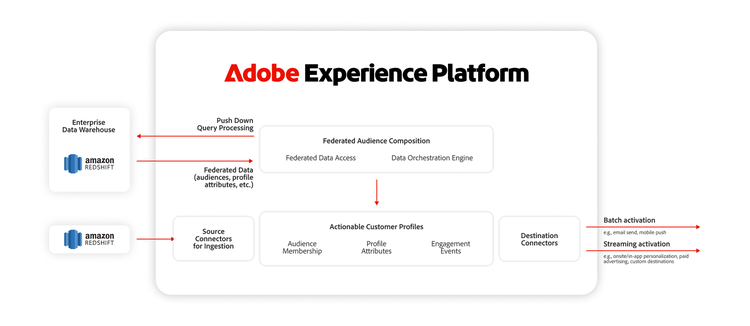
Adobe Real-Time CDP supports two pathways to connect to Amazon Redshift. Customers can either use a prebuilt connector to import data from Redshift directly into Real-Time profiles, or they can build audiences from Redshift datasets without copying underlying data.
The latter approach supports data composability, enabling marketers to manage and activate audiences using data outside of Adobe’s Real-Time CDP — without needing to move or replicate it. This is especially powerful for organizations that have standardized their data management on Amazon Redshift and view that system as their source of truth for customer data. With data federation, Adobe empowers brands to:
- Query external data sources directly using a marketer-friendly UI.
- Build audiences in real time without delays or data duplication.
- Maintain governance and control by keeping sensitive data in its original location.
- Activate audiences across channels via prebuilt destinations and native Adobe Experience Cloud applications.
Why Amazon Redshift is an ideal partner.
Amazon Redshift is one of the most widely adopted cloud data warehouses, trusted by enterprises across industries — from finance and retail to healthcare and gaming. Its architecture is optimized for high-performance analytics on structured data, making it ideal for audience segmentation and activation use cases.
Key benefits of Redshift include:
- Massively Parallel Processing (MPP) and columnar storage that enable faster query execution on large datasets.
- Petabyte-scale performance with seamless scalability and reliability.
- Deep integration with Amazon Web Services (AWS), through services like AWS Glue for ETL, Amazon S3 for data lakes, and Amazon Kinesis for real-time streaming.
- Zero-ETL capabilities that allow near real-time data movement from operational databases into Redshift
The power of integration.
By connecting Adobe Real-Time CDP with Amazon Redshift, brands can unlock a new level of agility and intelligence in their marketing operations:
1. Real-time audience activation.
Marketers can build audiences using historical transaction data stored in Redshift — such as past purchases, loyalty status, or propensity model output — and activate them instantly and consistently across channels. Additionally, audience memberships can be retained in real-time customer profiles to be available for instant personalization when triggered by a streaming customer interaction event.
2. No data movement, full governance.
Sensitive or regulated data can remain in Redshift, ensuring compliance with internal policies and external regulations. Real-Time CDP queries the data in place to build aggregated audiences, reducing risk and complexity.
3. Unified data strategy.
This integration supports a composable architecture where Redshift acts as a cloud data warehouse source of truth, alongside Real-Time CDP to provide a powerful experience layer. Together, they enable brands to unify their data and deliver personalization at scale using best-in-class technology providers.
4. Accelerated time to value.
With Redshift’s performance and Real-Time CDP’s audience-building capabilities, teams can quickly go from data management to audience creation and activation for critical marketing initiatives.
Integration patterns.
Unlocking these benefits is straightforward. Customers can set up a connection from Adobe Real-Time CDP to Amazon Redshift by choosing one or both of the following paths:
- Data federation via Federated Audience Composition.
Federated Audience Composition enables customers to create and update Adobe Real-Time CDP audiences directly from Amazon Redshift — without any ingestion process. This is accomplished by creating a connection to Redshift, then designing and creating data models that define the structure, relationships, and constraints of the data being federated. Next, the data is transformed to fit intended applications, followed by the creation and orchestration of audiences for specific use cases. Step-by-step instructions for integrating Amazon Redshift with Real-Time CDP via Federated Audience Composition are available on Adobe Experience League.
- Direct dataset ingestion via prebuilt source connector.
Direct dataset ingestion allows brands to copy raw data from Amazon Redshift for audience creation in Adobe Real-Time CDP. This approach is appealing for brands that want to work with raw data to build granular audiences in Real-Time CDP when leveraging Real-Time CDP purpose-built AI, and for copying critical datasets to power low-latency use cases. Add IP addresses to an allowlist, then connect Amazon Redshift using APIs or the UI. Users will then create a dataflow for Redshift source data and schedule ingestion runs at a cadence they choose for use case requirements. Step-by-step instructions for the Amazon Redshift source connector are available on Adobe Experience League.
Use case spotlight: retail personalization.
Imagine a retail brand using Amazon Redshift to store real-time inventory and purchase data, and Adobe Real-Time CDP to power consistent personalized experiences across channels. The retail brand can:
- Build an audience of high-value customers who purchased in the last 24 hours.
- Cross-reference inventory data to promote in-stock complementary items for cross-sell.
- Launch personalized campaigns via email, push, and paid media — all without moving raw transaction or inventory data out of Redshift.
Final thoughts.
The integration between Adobe Real-Time CDP and Amazon Redshift exemplifies the future of composable, federated marketing technology. It empowers brands to harness the full power of their data — wherever it lives — and deliver personalized experiences at scale, securely and efficiently.
Whether you're a data architect, marketing leader, or product owner, this is a strategic opportunity to modernize how you build and activate audiences and unlock value from your enterprise data investments. To learn more, please contact your Adobe account team for a demo today.
Matt Skinner is Director, Product Marketing for Adobe Real-Time CDP. In this role, he leads a team driving strategy and go-to-market for Adobe's industry-leading customer data platform. He joined Adobe in 2016. Prior to this, Matt spent 10 years in media buying and media strategy, both agency and client-side, with a focus on integrated digital marketing.
Ranjith Raman is a Principal Partner Solutions Architect at AWS leading the technical strategy for business applications partnerships at AWS. Ranjith specializes in helping enterprise software companies leverage the power of AI and cloud technologies to drive digital transformation. In his role, he is responsible for driving strategic technical decisions and providing architectural guidance to help partners leverage AWS's comprehensive suite of services. Ranjith collaborates closely with enterprise software companies to develop innovative solutions that address complex business challenges and deliver measurable value to joint customers. His focus areas include artificial intelligence, cloud architecture, and business applications. Ranjith joined AWS in 2019, and is based in Dallas, TX.