







What CMOs and CIOs need to know about the ROI of personalization at scale.
Turn personalization into business impact.
Many organizations struggle to prove the ROI of personalization at scale. This guide, based on data from an Adobe-commissioned Forrester report, provides actionable insights for CIOs and CMOs to prove ROI on their investments. Learn from Experience Leaders and apply relevant strategies around buyer intent, zero-party data, and generative AI to transform personalization into a competitive advantage.
CMOs face mounting pressure from customers to deliver personalized experiences at scale, while CIOs are tasked with enabling that delivery through technological innovation. Even with the right technologies and strategies in place, many organizations struggle to prove ROI from their personalization investments.
Our commissioned study conducted by Forrester Consulting, How to Improve the ROI of Personalization at Scale in the Era of AI, shows that most organizations have increased personalization investments over the last three years to create more relevant, meaningful customer experiences.
But as these strategies expand, the data reveals a key insight — not every moment is the right one to personalize.
To unlock personalization’s full potential, organizations must focus on when and where it will have the greatest impact.
Three key takeaways to improve ROI through better personalization.
1. Personalization strategies are not consistently meeting buyer expectations.
Close to three-quarters of buyers expect organizations to personalize interactions based on their preferred timing, channels, and context. However, many are left feeling disappointed, often finding these experiences irrelevant or even invasive.
Understanding customer context is crucial for delivering relevant, valuable personalized experiences. When organizations fall short, they risk alienating customers with poorly timed or misaligned interactions.
of organizations prioritize understanding customer context when personalizing experiences.
2. Organizations have made significant advancements in personalization capabilities since 2022.
While many organizations may not be prioritizing the finer points of personalization, the Forrester study shows they’re increasingly adopting an enterprise-wide approach. They’re also more likely to treat personalization at scale as a strategic initiative, use more first-party data, and activate it across a broader range of touchpoints.
of organizations have C-level support for personalization strategies in 2025, compared to just 70% in 2022.
of organizations are more likely to have an enterprise-wide approach to personalization in 2025, compared to just 21% in 2022.
3. Experience Leaders shape the future of personalization at scale.
Experience Leaders — respondents from the most advanced organizations — are defined by their ability to consistently deliver the right personalized experiences at the right moments. They’ve achieved this by using data to understand customer needs, creating content to support those desired experiences, and empowering customers to guide their own journeys.
As a result, Experience Leaders can more easily demonstrate the ROI of personalization strategies compared to organizations that are in the earlier stages of personalization initiatives. Organizations that follow in the footsteps of Experience Leaders see stronger business outcomes by using advanced personalization to deliver customer-centric experiences.
of Experience Leaders reported higher-than-expected cost savings from personalization efforts, compared to just 40% of other organizations.
of Experience Leaders reported higher customer lifetime value because of personalization efforts, compared to just 46% of other organizations.
Three challenges of proving personalization ROI.
Long-term cost justification.
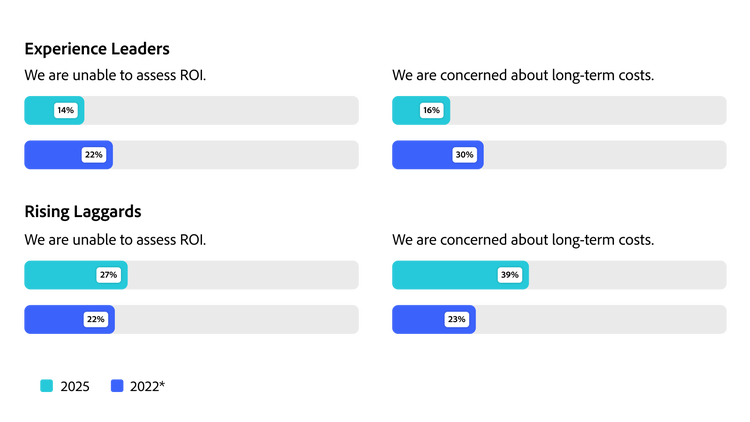
Many organizations struggle to justify the long-term costs of personalization programs. However, Experience Leaders outperform their peers not only by justifying long-term costs and demonstrating ROI, but also by putting strong frameworks in place. Organizations must develop similar frameworks to measure the long-term benefits of personalization, including customer lifetime value and retention rates.
Assessing impact across multiple touchpoints.
Personalization efforts often span multiple teams and touchpoints, making it difficult to measure their collective impact. A holistic measurement approach — one that evaluates efforts across short-, medium-, and long-term metrics — can give organizations a clearer view of personalization’s overall effectiveness.
Data deprecation and privacy concerns.
The deprecation of third-party data and increasing privacy regulations are making it harder for organizations to collect and use customer data effectively. By using zero-party data and contextual signals, organizations can overcome these challenges and strengthen their personalization strategies.
of B2C marketing decision-makers say it will be difficult to understand the behaviors, attitudes, motivations, and context of their high-priority customers and prospects over the next 12 months.
Organizations' challenges with implementing/ expanding personalization at scale
Recommendations for stronger personalization outcomes.
To gain meaningful results from personalization at scale, focus on the following strategies:
-
Understand and respect customers.
Focus on delivering relevant, valuable interactions spanning functional, economic, experiential, and symbolic (or meaningful) dimensions.
-
Personalize using buyer intent.
Tailor personalization to the later stages of the customer journey, where buyers find greater value, and prioritize their goals over business objectives.
-
Demonstrate value with data.
Prove to customers that sharing data leads to real value by using zero-party data to shape personalization strategies and enhance their experiences.
-
Measure personalization impact.
Implement a holistic measurement approach to assess the impact of personalization programs across short-, medium-, and long-term metrics.
-
Scale personalization with generative AI.
Tap into generative AI to deliver timely, relevant interactions through real-time context, intelligent content creation, natural language interfaces, and application assistants.
of decision makers plan to boost internal and external personalization investments by 10% or more in the next two years.