Agile marketing helps teams identify the highest-value Projects and concentrate their resources accordingly. Working collaboratively, teams complete Projects, evaluate their impact, and continuously refine their approach to achieve stronger results.
In this guide:
- What is Agile marketing?
- How does Agile marketing work?
- The benefits of Agile marketing
- How to implement Agile marketing methodology
- Is Agile marketing right for me?
- How can Agile marketing help my business in the long run?
What is Agile marketing?
Agile marketing is a tactical approach in which teams collaborate to identify high-value Projects and direct their efforts collectively. Central to this methodology are self-organisation, experimentation, and delivering work in short, focused bursts – making it both fast-paced and adaptable.
Agile marketing teams complete Projects using sprints – brief, high-intensity periods designed to address specific tasks. Sprints enable teams to experiment, adapt under pressure, and deliver results quickly. After each sprint, managers assess performance, identify Insights, and apply these learnings to continuously improve future Projects.
Consider a marketing team tasked with increasing webinar sign-ups. Rather than launching a single large campaign, the team breaks the work into sprints. In the first sprint, they test two email subject lines to determine which drives higher open rates. In the second, they refine their landing page based on click-through data. By the end of the sprints, the team has not only achieved higher webinar registrations, but also gathered valuable Insights for future campaigns.
More broadly, Agile is a project management methodology centred on speed and adaptability. Unlike Kanban, which prioritises a smooth workflow, or Waterfall, which relies on rigid, top-down structures, Agile thrives on flexibility and rapid iteration.
How Agile marketing compares to traditional marketing approaches
Agile marketing and traditional marketing differ in several key ways:
- Traditional marketing depends on fixed, long-term plans and large-scale campaigns, often committing teams to strategies that are difficult to adapt when circumstances change.
- Agile marketing, by contrast, prioritises flexibility and iterative progress, enabling teams to respond quickly to shifting market conditions.
This adaptability enables Agile teams to experiment, learn, and refine their strategies in real time – maximising value and driving results in ways that traditional methods simply cannot match.
How does Agile marketing work?
Agile marketing is built on frequent output and regular recalibration. Though carefully planned, it prioritises flexibility and experimentation, allowing teams to adapt swiftly and make data-driven decisions.
A core principle of Agile marketing is audience prioritisation. By responding swiftly to changing conditions, teams can implement highly targeted strategies that deliver results.
On occasion, Agile teams may conclude that a Project did not deliver sufficient value and choose not to repeat it. Far from being a failure, this is a positive development – understanding what does not work provides valuable Insights that can lead to stronger outcomes in the future.
The Agile marketing approach is guided by key values:
- Responding to change over rigidly following a plan
- Rapid iterations over large, one-off campaigns
- Testing and data over opinions and assumptions
- Multiple small experiments over a few big bets
- Individuals and interactions over broad, impersonal markets
- Collaboration over silos and hierarchy
At its heart, Agile marketing is about delivering value through iterative learning and adapting on the basis of experimental outcomes – not simply operating at pace. Rather than rushing through tasks, Agile teams focus their energy on high-impact efforts that yield measurable, meaningful results. The underlying principle is clear: work smarter, not harder.
What are the benefits of Agile marketing?
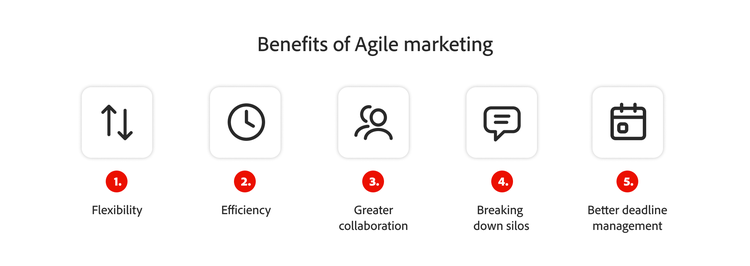
1. Flexibility
Agile marketing equips teams to identify and address issues as they arise. Whether that means adapting messaging, shifting project priorities, or responding to unexpected business needs, the Agile approach is built on adaptability.
2. Efficiency
Agile processes give every team member a clear picture of what needs to be done, who is responsible, and when it will be completed. This shared clarity removes confusion and keeps projects progressing without delay.
3. Greater collaboration
Adapting and iterating on marketing plans in real time depends on clear communication, alignment, and shared expectations across the team. The Agile methodology fosters exactly this kind of collaboration, ensuring all team members remain aligned.
4. Breaking down silos
In modern organisations, marketing must integrate across all departments. Agile transformations naturally promote cross-functional relationships and efficient communication, reducing the risk of departmental silos.
5. Better deadline management
Agile processes support marketing teams in setting – and consistently meeting – deadlines. As teams demonstrate reliability and deliver results, stakeholders are more likely to grant them greater autonomy.
For teams with sufficient influence, meaningful workflow improvements can be achieved through advanced tools such as WIP (work-in-progress) limits in methodologies like Kanban or Scrumban. These tools accelerate results but demand a high degree of team independence to be effective.
What are the customer benefits of Agile marketing?
Beyond improving workflows, Agile marketing also enhances the customer experience, delivering benefits such as:
- Faster response to needs: Agile teams adapt swiftly to market changes, ensuring customers receive timely, relevant communications.
- Personalised messaging: Iterative testing enables marketers to refine campaigns in line with customer preferences and behaviours.
- Improved engagement: Data-driven decisions produce engaging, valuable campaigns tailored to audience needs.
- Seamless experiences: Cross-functional collaboration ensures consistent messaging across platforms, delivering a unified customer journey.
- Transparency and trust: Agile teams communicate clearly during periods of change, building customer loyalty.
- Continuous value: Agile’s iterative approach keeps campaigns relevant and continually improving, enhancing customer satisfaction.
Agile marketing success is about more than completing sprints or working at pace – it is about delivering results that align with your objectives. Agile methods make it straightforward to track meaningful metrics, such as:
- Sprint velocity: Whilst speed alone is not the defining measure, tracking the volume of work completed in each sprint provides insight into the efficiency and effectiveness of your efforts. This helps teams maximise productivity and identify bottlenecks.
- Campaign ROI: Assessing the return on investment for Agile-driven campaigns enables your team to make data-driven decisions, ensuring resources are allocated effectively to maximise impact.
- Customer engagement rates: Monitoring how customers respond to Agile-optimised initiatives – such as email campaigns or website updates – helps measure the success of your strategies and refine them for better engagement.
Analytics platforms such as Adobe Analytics play a central role in visualising these KPIs, helping teams maintain focus and deliver value. They also offer the flexibility to adjust strategies as market conditions or customer behaviours evolve.
Challenges in Agile marketing and common missteps to avoid
Agile marketing offers both flexibility and efficiency, enabling teams to make informed decisions in a constantly evolving marketing landscape. In principle, it’s a sound approach – but implementation can present its own challenges.
Common pitfalls teams encounter include:
- Resistance to change
- Poorly defined goals and overloaded sprints
- Difficulty integrating or adapting to iterative workflows
- Inconsistent communication, which can undermine collaboration and create bottlenecks
- Overloading your team with too many projects or deviations, reducing productivity
Identifying and addressing these issues at an early stage – and putting measures in place to prevent them altogether – helps teams progress more smoothly and achieve successful Agile adoption.
Implement Agile marketing methodology
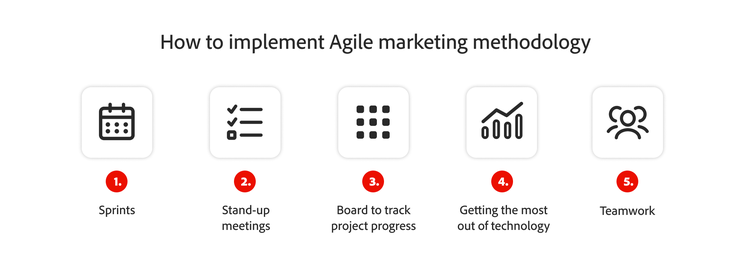
1.
A sprint defines the timeframe in which your team completes their ongoing work. Typically, sprints last between two and six weeks. Larger initiatives may span more than one sprint, so it can be helpful to break these down into smaller, more manageable tasks to tackle across multiple sprints.
Two. Stand-up meetings
Each day, your team should gather for a brief stand-up meeting lasting no more than 15 minutes. Every team member should summarise what they completed the previous day and outline their priorities for the day ahead. They should also raise any issues or blockers that need to be resolved.
Three. Board to track project progress
Whether it’s a traditional whiteboard with sticky notes, a simple Kanban board, or specialised software, you need a centralised way to track your sprint.
Four. Getting the most out of technology
The right tools and platforms are essential to effective agile marketing. Task management tools such as Jira, Asana, or Trello help organise sprints and visualise project progress. Slack and Microsoft Teams support team communication, whilst platforms like Adobe Marketo Engage deliver data-driven insights into campaign performance to help refine strategies. Selecting the right technology stack supports smoother workflows and closer alignment with the core principles of agile marketing.
5.
Whilst individual team members may own specific tasks, the success or failure of each sprint is a shared responsibility. The ability to collaborate and support one another is fundamental to the Agile marketing framework.
What an Agile marketing department can do
- Respond swiftly to market changes
- Develop rapid campaigns that can be tested and optimised over time
- Test a wide range of approaches and build on what works
- Draw on cross-departmental input to strengthen marketing efforts
- Back campaign and project decisions with hard data
- Collaborate across the team to avoid a narrow, tunnel-vision approach to marketing
When you begin to assess opportunities on a project-by-project and sprint-by-sprint basis, the potential is almost limitless.
Is Agile marketing right for me?
Does your current marketing approach feel overly rigid? Are inflexible processes holding back your KPIs? Before adopting Agile marketing, take time to assess your team’s needs, challenges, and goals. Your ‘why’ should inform your ‘how’.
Where a team is overstretched, showing signs of burnout, or experiencing high turnover, the priority should be easing that burden – not introducing a methodology that demands extensive training or role changes, such as Scrum. Conversely, where a team is stable and ready for change, a methodology like Scrumban can provide a genuine competitive advantage.
When external interruptions are derailing projects, clear structure and boundaries are likely the answer. Where greater collaboration and adaptability are the goal, Agile methods may be the more natural fit. The key is selecting an approach that reflects what your organisation aims to achieve.
To establish whether Agile is the right fit for your organisation, consider the following questions:
One. Do I have the right team?
Your team is the foundation of any Agile marketing transformation. The individuals involved will determine whether the process succeeds or fails, so be realistic about their strengths and challenges.
Select your Agile methodology based on the team you have – not the ideal team you might wish for.
Two. Are my marketers willing to go Agile?
Change is only effective when people are receptive to it. Where a team is firmly attached to established ways of working, resistance is a real possibility.
In such cases, starting small with a lightweight approach such as Kanban can minimise disruption and ease the transition. Adaptability is essential, but cross-functionality matters just as much – a team’s willingness to experiment is as important as its skill set.
Three. Do I have cross-functional marketers?
Cross-functional teams are better placed to execute Agile projects independently. With a broad range of skills, they can manage the full lifecycle of a project without a constant reliance on external support.
For highly cross-functional teams, methodologies such as Scrum are well suited. For teams with more specialised skill sets, Scrumban or Kanban offer the flexibility and support needed.
Scaling Agile across teams
Agile is capable of scaling to support large teams and cross-departmental collaboration. For example:
- Large organisations can establish multiple Agile teams, each focused on specific goals but aligned through shared sprints and retrospectives.
- Cross-functional teams, including members from marketing, sales, and product development, can address broader organisational objectives.
Shared Kanban boards and integrated communication tools help maintain coordination across teams at scale.
Four. Do I have the right size team?
Team size should also inform your choice of methodology.
Scrum typically works best for teams of five to nine members, though teams as small as three, or larger departments divided into Scrum teams, can still benefit.
Kanban and Scrumban are more flexible and scale more readily, making them well suited to teams of all sizes – particularly if your organisation is new to Agile.
Five. Is Agile suitable for my business?
Agile marketing may not be the right approach if:
- Your work involves no uncertainty or change.
- You anticipate strong resistance to change within your organisation.
- Your current pace is slow, and that suits your needs.
Agile is designed to manage the uncertainty inherent in complex, knowledge-driven work. Where projects are predictable and requirements are fixed, Agile is unlikely to deliver significant benefits.
Pilot programmes can help assess Agile’s value without requiring full-scale commitment. Assemble a small, motivated team and trial Agile on a content marketing or social media campaign. Review the results and scale up where the approach proves effective.
How can Agile marketing help my business in the long run?
Getting to grips with a genuine Agile marketing system takes time, and your first sprint is likely to feel more like a crawl.
Over time, Agile marketing can help marketing departments of virtually any shape and size to:
- Be more efficient
- Serve customers better
- Integrate more fully into the wider business
Agile is also gaining considerable momentum in marketing circles. This kind of flexibility:
- Speeds up the production and approvals processes
- Reduces the amount of time spent in meetings
- Minimises the time creative staff spend on non-creative work
Creative teams that find the right solution for managing their Agile marketing process will be among the first to benefit from this growing trend.
Adobe can help your team switch to Agile
For teams ready to make the switch to Agile marketing, Adobe is on hand to help. Adobe Marketo Engage is a marketing automation platform that helps your team manage leads, personalise the customer experience, and analyse your efforts to inform data-driven decisions. It supports Agile marketing by enabling teams to assess quickly the effectiveness of each piece of content and how well their customer journeys are performing.
Watch an overview or take an interactive tour to find out how Adobe Marketo Engage can support your marketing team.