Agile retrospectives – complete guide

Adobe for Business Team

05-28-2025

Three women having a conversation. Overlaid with a chart showing retrospective results.

Agile’s iterative approach delivers tangible value across industries seeking a more efficient and effective project management process. Organisations are increasingly adopting Agile practices both within and beyond software development.

During initial implementation, retrospectives are frequently overlooked within the Agile process. Yet they are essential to sustaining communication and efficiency. Retrospectives deliver 24% higher responsiveness and 42% greater quality compared to Agile teams that omit this step.

This article examines what an Agile retrospective is, how these meetings can support your existing processes, and how to facilitate a retrospective effectively.

In this guide:

What is an Agile retrospective?

An Agile retrospective is a meeting held at the end of an iteration of work, typically a sprint. It’s a dedicated space for team members to discuss achievements and areas for improvement as they plan for the next phase of project work. Team members are encouraged to speak candidly about their experiences and reflect on processes, procedures, and tasks, so the broader team can benefit and improve over the long term.

Retrospectives form part of the Scrum framework, comprising the fourth and final meeting outlined in the process. Scrum fosters collaboration and communication within and across teams through a series of meetings designed to encourage open discussion. These focus on both successes and obstacles, helping the team to optimise its performance going forward.

Agile retrospective meetings should focus on the tasks completed during the iteration or sprint. The aim is to identify areas for improvement to apply in the next phase of the project, or to highlight effective approaches that could benefit other team members. When applied to Scrum, these meetings also bring together contributors from various teams, enabling knowledge sharing in a wider forum.

Teams using Kanban can also benefit from conducting retrospectives. Although not an official part of the workflow, incorporating a retrospective can help contributors find ways to work more effectively as projects progress.

How is an Agile retrospective different from other meetings?

What sets an Agile retrospective apart from other meetings – such as reviews or postmortems – is its position within the iterative development or project process. Retrospectives take place at the end of a sprint, or iteration, that forms part of a larger project.

The goal is to refine workflows and approaches whilst the broader initiative remains in progress. This allows teams to adapt and become more efficient during work, rather than after the entire workload is complete.

Agile retrospective vs. sprint retrospective

There is an important distinction between an Agile retrospective and a sprint retrospective. Despite appearing interchangeable, the two terms refer to different stages and processes.

Aspect
Sprint retrospective (Scrum)
Agile retrospective (general)
Framework
Specific to Scrum
Any Agile framework
Timing
End of each sprint
End of sprint, release, or milestone
Focus
Team process improvement for next sprint
Team/process improvement at any point
Attendees
Scrum team only
Any agile team, may include others
Frequency
Every sprint
Flexible

Sprint retrospective is a specific type of Agile retrospective that occurs at the end of each Scrum sprint, with a focus on team process improvement.

Agile retrospective is a general term for any reflection meeting in Agile, not limited to Scrum or sprints.

The importance of Agile retrospectives

Adding another meeting to the schedule may not seem appealing at first, yet Agile retrospectives offer considerable advantages. They serve as a dedicated forum for exchanging ideas – something rarely accommodated by other project management methodologies.

Retrospectives encourage individuals to voice their views and share feedback with a wider audience. In doing so, they help refine the processes that affect both workflow and the ability to meet management’s objectives.

Although task breakdowns and priorities may be determined from above, contributors are given the opportunity to speak in an Agile retrospective, allowing leadership to gather input and implement changes. This can generate even greater efficiencies for those carrying out the work.

This improved communication can surface efficiencies in areas that might not otherwise be identified by stakeholders who are removed from the day-to-day fulfilment of tasks.

Agile is iterative in nature – meaning projects are broken down into a series of tasks within a defined time period – which allows teams to adapt as they encounter obstacles along the way. Conducting an Agile retrospective at the end of each work interval enables leadership to address issues before a project reaches completion.

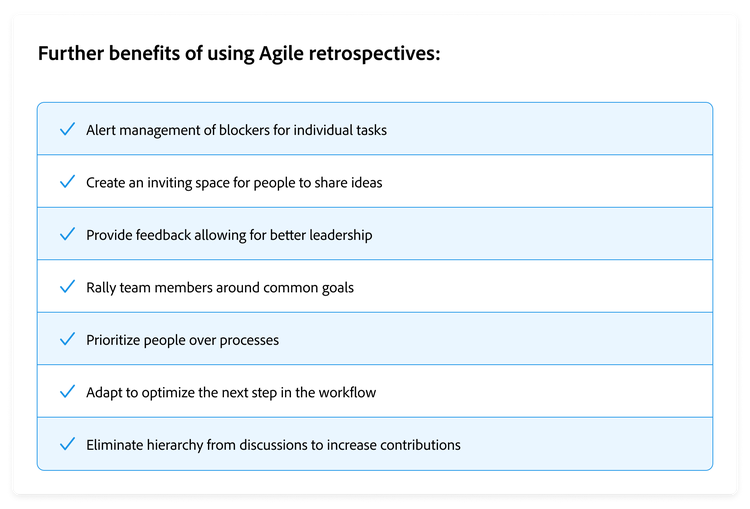
Further benefits of using Agile retrospectives

Chart showing additional benefits of using Agile retrospectives.

At its core, implementing an Agile retrospective contributes to a stronger end result, owing to the flexibility that Agile introduces to the development process or workflow in question. By surfacing roadblocks and concerns before they become significant obstacles, leaders can offer direction and constructive feedback whilst keeping the project on schedule.

How to conduct an Agile retrospective

Begin by considering the nature of your project work and the frequency with which your team moves through different phases of the development or production cycle. Identify natural stopping points at which to hold a retrospective – typically when teams complete an iteration of their work. These may occur at regular intervals, perhaps every 2 to 4 weeks, or be adjusted to align with the conclusion of a particular campaign or rollout.

Once the schedule is agreed, ensure that everyone involved in the project is invited to attend, so they can contribute feedback and gain from hearing their colleagues' perspectives. This includes leadership figures such as scrum masters and product owners, all individual contributors, and any other stakeholders who would benefit from the team’s input.

Approaching the retrospective becomes more straightforward when viewed through a Scrum framework. The primary goal of the meeting is to identify what worked well and what did not, in order to pinpoint areas for optimisation across teams and processes.

It is advisable to open by focusing on what went well during the iteration, establishing a constructive tone for the discussion. From there, invite feedback on what could be improved or what obstacles were encountered whilst working through the tasks. Leaders should keep the conversation anchored to a defined time period – typically the iteration, or sprint, that has just concluded.

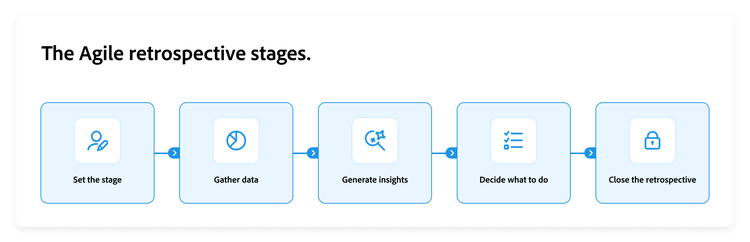
The Agile retrospective stages

Chart showing the stages of Agile retrospectives.
  1. Set the stage. Begin by making clear to all attendees what is and isn’t expected to happen during the meeting. Encourage everyone to share their perspectives respectfully, even when raising concerns. If you plan to apply a specific format or theme to your retrospective (see below), introduce it at this point.
  2. Gather data. Outline or revisit the main tasks and goals from the iteration, then invite everyone to comment on their contributions and reflections. This establishes a clear framework by providing categories within which to collect insights.
  3. Generate insights. Give attendees the opportunity to discuss their experiences and gather feedback as the conversation progresses. This can be facilitated through note-taking or more transparent methods such as whiteboarding. Group recurring ideas together to identify themes or areas that may require further attention.
  4. Decide what to do. Identify concrete steps to address how processes can be refined or improved for better outcomes in the next iteration. Where possible, the group should reach decisions collectively, with leadership consulting stakeholders on broader strategic direction. The goal of a retrospective is to leave with clear, actionable items that will strengthen existing processes ahead of the next round of work.
  5. Close the retrospective. Summarise the outcomes of the meeting and outline the next steps for all attendees, as applicable. Take time to thank everyone for their contributions and encourage continued engagement with the process.

Retrospectives are more than fact-finding missions – they’re collaborative environments where leaders can also draw on individual contributors for creative solutions.

Towards the close of the meeting, invite everyone to contribute their own ideas on how to address the issues raised and what actions should be taken to resolve outstanding challenges. Group common items together and look for trends or themes that can be tackled simultaneously.

Types of retrospectives

All Agile retrospectives serve as a general forum for encouraging and collecting feedback. That said, a wide range of formats can be applied to suit different approaches to team management and workflows.

Leaders may find it beneficial to draw on different approaches or adapt their format to suit the personalities and needs of their team:

What all these formats share is a commitment to fostering creative, engaging environments where attendees are active participants rather than passive observers. Many project managers, scrum masters, and other leaders identify participation as one of the greatest obstacles to effective Agile retrospectives.

Some attendees may feel their input is not valued, or that speaking candidly about what did not work could have consequences. The responsibility falls on the meeting facilitator to create a safe, inclusive space where everyone feels comfortable contributing – encouraging openness, engagement, and follow-through.

Barriers to success

One. Low engagement

Your team appears disengaged – offering few suggestions and staying largely quiet. To re-engage your team, consider varying your approach to accommodate different learning styles. Visual and kinaesthetic activities can break familiar patterns and stimulate creativity.

Two. Lack of trust

When conversation remains surface-level and no one raises concerns, trust is likely the issue. The facilitator should cultivate a space where everyone feels comfortable sharing their views. Acknowledge and reward participation – particularly when it surfaces a problem. Encourage the team to raise and address issues early, before they escalate. Seek individual, confidential feedback to uncover any deeper concerns.

Three. Poor follow-through

Low engagement and lack of trust can also arise when participation appears to make no difference. Over time, people simply stop contributing. To prevent this, act on the issues raised and the ideas offered, validating each contribution. Ensure changes are implemented in the next sprint, or set clear, actionable goals and keep the whole team informed of progress.

Tips to succeed

One. Ask team members to come prepared

Set clear expectations about how much preparation is needed and in what format. For instance, ask participants to note their thoughts in a shared document – specifying whether you need one or two sentences, a paragraph, or a few examples. Making alternative sharing options available broadens participation, particularly among those who are less comfortable speaking up in meetings.

Two. Stay on task and respect everyone’s time

Retrospectives offer a valuable opportunity to examine issues in depth, yet there’s always a risk that one person or topic dominates while others disengage. A clear, time-boxed agenda keeps discussion on track and ensures the meeting respects everyone’s time.

Three. Mix it up and try new formats

The traditional approach – asking ‘What worked, what didn’t, and what will we do next time?’ – poses broad questions that are often difficult to answer with any real depth or specificity. Introducing a new activity or format encourages more focused, productive conversation. Here are some examples:

Get started with Agile today

Retrospectives form an integral part of any Scrum or Agile project management process, giving teams a structured opportunity to reflect constructively on both their achievements and the challenges they have encountered.

Leaders can act on this feedback and implement changes in real time, helping to optimise outcomes for the next iteration and strengthen overall performance. These meetings foster a positive and productive team environment, creating a forum for feedback that can be escalated to stakeholders for further consideration.

Through Agile, teams are able to deliver products that more closely align with both customer needs and market conditions.

Agile approaches support faster, more efficient project management by enabling team members to focus on smaller, clearly scoped tasks within defined timeframes. The outcome is the iterative delivery of content, products, or services that reach the market with greater speed, efficiency, and quality.

Agile retrospectives are just one element of a successful project management framework. As leaders embed these meetings into their processes, they often look for tools to support the broader Agile workflows they are managing. That’s where Adobe Workfront can help.

Workfront is work management software that supports Agile teams and a range of project management methodologies. Bring together people and processes across your organisation for stronger collaboration throughout the entire lifecycle of a project. Whether you’re working with Scrum or Kanban, Agile is made simpler with Adobe.

Take a product tour or watch our overview video to see how Adobe Workfront can bring greater efficiency and ease to your Agile management processes.

https://business.adobe.com/fragments/resources/cards/thank-you-collections/workfront