Agile project management has extended well beyond software development and is now used by over 70% of US companies. For organisations building Agile teams, the process can appear daunting – Agile project managers must balance a constant flow of inputs whilst supporting their teams.
Without Agile teams, organisations struggle to adapt to sudden market shifts, emerging competitors, or unforeseen industry changes.
Agile methodology definition
Agile methodology is a project management practice that breaks down larger objectives into smaller phases, with the goal of continuous iteration, progress, and improvement. This aligns with the definition of the term ‘Agile’, which refers to a team’s ability to move without restraint, recalibrating in response to both challenges and successes.
Agile methodology enables organisations to respond quickly and effectively to challenges, from rising customer demands to product delays. Businesses using Agile achieve a 64% success rate, compared with 49% for other strategies.
This guide explores Agile principles and how to apply them to current operations:
What is an Agile team?
An Agile team is a group of individuals with diverse, multipurpose skills who are dedicated to the success of an Agile project across all stages of development, testing, and delivery. Agile teams typically consist of 5 to 10 individuals, carefully selected for their expertise in specific business areas.
These groups are carefully curated and assigned a clear purpose within the organisation, typically tied to a specific business objective. They are self-directed and self-organised, share accountability, and provide cross-functional support to meet their goals.
Advantages of an Agile team
Flexibility and scalability – whether in favourable or challenging times – are just two of the advantages an Agile team brings to an organisation. Many businesses are adopting Agile team approaches – for software development and beyond – given the wide range of benefits they offer. Here are a few:
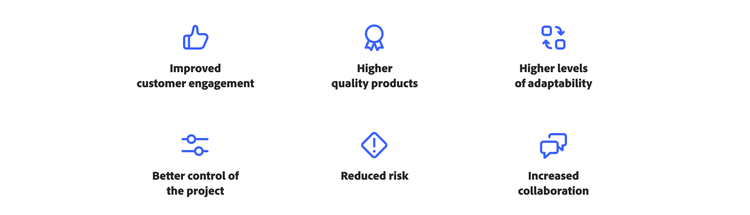
- Improved customer engagement and satisfaction: Agile’s iterative approach enables organisations to continuously deliver new products or services, refining customer relationships and improving retention.
- Higher-quality products: Process improvement is central to Agile, where contributors are encouraged to identify areas for growth. This helps processes evolve more quickly, removing stopgaps and improving quality control.
- Higher levels of adaptability: The ability to adjust helps teams overcome roadblocks or incorporate positive changes with little to no downtime. Teams also have the freedom to reassess their priorities as they move forward, allowing for more consistent delivery.
- Better control of the project: With the overarching project goal clearly defined, Agile teams can manage their outcomes through continual progress and regular group reviews of deliverables.
- Reduced risk: This progressive approach also minimises the risk of missing goals. Team members can recalibrate their expectations and methods to achieve the desired outcomes in new ways.
- Increased collaboration and feedback: Communication is valued and actively encouraged within Agile teams. Members meet regularly to share feedback, progress updates, and ideas for continual improvement.
Characteristics of an Agile team
Agile teams naturally vary in their design and execution, yet all successful ones share a number of defining traits. Central to Agile methodology is the aim to break down silos and foster a culture of collaboration that is both positive and productive.
Improved team collaboration
The most effective Agile teams are defined by a strong sense of unity that runs through every action and interaction. Team members are encouraged to share both successes and setbacks openly, working together to develop or recognise solutions as required. Functioning as a cohesive unit strengthens overall team performance and improves the capacity to achieve shared goals.
High productivity
A unified approach is central to high productivity within an Agile team. When responsibilities and deadlines are clearly defined, each contributor develops a clear understanding of their role and is better placed to complete tasks efficiently.
Cross-functionality
Cross-functional Agile teams are often likened to T-shaped teams – where members hold deep expertise in specific areas alongside the ability to work across other disciplines – and the comparison is apt. Yet cross-functional Agile team members are more likely to possess skills that extend well beyond traditional disciplines. It’s this breadth of capability that enables them to contribute to various projects, which in turn increases an Agile team’s velocity. The maths is simple – without the need to wait for external resources, more gets done in less time.
Well-defined responsibilities
Whilst team members should remain willing to support one another when required, clearly defined tasks and responsibilities for each individual help to focus efforts and attention effectively. Project managers or Scrum masters can ensure there is no overlap between tasks, keeping contributors productive and efficient by maintaining clear boundaries and assignments.
Self-organised around value
Agile teams perform at their best when they have a clear understanding of the value they are expected to deliver to the organisation. Leaders should establish goals and outcomes from the outset, defining what value looks like and demonstrating how today’s iterative tasks feed into the final product or service.
Emotional intelligence
Agile projects can be demanding, with team members working to meet defined deadlines and deliver precise outcomes. Teams with a high degree of emotional intelligence are better placed to manage periods of pressure – whether stemming from professional or personal factors – by keeping focus on the work rather than the individual. The result is measured progress rather than reactive panic when the pressure mounts.
Adaptable and willing to learn
Agile team members adapt readily to changing environments with minimal disruption to output. They typically demonstrate a well-developed understanding of the professional setting that brings out their best, enabling them to work productively across a wide range of situations.
Advanced T-shaped skills
T-shaped team members are understood to have a broad awareness of most aspects of a project (represented by the horizontal line at the top of the ‘T’), alongside deep expertise in one area of specialisation (the vertical line at the centre). This combination is a valuable asset for teams seeking to drive development or advance processes in specific areas.
Agile team roles and responsibilities
Agile teams typically divide responsibilities clearly across defined roles, and Agile methodology provides a range of formal structures to support this. The two most pivotal to success are:
Product owner
Within an Agile team, the product owner is responsible for defining tasks, deadlines, and expectations in line with broader organisational goals. Often described as overseeing the ‘what’ of the project, the product owner – or project owner in Agile marketing – serves as the designated team leader. This role is typically filled by an existing leader within the organisation, such as a director or manager. The primary objective is to break down assignments into manageable iterations that align with Agile development.
Scrum master
Specific to the Scrum methodology – and sometimes incorporated into the hybrid Scrumban approach – the scrum master filters incoming requests to the Agile team, manages the backlog, and facilitates all Scrum meetings. This is not inherently a leadership role; in fact, it can be a rotating position held by any member of the Agile team.
The scrum master translates the task lists prepared by the product owner into practice by establishing team processes and structures that enable everyone to work efficiently and effectively. In this sense, the role oversees the ‘how’ of the project and is equally critical for both internal and external team communication.
Although product owners and scrum masters are central to Agile teams, other roles carry significant weight too. An internal stakeholder, for instance, may be the one to initiate the project or desired outcome and remain informed of progress whilst co-ordinating with other teams around a launch or update. Stakeholder feedback is often critical in shaping the direction of individual tasks.
Much like developers in Agile development, individual contributors form part of the Agile team and represent a primary source of the team’s productivity and output.
How do product backlogs optimise Agile?
A well-maintained product backlog is central to effective Agile project management. By building and sustaining one, your team can:
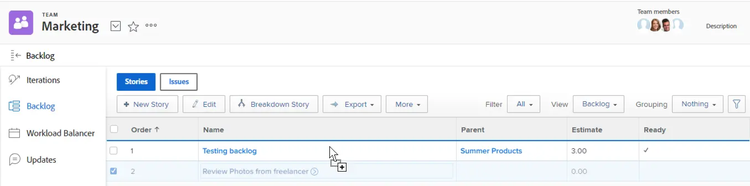
- Keep your to-do list up to date. Team members always know what to focus on next, whilst team leaders can identify the highest-priority tasks and assign them to the most suitable team member.
- Encourage discussion about priorities. With the backlog kept under constant review, team members can actively contribute to conversations about which items are most critical and should be elevated in priority. The team can agree on what matters most and gauge how much effort is likely to be required.
- Increase efficiency. When everyone works from a shared, prioritised task list, the team spends less time debating and second-guessing and more time developing a better product.
- Improve flexibility. By regularly reassessing backlog items, teams can adapt readily to new needs and changing circumstances. As priorities evolve, the list evolves with them.
How to create a product backlog
The product owner bears responsibility for managing the backlog. It’s their responsibility to create and maintain the list of backlog items. the backlog. It’s their responsibility to create and maintain the list of backlog items.
Prerequisites to creating a product backlog – the two Rs
Before creating the backlog, the team should have a clear understanding of the project’s general requirements and a roadmap for developing it – these are the two Rs of Agile backlogs. The requirements cover the functions, services, and features of the product. The roadmap sets out the high-level plan of action for the product.
With these two Rs firmly in place, here’s how to create a project backlog:
- Collect items. Begin by gathering the tasks, to-dos, and upcoming work that you and your team have already identified. These may already feature on the team’s or individual members’ to-do lists. Bring tasks from all these various sources together into a single location.
- Clarify items. Ensure you and the team have a thorough understanding of each item. Establish why it was requested, what the specific requirements are, and what value it will deliver. Use the product roadmap to guide which items are added to the backlog and which remain there.
- Prioritise items. Arrange items in order of importance. There are several approaches to this. You could tackle the most complex tasks first, or prioritise by urgency. Some teams prioritise based on the level of impact relative to effort. Others focus on business value – the work’s effect on revenue or cost savings. The method you choose will depend on the nature of the project you are working on.
- Manage the backlog. Keeping priorities current requires active backlog management – a process known as ‘backlog refinement’. As new ideas and requests emerge, items are continually added to the backlog. You’ll also need to remove and modify items as circumstances change.
Each of these steps is initiated during backlog creation and continues as an ongoing process throughout the project’s entire lifecycle.
Tips and best practices for product backlog management
As new requests and items arrive continually, the backlog can quickly become unwieldy. Staying on top of it is a key responsibility for the product owner. The following best practices support ongoing backlog refinement.
- Split up a large list of backlog items. An oversized backlog makes items difficult to locate and obscures progress. Keeping the backlog manageable is therefore essential. One effective approach is to categorise items into long-term and short-term tasks.
- Delete items. Items that are unlikely ever to be completed should be removed from the backlog. If an item hasn’t demonstrated sufficient value and has been sitting on the backlog for some time, it’s time to remove it. With new items being added continually, the product owner must take a proactive approach to keeping the backlog focused.
- Share the backlog. A backlog that exists solely as an internal document risks becoming stagnant – which runs counter to Agile principles. All those involved should have access to the backlog; share it with all relevant stakeholders.
- Visualise the backlog. Alongside any digital visualisation, it can also be valuable to maintain a physical one. Something as straightforward as posting notes on the wall can work well. Displaying them close to where the team works helps keep everyone engaged.
- Review and reprioritise. Flexibility and responsiveness are central to Agile, and your backlog should reflect shifting priorities accordingly. The highest-priority items should always sit at the top of the backlog. Whatever approach you take, regular review and reprioritisation of backlog items is essential.
Different Agile frameworks
No single Agile framework stands as the definitive approach. Many leaders choose to draw on elements from several frameworks, developing a method that best suits their team, industry, or organisation, with a focus on improving performance and achieving their objectives. The following is an overview of some of the most widely used approaches.
- Scrum
Widely adopted in software development, the Scrum framework is an Agile approach in which team members self-organise around an assortment of tasks, tackled iteratively. By working towards a shared goal through structured meetings and tools, Scrum participants can provide feedback and progress incrementally through a development cycle, ultimately building towards a final product. Scrum is best suited to environments that require frequent change and adaptability.
- Kanban
At its core, Kanban is a lean workflow management approach particularly well suited to teams managing a steady flow of incoming requests or seeking to streamline their work in progress. The approach provides a clear visual representation of the work queue, advancing items according to the stages or resources they require. Critically, it is the workload – not the individual – that the project owner manages: they populate the queue and allow team members to select items for development or review.
- Crystal
Placing communication and interaction above rigid processes, the Crystal Agile framework empowers team members to speak candidly about the obstacles and efficiencies they observe, enabling them to direct their own workflow. Rather than adhering to restrictive documentation and reporting requirements, teams operate under broad collaborative guidelines that actively encourage knowledge sharing. Crystal tends to work well for cohesive teams that communicate effectively and are able to keep scope creep in check.
- Extreme Programming Framework (XP)
Returning the focus to software development, the Extreme Programming framework applies Agile methodology with a clear emphasis on sound engineering practices. Collaboration remains central, but team members also follow a defined set of 12 processes that support iterative, continuous sprints to sustain ongoing development progress. This encompasses elements such as small releases, consistent integration, and collective code ownership.
- Dynamic Systems Development Method (DSDM)
For organisations requiring a faster release cadence, DSDM may be a well-suited option. Built around strategies that prioritise rapid releases across multiple iterations, this approach acknowledges that revisions and rework are likely to be necessary throughout or after the process. Agile team members still follow defined processes and procedures, but work at a considerably faster pace than their counterparts in a purely Scrum-based environment.
The ideal Agile team is typically small, comprising around three to seven people. Keeping teams compact supports active communication and reduces the complications that can arise when working in larger groups. Many organisations assign a project owner to each Agile team, though it can be more effective for multiple Agile teams to report to a single project owner – typically someone they already report to. Where your team exceeds seven people, consider dividing it into smaller Agile units.
Consider the following tips for building Agile team structures:
- Understand, align, and map your business capabilities. When forming a team, defining business goals and outcomes provides a clear foundation for determining how to achieve those objectives. This means bringing together the right contributors based on business needs, rather than other priorities.
- Establish team expectations and boundaries. Leaders should clearly define what falls within scope and what does not. This helps guard against scope creep from other stakeholders, as well as peripheral work that naturally arises from team collaboration and innovation.
- Instil the value of self-organisation within the team. For an Agile team to remain productive, members must feel empowered to speak up, contribute, and take ownership of their work. Leaders can identify contributors who demonstrate these qualities and empower them further within the right Agile structure.
- Manage work, not people. The team nominates individuals best placed to determine how the agreed goals should be achieved. Leaders should concentrate on keeping priorities, requirements, and deadlines for work items clear, allowing the team to self-organise.
- Establish clear channels of communication with the product owner. While product owners align tasks with business goals, contributors must be able to share essential feedback that may shape future plans.
Improving Team Collaboration
Effective communication is a cornerstone of successful collaboration. It supports sound decision-making, helps teams fulfil their responsibilities, and accelerates progress. As leaders build Agile teams, there are practical steps they can take to strengthen both collaboration and outcomes over time:
- Align every team member with the shared vision and the task at hand.
- Include a varied range of skills that do not overlap significantly with other team members’ specialities.
- Build regular feedback loops into the learning cycle and apply them consistently.
- Avoid assigning Agile team members to additional teams simultaneously.
- Identify and manage different work types on a Kanban board.
- Introduce classes of service to enhance predictability.
- Visualise cross-team dependencies to streamline collaboration.
Project managers and leaders achieve better outcomes when they understand how an Agile approach defines specific roles and functions. With everyone in their designated position, leaders can draw on tools and software to support the implementation of their chosen Agile framework.
When you’re ready to begin, consider exploring Agile project management software that can help you manage projects at scale. Adobe Workfront is designed to help project managers collaborate with teams and stakeholders whilst monitoring projects in real time, wherever they are.
Take a product tour of Adobe Workfront or watch the overview video to find out more.