Building relationships with financial customers relies on scalable content – and that can only be achieved with integrated collaboration tools. Personalised, data-driven experiences are what earn customer loyalty, and delivering these requires a sophisticated and agile financial services content supply chain.
Delivering personalised experiences at scale requires financial services organisations to take a comprehensive approach that brings together data, content, and customer journeys. Understanding customer needs and preferences through data forms the foundation for those personalised experiences. Translating that understanding into relevant, valuable content is what drives meaningful customer engagement and enables seamless journeys. As personalisation efforts mature, the demand for greater volumes and variety of content grows in line with the increasing complexity of personalised experiences.
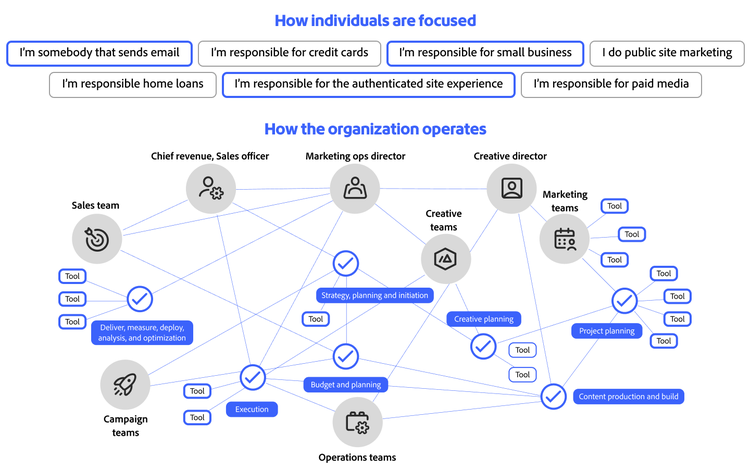
The content supply chain is the process that unites people, tools, and workstreams to create and deliver the volume of content that personalisation at scale demands. Without scalable content, organisations cannot provide the optimal financial experience or build the trust that customer loyalty requires.
This post will cover:
- Create content supply chains for financial service organisations.
- Marketing personalisation and hybrid customer journeys drive content growth demand.
- The advantages of integrated work management in financial services.
- Build a financial service content supply chain with Adobe GenStudio for Performance Marketing.
Create content supply chains for financial service organisations
One. A unified and Agile workflow
The traditional, siloed approach to content creation – where marketing, compliance, and IT operate in isolation – belongs to a different era. A modern content supply chain management strategy demands a centralised and collaborative ecosystem.
City National Bank’s transformation demonstrates this in practice. By adopting a unified work management platform, they dismantled departmental barriers, consolidated 20 disparate processes into a single, streamlined workflow, and significantly reduced review cycles. The result was not only a saving of 1,500 hours of work annually, but also the development of a collaborative culture that is central to agile content creation.
https://video.tv.adobe.com/v/3442595?end=nothing&learn=on&captions=eng
Two. Streamline content creation and personalisation with Generative AI
The 2025 Adobe Digital Trends Financial Services in Focus report highlights how FSI companies are using Generative AI to improve client interactions and boost employee productivity. 60% of wealth and asset management and insurance providers plan to focus on using AI to reshape client relationships. For example, Morgan Stanley Wealth Management recently launched a Generative AI-based tool that helps financial advisers manage administrative tasks, freeing up time to focus on client engagement.
Forrester research further indicates that organisations need to understand B2B buyers and the touchpoints they use throughout the purchasing process. The research found that buyers want contextually relevant content that addresses their needs, and that experience leaders use AI/ML to deliver optimised content.
Of all the developments reshaping the content supply chain, the integration of AI is arguably the most significant. AI tools can now be applied at every stage of the content lifecycle:
- Ideation and creation: Generative AI can assist with drafting articles, social media posts, and email copy, freeing up human creators to focus on strategy and higher-value content.
- Personalization at scale: AI algorithms can analyse customer data to deliver high-quality content, ensuring each interaction is relevant and timely. This may include personalised investment insights, tailored loan offers, or proactive financial wellness tips.
- Performance analytics: AI-powered analytics deliver deep insights into content performance, enabling rapid optimisation and a data-driven approach to future content strategy.
Three. Compliance adherence is a catalyst for content supply chains
Within the highly regulated financial sector, compliance can present a significant barrier to timely content delivery. A content supply chain addresses this by embedding compliance into the workflow from the outset.
By adopting a centralised digital asset management (DAM) system, financial institutions can ensure that only pre-approved, up-to-date assets are used in content creation. Automated workflows route content to legal and compliance teams for review and approval, establishing a clear audit trail and significantly reducing the risk of non-compliant communications. This proactive approach to compliance not only mitigates risk but also accelerates time-to-market for critical content development.
Marketing Personalization and hybrid customer journeys drive content growth demand
Part 2 of this three-part series highlighted the crucial role of unifying data and acting on real-time insights to achieve successful Personalization at scale. Here, we examine the importance of optimising your content strategy and processes to increase the speed and efficiency of content creation and meet the growing demand for Personalization.
Hyper-personalisation and AI help create an effective content supply chain
The demand for an optimised content supply chain is driven in part by customers' expectation of hyper-personalisation and the growing capabilities of AI. Without a scalable content process, however, those insights remain untapped.
Financial institutions are moving beyond broad segmentation towards one-to-one conversations. This demands a varied library of content components that can be dynamically assembled to address individual customer needs at specific moments in the journey. Generative AI can produce initial drafts of market commentary and personalise email subject lines for maximum impact.
For example, financial institutions now employ AI-powered virtual assistants, such as Bank of America’s Erica, to manage billions of customer interactions, providing personalised insights and guidance. This level of engagement is only achievable with a content strategy designed for real-time, individualised communication.
No single department can deliver excellent customer experience in isolation. The journey demands collaboration across every business unit, from marketing creatives to frontline agents and bank tellers to legal and compliance during reviews.
The advantages of integrated work management in financial services
One. Shorten legal and compliance reviews
Delivering timely, relevant content and advice is essential for financial services organisations to remain competitive and build lasting customer relationships. This is especially important during periods of economic instability, when customers seek guidance and support to protect their financial wellbeing. Compliance reviews within content marketing can, however, hinder rapid turnarounds. By adopting a work management solution, organisations can improve their content production and review processes, streamlining content creation, facilitating reviews, and enabling straightforward routing and tracking of approvals.
2. Streamline content audits with centralised record keeping
Compliance-related audits demand a clear, well-organised record of campaigns and delivered content. An integrated marketing solution that encompasses all customer touchpoints and marketing assets brings all content related to customer journeys together in one centralised location, simplifying the auditing process.
3. Ensure only approved and current assets are available for use
Scaling content across multiple interactions carries inherent risks for your organisation, yet it is essential for delivering modern customer journeys. To manage those risks and ensure only approved, up-to-date assets are used, a centralised asset library is indispensable. With a centralised library in place, content creators across your organisation can readily access the latest approved marketing assets and create posts with confidence – resulting in consistent, high-quality content across all channels.
Build a financial service content supply chain with Adobe GenStudio for Performance Marketing
A memorable customer experience relies on effective collaboration across all departments. Marketing and creative teams craft tailored content and reach target audiences effectively, while advisory teams strengthen customer relationships, legal teams maintain customer trust, and IT teams safeguard sensitive information.
Developing an agile and intelligent financial services content supply chain is a strategic priority. It calls for a holistic approach encompassing people, processes, and technology. By breaking down silos, embracing AI and automation, embedding compliance, adopting a modular content strategy, and nurturing a culture of continuous improvement, financial institutions can not only meet the expectations of today’s discerning customers – they can build the foundations for lasting relationships and sustainable growth.
The quality of the customer experience will shape the future of financial services. A well-considered, strategic content supply chain is central to realising that future.
Watch a video overview to see for yourself how GenStudio can help you create financial service content supply chains and improve time-to-market to drive an impact for your business.
Recommended for you
https://business.adobe.com/fragments/resources/cards/thank-you-collections/financial-services