Waiting for leads to find you isn't a strategy, it’s a gamble. Leaving your lead pipeline to chance is a risk most marketing leaders can't afford. Outbound marketing has shed its 'interruption-based' reputation. Today, it is a high-precision, data-driven discipline designed to engage high-value accounts before they even hit your competitors' radar. This guide outlines how to build an outbound marketing strategy that scales growth and works in lockstep with your inbound efforts.
This post will cover:
Building an effective outbound marketing strategy
Comparing inbound vs. outbound marketing
Weighing the pros and cons of outbound marketing
Powering an outbound marketing strategy with Adobe Marketo Engage
Building an effective outbound marketing strategy.
For a CMO, the shift from tactics to strategy happens when outbound marketing moves from a series of tasks to recurring revenue.
Using data for high-definition targeting.
In a saturated marketplace, strategic precision is the primary driver of meaningful engagement. Rather than broad demographic categories, use a high-definition approach to your ideal customer profile (ICP). This requires combining company profiles with their current tech stack and real-time signals that show they are in the market for a solution. By applying a rigorous framework like the STP marketing model (segmentation, targeting and positioning), you ensure your team is focusing energy only on the accounts with the highest propensity to buy.
Crafting value-driven messaging to earn attention.
Outbound marketing is about problem-solving, not pitching. Your content, whether an executive brief, a targeted ad or a bespoke webinar, must act as a bridge between your prospect’s current pain point and their desired future state. To earn attention in a crowded market, the messaging must provide immediate utility, positioning your brand as a consultant rather than just another vendor.
Synchronising sales and marketing for unified revenue growth.
Outbound marketing is most effective when teams agree on a singular definition of a 'qualified lead' to prevent operational friction during the handoff process. Establishing shared revenue goals further ensures that both departments are incentivised to prioritise lead quality over mere volume. Finally, a continuous feedback loop is essential, allowing real-time sales insights to refine marketing’s targeting and messaging for maximum impact.
Implementing a data-driven framework for business impact.
A sophisticated outbound marketing strategy prioritises business outcomes over tactical signals like clicks and opens. While these signals help optimise messaging, a strategic framework focuses on metrics that directly affect the bottom line. It’s important to match your KPIs to your goals. New campaigns need to measure account reach, while closing deals requires a focus on conversion speed.
To ensure outbound marketing is driving revenue growth, evaluate performance through these three lenses:
Lead pipeline contribution: Track the volume, quality and conversion rates of outbound-sourced leads. Comparing this data against other channels reveals how effectively your proactive outreach is capturing demand and whether it is shortening the overall sales cycle.
Customer acquisition cost (CAC): Since outbound marketing is resource-intensive, it is essential to monitor unit economics closely. A data-driven approach ensures that the total investment in sales and marketing outreach remains sustainable when measured against the actual volume of new customers acquired. By tracking this closely, leadership can ensure that the proactive pursuit of high-value accounts doesn't outpace the revenue they generate.
Strategic ROI and lifetime value (LTV): The ultimate measure of success is the ratio of LTV to acquisition cost. Because outbound allows you to hand-pick high-value targets, a higher initial CAC is often justified by the significantly higher contract values and long-term retention these accounts provide.
Comparing inbound vs. outbound marketing.
The fundamental difference between inbound marketing and outbound marketing is that inbound is initiated by the consumer, while outbound is initiated by the business. The two marketing approaches are not mutually exclusive. Most companies use both inbound and outbound marketing to make sure they reach their target audiences in the most effective ways possible. A strong account-based marketing (ABM) strategy includes a combination of both tactics to build a solid customer relationship that leads to sales, referrals and repeat business.
- Inbound marketing attracts customers through valuable content to capture existing intent.
- Outbound marketing proactively initiates contact to generate new demand.
An effective strategy integrates both. Your inbound content provides the value for outbound outreach, while your outbound efforts drive targeted new audiences toward your inbound ecosystem.
Weighing the pros and cons of outbound marketing.
While some argue that inbound is the natural fit for B2B and outbound for B2C, companies know that a successful strategy requires both. Outbound is particularly vital when you need to push a message to build awareness for a new product or category rather than waiting for customers to find you.
To determine how to implement this strategy, consider the following trade-offs:
The pros of outbound marketing.
- Rapid brand awareness: Outbound marketing is the fastest way to introduce your brand to a new audience that isn't yet searching for your solution.
- Wide and immediate exposure: You can bypass the long waiting period of organic search and get your message in front of large, targeted segments instantly.
- Speed to market: A single, high-impact message can be distributed across a broad audience using a single channel, making it easier to manage than complex multi-stage content funnels.
The cons of outbound marketing.
- High-effort conversions: Because the prospect didn't initiate the contact, your team must work harder and follow up more frequently to move them through the funnel.
- Variable lead quality: If targeting isn't precise, you risk reaching unqualified prospects who aren't ready to buy, which can lead to a negative first impression.
- Attribution challenges: It can be difficult to track the exact ROI of broad-reaching awareness campaigns compared to the direct click-to-lead path of inbound marketing.
- Finding the balance: The most effective companies don't choose one over the other. They use inbound to provide depth when customers are researching and outbound to initiate contact when a high-value account matches their strategic goals.
Powering an outbound marketing strategy with Adobe Marketo Engage.
Executing a data-driven outbound strategy requires an integrated ecosystem to orchestrate outreach and maintain visibility at scale.
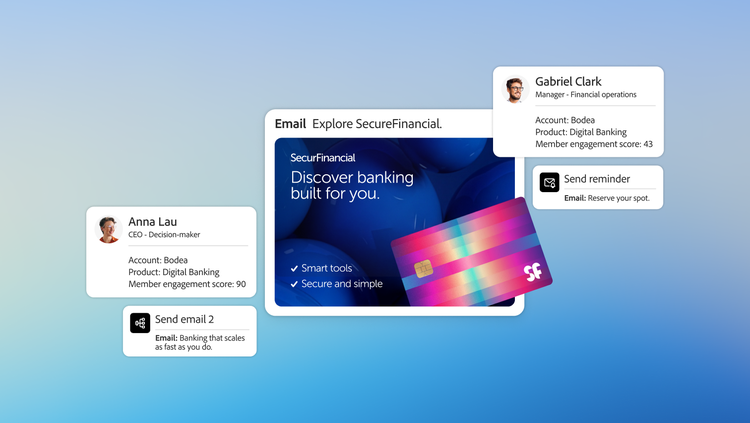
Marketing automation platforms: A comprehensive platform, like Adobe Marketo Engage, can power your outbound marketing strategy. These applications enable you to build precise target account lists, execute multi-step omnichannel campaigns and nurture leads while providing a clear line of sight into their impact on pipeline and revenue.
Customer data platforms (CDP) and data providers: To build the high-definition audience lists necessary for modern outbound, you must unify your internal data. Integrating a customer data platform (CDP) or dedicated data provider allows you to enrich your first-party insights with third-party firmographic and real-time intent signals, ensuring your outreach is always timely and relevant.
Sales engagement platforms: These platforms are the critical bridge between marketing strategy and sales execution. By co-ordinating outreach and providing sales teams with the necessary account context for every interaction, they ensure a seamless handoff and more effective, personalised follow-up.
A strategic framework is the blueprint, but a powerful platform powers your outbound marketing strategy. Transitioning from reactive lead generation to a proactive, predictable outbound model requires a tool built for the complexity of the modern B2B landscape.
Adobe Marketo Engage provides the orchestration and intelligence needed to bring this guide to life. By unifying your data, automating personalised outreach and providing deep visibility into pipeline impact, Marketo Engage allows you to scale your outbound efforts without sacrificing the precision that modern buyers demand.
Recommended for you
https://business.adobe.com/fragments/resources/cards/thank-you-collections/marketo-engage