Mastering work breakdown structures (WBS) for effective project management

Image of a man outside a building, overlaid with an Adobe Workfront UI element and a Q2 social campaign task.

For project managers and those overseeing a broad scope of work, a work breakdown structure (WBS) is a practical tool for making complex projects more manageable. Its core function is to break a project into a series of tasks and deliverables, ranked in order of priority. In doing so, it supports stronger planning, organisation, and control across the entire project.

WBS frameworks come in two forms: deliverable-based and phase-based, each adaptable to your priorities and preferred ways of working. If you’re a professional exploring project management tools, read on to find out more about work breakdown structures.

What is a work breakdown structure (WBS)?

A work breakdown structure (WBS) is a planning tool designed to break down everything required to complete a project. When faced with a large project, it can be difficult to know where to begin. A WBS addresses this by dividing one large task into smaller, more manageable ones, making it easier to determine what to tackle first. An effective work breakdown structure should include the following:

  • Deliverables: These represent the outcomes your work is designed to achieve. A project may have a single final deliverable or several goals to work towards. Regardless of the project’s scale, defining your deliverables at the outset is always advisable.
  • Tasks: These are the actions required to deliver your outcomes. A WBS helps you identify and define these tasks, each tailored to your specific project. They may range from work you handle directly to responsibilities you delegate to others.
  • Subtasks: Many tasks will be too large to manage in isolation and will need to be broken down further into subtasks. In principle, subtasks can be divided into progressively smaller components, though a natural point will arise beyond which further division serves no practical purpose.

In essence, a WBS enables you to build a flowchart that converts all deliverables into manageable tasks, providing your team with a clear guide for developing or completing a project.

A key aspect of any WBS is the interplay between structure, project scope, schedule and budget. All four influence one another and determine what is and isn’t achievable. For example, a tight two-week schedule will limit the scope – but it may help reduce the overall budget. Conversely, a generous budget might allow you to bring in additional staff, enabling you to expand the scope or complete more tasks within the same timeframe.

The 100% rule is a further principle to consider. It stipulates that the work breakdown structure must account for 100% of the project’s scope and all its deliverables. In other words, nothing should sit outside the WBS – every aspect of the project must be captured, no matter how minor it may appear.

Deliverable-based vs. phase-based WBS: Choosing the right approach

There are two distinct approaches to creating a WBS – deliverable-based, which focuses on individual tasks or parts of the project scope, or phase-based, which breaks down projects by timeline.

Deliverable-based

Deliverable-based approaches are the most common in project management. They create a visualisation of the relationship between the project’s deliverables and the overall scope of work. This approach helps to break down tasks into their component subtasks.

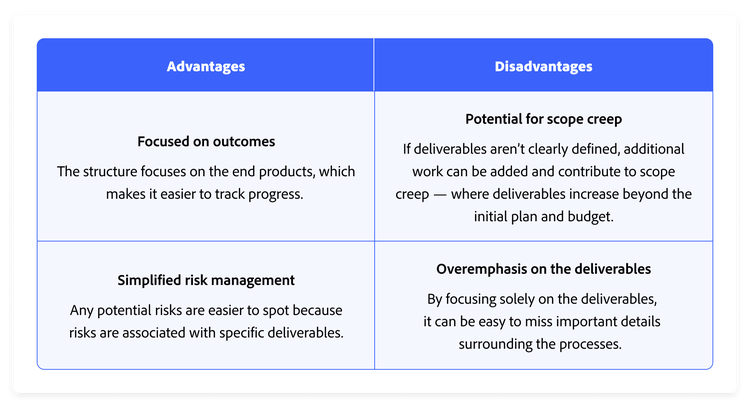
Chart showing the advantages and disadvantages of a deliverable-based WBS.

Advantages:

  • Focused on outcomes. The structure centres on end products, making progress easier to track.
  • Simplified risk management. Potential risks are easier to identify, as each is linked to a specific deliverable.

Disadvantages:

  • Potential for scope creep. Where deliverables are not clearly defined, additional work can be incorporated and contribute to scope creep – where deliverables expand beyond the original plan and budget.
  • Overemphasis on deliverables. Focusing solely on deliverables makes it easy to overlook important details within the surrounding processes.

Phase-based

Phase-based approaches typically follow five core stages: initiation, planning, execution, control and closeout. Once these phases are defined, the project team works together to sort and assign tasks to the appropriate phase.

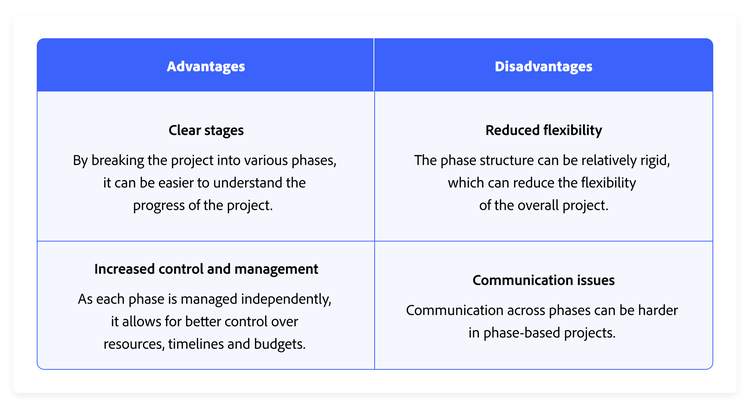
Chart showing the advantages and disadvantages of a phase-based WBS.

Advantages:

  • Clear stages: Breaking the project into distinct phases makes it easier to track overall progress.
  • Increased control and management: Managing each phase independently allows for better control over resources, timelines and budgets.

Disadvantages:

  • Reduced flexibility: The phase structure tends to be relatively rigid, which can limit the overall flexibility of the project.
  • Communication issues: Coordinating communication across phases can be more challenging in phase-based projects.

Key components of a work breakdown structure

A clearly defined work breakdown structure ensures every detail and project phase is accounted for before work begins. The WBS communicates the overall picture clearly, keeping all stakeholders aligned throughout the project.

Several key features contribute to the overall work breakdown structure, with each occupying a separate level. The top level – Level 1 – represents the overarching goal or goals. Moving down through the levels, goals break into tasks, and tasks into smaller subtasks. The core components of a typical WBS are:

  • Final deliverables: Also referred to as the project goal, final deliverables sit at the top of the structure and represent the outcomes your team is working towards. Depending on the format used, these may appear at the top of the work breakdown structure or in the first column.
  • Major deliverables: Sitting at Level 2 of the structure, each major deliverable is assigned to a core category. Every aspect of the project must fall under one of these categories.
  • Sub-deliverables: At Level 3, each major deliverable is broken down into smaller, more manageable tasks.
  • Work packages: Positioned at the bottom of the WBS, work packages are deliverables that can be broken down only into tasks and subtasks.

The deeper into the structure you go, the more detailed the tasks become. Higher up, you can expect broad goals that require the completion of multiple smaller tasks. By assigning a clear objective to each subtask, you can use a WBS to track the milestones of your project. Once in place, use your WBS to monitor and tick off each individual section.

How to create a work breakdown structure: A step-by-step guide

When creating a work breakdown structure, start by outlining the desired outcome. Working backwards from completion to kick-off, divide the project into smaller deliverables, then break each deliverable down into manageable tasks and subtasks.

Depending on the size and scope of your project, your work breakdown structure might span three levels or ten. There is no fixed number of levels or tasks in a finished WBS. Keep breaking down work into its smallest component parts. You’ll know you’ve reached the right point when a deliverable can no longer be divided into sub-deliverables and each work package carries a single project outcome.

Step 1: List every major deliverable

Chart listing the deliverables of a campaign, including downloadable collateral, emails, webpages, social media, blogs, and newsletters.

Begin by identifying your final deliverable – the overall outcome or project goal. This sits at the top of your WBS (Level 1) and might look something like: Launch a targeted content campaign.

Once that’s defined, break it down into major deliverables (Level 2) – the key categories of work required to achieve that goal. These might align with departments, workstreams, or project phases.

For example, the major deliverables of a targeted content campaign might include:

  1. Downloadable collateral
  2. Emails
  3. Webpages
  4. Social media
  5. Blogs
  6. Newsletters

Address any ambiguity or confusion about the project resources, deliverables, or constraints before you begin your work breakdown structure. Resolving these early will save considerable time and help avoid potential conflicts further down the line.

Once complete, ensure your list is reviewed and approved by all the stakeholders using a digital proofing tool. Depending on the project, there may be stakeholders from different teams, departments, or even separate organisations. It is important that all parties have signed off on the list of deliverables and that everyone is in agreement.

Step 2: Break each deliverable into work components

Work components are groups of related deliverables that combine to form a larger, major deliverable. Depending on the size and scope of your project, you may have more than one level of work components. Organising them by task type or role is a practical starting point. For example:

Deliverable: Social media

Chart with social media broken down by platform, including X, Instagram, Facebook, and LinkedIn.
  • Work component: X
  • Work component: Instagram
  • Work component: Facebook
  • Work component: LinkedIn

Work components can be broken down further where necessary:

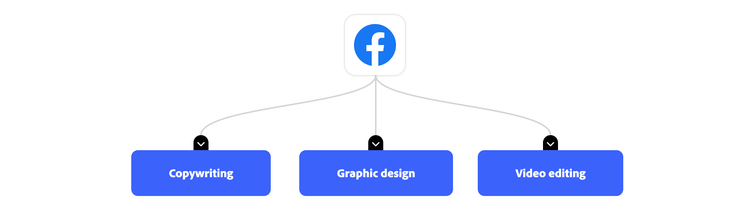
Work component: Facebook

Chart breaking Facebook down into copywriting, graphic design, and video editing.
  • Sub-component: Copywriting
  • Sub-component: Graphic design
  • Sub-component: Video editing

There is no set requirement or limit on the number of work components. The structure that best serves your team is the right one.

Step 3: Break each work component into work packages

The final and most detailed level in your work breakdown structure comprises work packages – lists of individual tasks that one person can complete. Think of each work package as a self-contained mini-project, with its own budget, resources, schedule, and milestones.

Each work package should be unique, and no work package should be repeated under any work component.

For example:

Deliverable: Social media

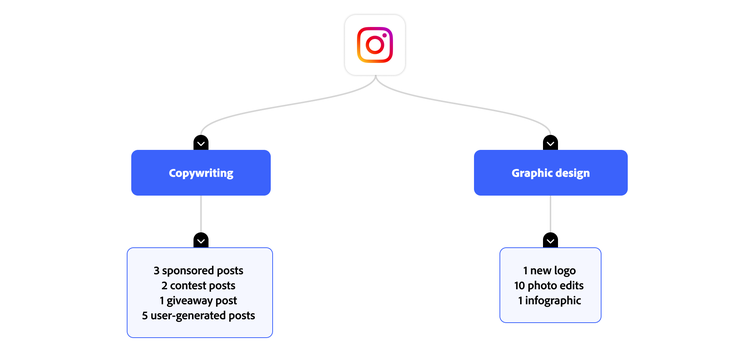
Chart breaking down Instagram into copywriting and graphic design.
  • Work component: Instagram

    • Sub-component: Copywriting

      • Work package: 3 sponsored posts
      • Work package: 2 contest posts
      • Work package: 1 giveaway post
      • Work package: 5 user-generated posts
    • Sub-component: Graphic design

      • Work package: 1 new logo
      • Work package: 10 photo edits
      • Work package: 1 infographic

Step 4: Identify dependencies

Once you have listed all work down to the most granular task, identify any dependencies – work that cannot begin until other tasks are complete. For example, video editing cannot proceed until the copywriter has delivered the voiceover script. Understanding the required sequence of work will help you schedule, manage time effectively, and anticipate potential roadblocks.

Step 5: Prioritise and assign

The final step in building a work breakdown structure is to organise all work in order of priority, guided by your list of dependencies. Once your WBS is in a logical sequence, assign work packages to individuals, then build your schedule from work packages all the way back through to the final deliverables.

Your WBS can also include any of the following information to support organisation and transparency:

  • Name of the department responsible for each piece of work
  • Estimated project cost and estimated work component costs
  • Start dates and delivery dates

Different formats for visualising your WBS

A work breakdown structure can be created in outline format, but one of its key advantages is the visual hierarchy it provides – breaking your workflow down to its smallest components. Every deliverable is accounted for and assigned, and it becomes straightforward to see how individual components contribute to a larger task and, ultimately, to the whole project. Consider building your work breakdown structure using a table, flowchart, or collaboration software.

When sharing your WBS, there are several options available. Common formats include spreadsheets, flowcharts or tree diagrams, outlines, and Gantt charts. Each has its own advantages and disadvantages, so consider experimenting to find the version that works best for you.

  • Spreadsheets are relatively straightforward and easy to edit, though they may not offer the most visually appealing presentation.
  • Flowcharts provide a clear visual representation of a project’s hierarchy and effectively illustrate the relationships between tasks.
  • Outlines also offer a hierarchical view, but in a text-based format. They suit a straightforward WBS well, though they can become unwieldy at a larger scale.
  • Gantt charts with integrated work breakdown structures allow you to combine visual representation with a timeline view, providing an additional perspective.

Best practices for creating a WBS

When it comes to work breakdown structures, one of the most widely observed best practices is the 100% rule.

Developed by Gregory T. Haugan, the 100% rule states that a work breakdown structure must account for 100% of the work required to complete the deliverables – and should not include any work that falls outside the defined project scope.

Your WBS should be exhaustive and detailed, enabling you to identify work gaps or redundancies whilst eliminating anything unnecessary. Be specific, be thorough, and do not shy away from adding too much detail.

Exclusivity is another key best practice for WBS. Limiting repetition is essential – not only to preserve the integrity of the 100% rule, but also to avoid wasting resources, budget, or time. Equally, you should focus on outcomes rather than activities, directing your effort towards the results of your work rather than the individual actions taken.

Getting started with Adobe Workfront

Creating work breakdown structures by hand or using standalone flowchart tools can be time-consuming and difficult to keep current. Using project management software to build a work breakdown structure ensures all information stays up to date, gives your team the clarity they need, and provides the flexibility required to plan work effectively.

Adobe Workfront is a work management solution that enables you and your teams to plan, track and organise your workload. It also provides all the tools needed to create, visualise and manage a WBS.

Learn how Adobe Workfront can help you build your work breakdown structure and reach your project goals.

Let’s talk about what Adobe can do for your business.

Get started