In today’s workplace, where operational efficiency and strong teamwork are more critical than ever, even a short breakdown in collaboration costs employees valuable time and hinders project workflows. To understand how cross-functional collaboration works and where it falls short, we surveyed over 1,000 full-time employees across US industries about their experiences with digital collaboration and team productivity tools. Our findings demonstrate that poor communication has a significant effect on both workers and projects and that a lack of a single source of truth for project information is a key cause of misalignment and delayed results. Marketers need more transparent and connected working methods — the type that products like Adobe Workfront are designed to support.
Key findings.
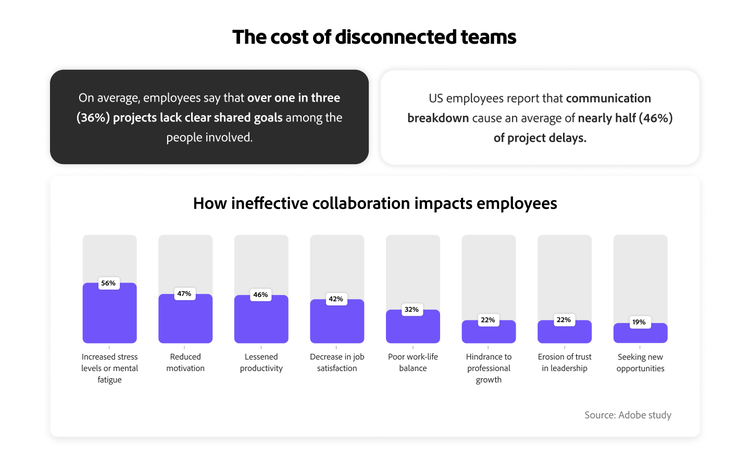
- Communication breakdowns cause nearly half (46%) of all project delays.
- For nearly 6 in 10 (56%) US employees, ineffective collaboration leads to mental fatigue.
- More than one in three projects (36%) lack clear and shared goals among those involved.
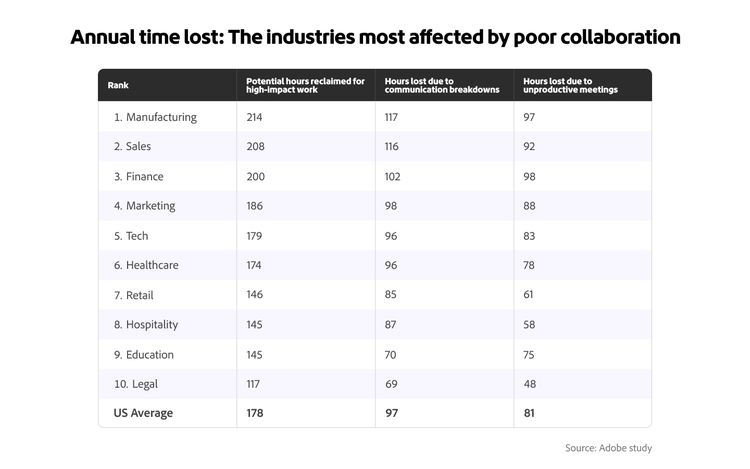
- On average, US employees say they waste 81 hours annually in unproductive meetings.
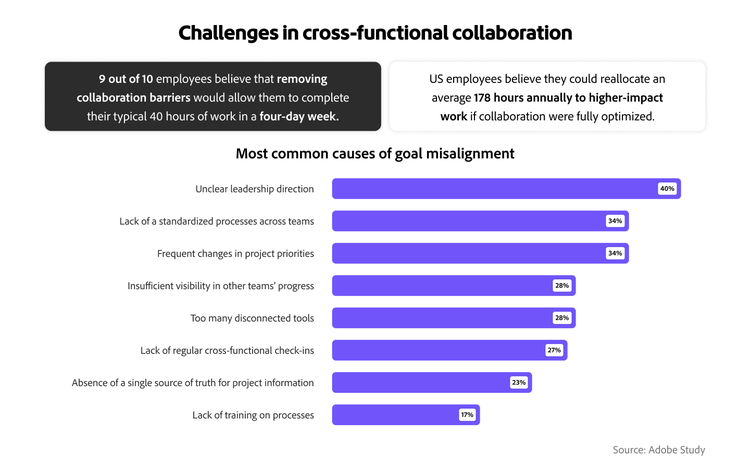
- Unclear leadership directives (40%) and a lack of standardisation across teams (34%) are the most common sources of goal misalignment.
- 9 out of 10 employees believe that removing collaboration barriers would allow them to complete their typical 40 hours of work in a 4-day week.
- If employees fully optimised collaboration, they could reallocate an average of 178 hours annually to higher-impact work.
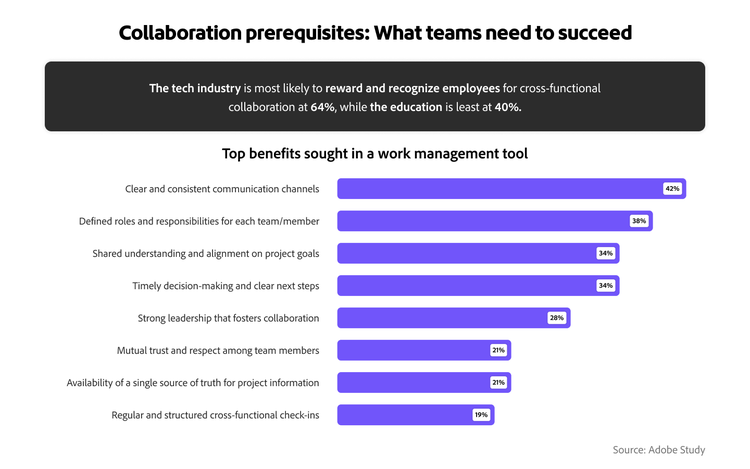
- The top ways to unlock efficiency are clear and consistent communication channels (42%) and defined roles and responsibilities (38%).
- The tech industry is the most likely to reward employees for cross-functional collaboration (64%), while education is the least likely (40%).
Positive impact of effective collaboration.
Effective cross-functional collaboration keeps projects moving and employees productive as well as engaged. Projects run more smoothly and efficiently from planning through delivery stages, leading to higher success rates. The cost of ineffective collaboration becomes evident in missed deadlines, duplicated work and lost productivity, often due to poor workflow management and a lack of a unified collaborative work tool.
When teams don’t share clear goals, projects quickly go off track:
- 76% say it leads to wasted time and effort
- 58% experience missed deadlines
- 57% report decreased work quality
- 47% struggle to track progress
- 23% encounter budget overruns
A unified work management platform can prevent these breakdowns by giving teams a shared view of goals and priorities, which in turn strengthens cross-functional collaboration and reduces avoidable delays.
Driving workflow automation.
By standardising repeatable processes and decreasing manual work, Workfront streamlines execution through its workflow automation capabilities. Auto-generated briefs and other AI-powered features reduce administrative burden and employee burnout, allowing teams to focus on more strategic work.
Together, these features establish Workfront as a tool that improves cross-functional collaboration, increases real-time project visibility and helps teams work together more effectively by creating a less chaotic environment. Providing the right work management software is essential to supporting expanding roles so employees aren't stretched thin. This is critical for retention, as remote and on-site workers are equally likely to cite poor collaboration as a stressor (55%), with on-site employees being 47% more likely to seek new opportunities because of it.
Facilitating more effective communication and productivity.
Addressing collaboration struggles helps teams reclaim valuable hours. Currently, on average:
- 97 hours are lost annually to communication breakdowns
- 81 hours are wasted in unproductive meetings
The opportunity for time savings depends on role, company size or location:
- Senior employees lose 91 hours a year due to unproductive meetings, compared with 65 for entry-level staff.
- Enterprise employees spend 88 hours annually in unproductive meetings, which is 69% more than small business employees (52 hours).
- Employees in New York lose the most time, averaging 90 hours annually, followed by New Jersey (81), California (79) and Florida (76).
In industries that move quickly, getting project workflows and communication right with support from modern team productivity tools means less wasted time and more focus on meaningful work. Some industries stand to benefit even more. Manufacturing employees could reclaim 214 hours annually if collaboration challenges were addressed. At the same time, sales (208), finance (200) and marketing (186) teams can regain more than the national average of 178 hours a year.
Adobe Workfront, a cloud-based work management platform, centralises work to help teams reclaim the 97 hours they lose each year to communication breakdowns. It improves cross-functional collaboration and facilitates structured workflow management. With features like automatic allocation of work to the right individuals as well as centralised request queues, the tool reduces the need for unnecessary meetings, manual processes and redundant conversations while streamlining project intake.
By predicting availability and assigning people to the right priorities, the resource management features in Workfront enhance real-time project visibility. Teams in fast-paced industries — where fluctuating demands can quickly result in meeting overload — benefit from this automation. Workfront also helps teams reallocate time away from administrative burdens and toward high-impact work by optimising resource allocation.
See how Workfront centralises workflows.
Keeping goals on track.
Clear goals are the basis for effective collaboration, but when alignment breaks down at the start of a project, wasted effort and rework quickly follow.
The right work management and team collaboration software can help teams align at the start and avoid costly rework. Poor initial alignment forces 33% of projects to undergo substantial rework and 9 out of 10 employees believe that removing collaboration barriers could free up enough time to fit a full week’s work into just 4 days.
Common causes of misalignment.
To maintain project alignment, organisations must address the recurring issues that employees feel throw projects off course:
- Unclear leadership directives (40%)
- Lack of standardised processes across teams (34%)
- Frequent changes in project priorities (34%)
- Insufficient visibility into other teams’ progress (28%)
- Too many disconnected tools (28%)
- Lack of regular cross-functional check-ins (27%)
- Absence of a single source of truth for project information (23%)
- Lack of training on processes (17%)
Robust workflow management and digital collaboration tools are essential to overcoming these challenges and provide real-time project visibility across departments.
Adobe Workfront addresses these root causes by formalising processes and creating a consistent and unified structure for managing project workflows. For example, project templates and blueprints in Workfront address gaps in standardised processes — cited by nearly half of legal employees (48%) as the primary cause of goal disconnection — by streamlining execution and reducing rework. With a centralised platform, teams can align early and maintain clarity throughout every stage of a project.
Industry-level differences.
The leading causes of goal misalignment vary by industry:
- Education and healthcare: Unclear leadership directives (46%)
- Finance and retail: Unclear leadership directives (38%)
- Hospitality: Lack of regular cross-functional check-ins (41%)
- Legal: Lack of standardised processes (48%)
- Manufacturing: Unclear leadership directives (44%)
- Marketing: Too many disconnected tools (43%)
- Sales: Unclear leadership directives (48%)
- Tech: Frequent changes in project priorities (42%)
Breaking down siloed team structures is essential for effective cross-functional collaboration, as over one in five employees across industries cite this as a barrier.
Workfront acts as a single collaborative work tool that unifies work, people and project data. By centralising workflows and eliminating disconnected tools — a leading cause of misalignment for 43% of marketing employees — Workfront provides a single source of truth that strengthens digital collaboration across teams. Its built-in real-time project visibility helps break down organisational silos, ensuring teams across industries stay aligned as priorities shift.
Improving collaboration in large organisations.
While true for any business, the need for smooth collaboration is amplified in large organisations, where the sheer volume of people, teams, stakeholders and systems requires complex alignment and integration. Managing this scale effectively is where Adobe Workfront excels. Across the board, the potential gains are significant.
If the barriers to alignment were removed, employees believe they could reallocate an average of 178 hours annually from admin tasks to higher-impact work. Finance teams are also optimistic, with 94% of the respondents saying a four-day workweek would be realistic if collaboration improved.
Factors driving effective cross-functional collaboration.
From communication to role clarity, the respondents have highlighted the need for approaches that strengthen collaboration, along with areas where progress often falls short.
Strong collaboration requires clear structures, communication and recognition, yet only 53% of employees believe their organisation’s performance review or incentive systems adequately reward effective cross-functional collaboration.
Factors that make collaboration work.
Employees point to several aspects that can help unlock smoother teamwork across departments:
- Clear and consistent communication channels (42%)
- Defined roles and responsibilities for each team member (38%)
- Shared understanding and alignment on project goals (34%)
- Timely decision-making and clear next steps (34%)
- Strong leadership that fosters collaboration (28%)
- Mutual trust and respect among team members (21%)
- Availability of a single source of truth for project information (21%)
- Regular and structured cross-functional check-ins (19%)
Remote employees are 28% more likely than on-site workers to highlight the importance of a single source of truth, reinforcing the need for team collaboration software and digital collaboration tools that keep everyone aligned.
Adobe Workfront brings more structure and transparent communication to daily work. In industries like education, where 40% cite timely decision-making as a top priority, measurement and reporting tools in Workfront help leaders quickly see how projects are progressing. With easy-to-read dashboards and status reports, teams get the real-time visibility they need to make decisions faster and move forward with confidence.
Differences in collaboration enablers across industries.
Different industries emphasise different collaboration enablers:
- Education: Timely decision-making (40%)
- Hospitality, legal, retail, finance and tech: Clear and consistent communication channels (55%, 45%, 44%, 43% and 42%, respectively)
- Healthcare and manufacturing: Defined roles and responsibilities (40% and 44%)
- Marketing: Shared alignment on project goals (45%)
- Sales: Defined roles and responsibilities (48%)
Varied generational priorities.
What each generation values most in collaboration also varies:
- Baby boomers: Timely decision-making and clear next steps (41%)
- Gen X and millennials: Clear and consistent communication channels (42%)
- Gen Z: Shared understanding and alignment on project goals (40%)
A collaborative work tool or work management platform that can be customised to adapt to these different needs across an organisation can help bridge generational preferences and foster alignment across the workforce.
By keeping assets, comments and project updates in one place, Workfront helps teams stay on the same page — a factor that 21% of employees say is essential for stronger collaboration. With clearer workflows and more consistent communication, organisations can create an environment where cross-functional teamwork feels more natural and is easier to support and reward.
The right work management product for more effective workplace collaboration.
When collaboration breaks down, projects stall and employees lose valuable time. With transparent processes, stronger communication and centralised work management, teams can be more efficient and focus on tasks that matter most.
Adobe Workfront helps bring it all together, giving organisations a single platform to keep projects aligned from start to finish.
Discover how Workfront can help your team collaborate and create from anywhere with the ability for everyone to plan, execute and monitor projects in real time. Take the product tour to experience how Workfront transforms collaboration.
Research methodology.
This article is informed by proprietary research conducted by Adobe. The study surveyed 1,075 full-time employees across the US, providing a 95% confidence level with a ±3% margin of error. Respondents were asked about collaboration in the workplace. As with all self-reported data, results may reflect personal perceptions and experiences that could differ from actual behaviour.