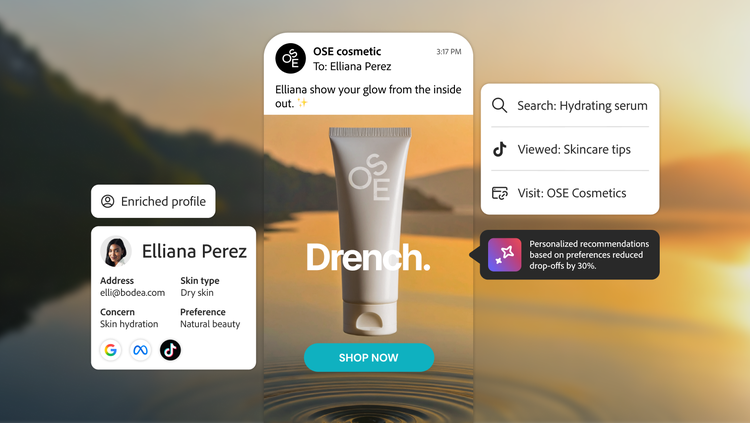
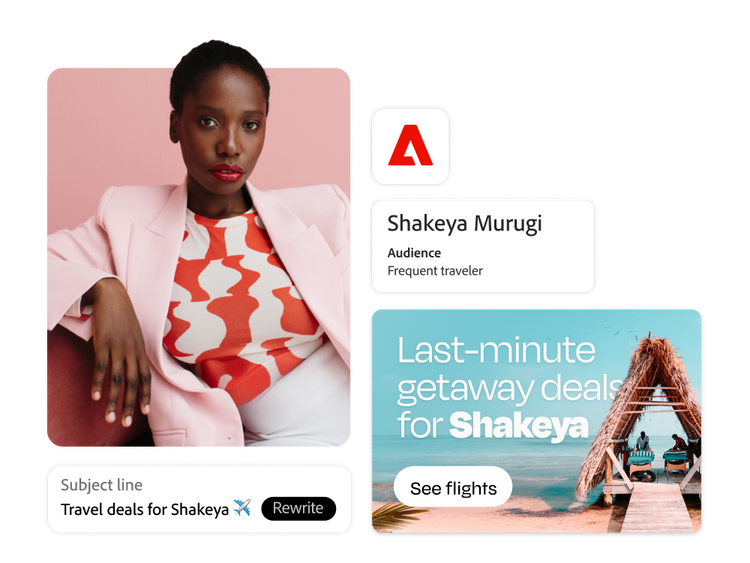
Powering the future of consumer goods with AI-driven personalised experiences.
Bruce Richards
04-09-2026
The consumer goods industry is entering a new phase. Amid converging B2B and B2C dynamics and rising expectations for multichannel experiences, brands are being reshaped by the need for speed, personalisation and relevance across every touchpoint. Buyers — be it retailers, distributors or consumers — now demand seamless, value-driven experiences across their entire purchase journey.
To understand how prepared the industry is for this shift, Adobe commissioned Incisiv to survey 579 consumer goods leaders across nine global markets, with 68% representing enterprises over US$1 billion in revenue and 56% at vice president or above levels. The findings revealed where brands are making progress, where foundational gaps persist and how AI is reshaping the future of personalised experience.
Personalisation maturity remains inconsistent across the journey.
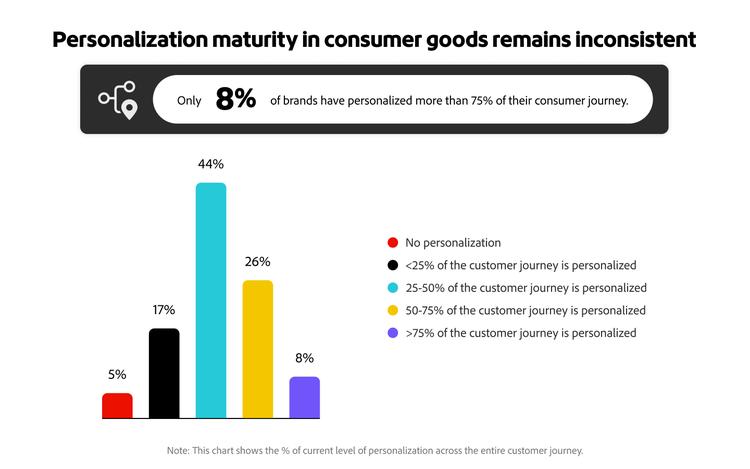
Personalisation across consumer goods is still early in its maturity curve. The survey shows that only 8% of brands have personalised more than 75% of their consumer and customer interactions, while a large portion of engagement is still below the 25% threshold.
This inconsistency reflects how brands operate today — with data and engagement split across retailer platforms, ecommerce marketplaces and direct brand environments. As a result, many organisations continue to rely on basic segmentation and rules-based campaigns instead of predictive, real-time personalisation.
However, this fragmentation also represents one of the greatest growth opportunities across the industry. By unifying consumer, customer and retailer signals, brands can shift from isolated campaigns to connected, always-on experiences that strengthen loyalty and improve commercial performance across complex distribution networks.
Fragmented data is stalling precision and relevance.
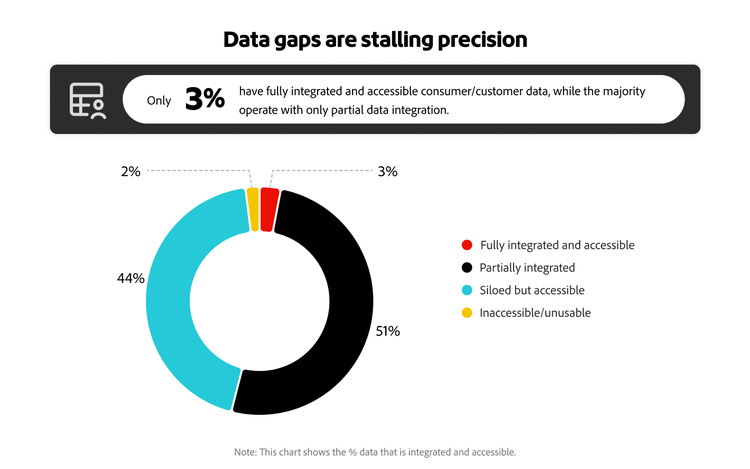
Disjointed data remains one of the most significant barriers to scale in the consumer goods space. Only 3% of organisations reported having fully integrated and accessible consumer and customer data, leaving most brands unable to recognise returning consumers across retailer, marketplace and owned channels.
This lack of integration weakens forecasting accuracy and prevents real-time personalisation — reinforcing why unifying consumer and customer data is foundational to turning disconnected signals into actionable insights at scale.
Marketing structures are shifting toward consumer-centric alignment.
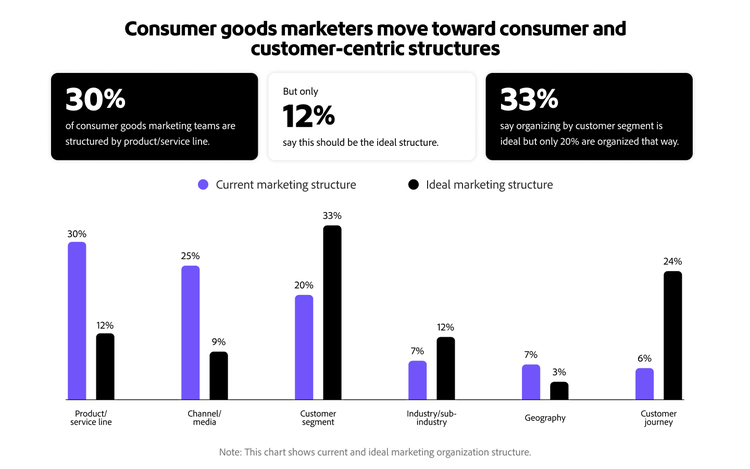
Marketing organisations are transitioning from traditional channel-led structures toward models aligned with consumer and customer segments. Yet the survey shows a clear disconnect between aspiration and execution. While 33% of leaders say organising around the customer segment is the ideal model, far fewer operate this way today. Furthermore, only 6% are currently organised by customer journey, despite 24% identifying this as the ideal structure.
This structural gap limits a brand’s ability to co-ordinate retail media, ecommerce marketplaces and direct brand environments. Leading organisations are starting to adopt hybrid operating models — pairing consumer-centric alignment with centres of excellence for data analytics, shopper insights and AI-driven personalisation — to better reflect how the consumer goods ecosystem functions.
Marketing is transitioning from brand awareness to revenue accountability.
Expectations from marketing teams have shifted — performance is now measured by business outcomes, not just activity.
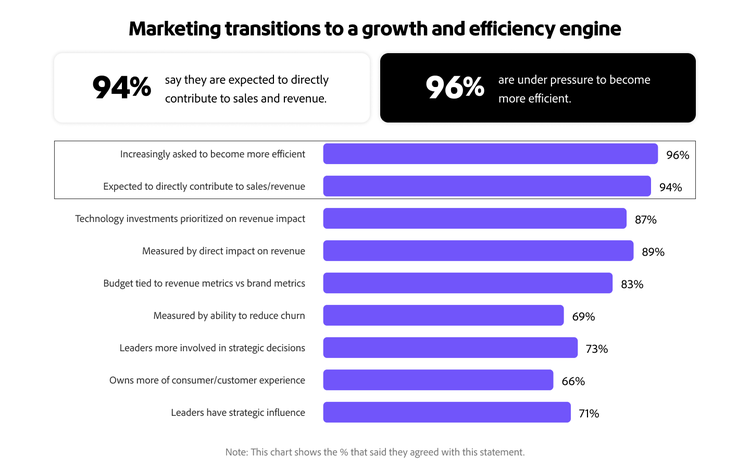
The survey reveals that 94% of leaders are now expected to directly contribute to sales and 96% are under pressure to become more efficient. This shift is forcing organisations to connect brand-building activity with trade investment, ecommerce conversion and distributor performance — turning marketing into a measurable growth engine across both B2B and B2C channels.
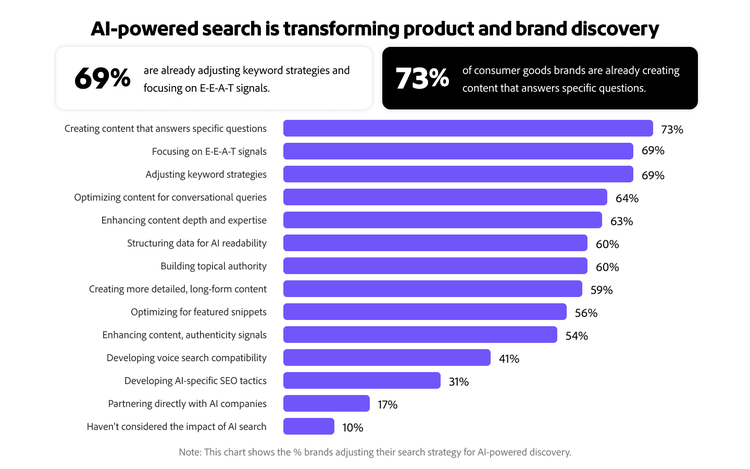
How buyers discover brands and products is being reshaped by generative AI. Already 69% of brands are adjusting keyword strategies to strengthen experience, expertise, authority and trust (E-E-A-T) signals and 73% are creating content that directly answers consumer and customer questions, thereby preparing for discovery in generative AI and conversational environments.
As discovery becomes more conversational, businesses are being forced to rethink how product information, usage guidance and brand stories should be structured. Those that invest in conversational relevance and AI-readable content models will be best positioned to influence demand across both retail and direct-to-consumer contexts.
Generative AI is reshaping content economics.
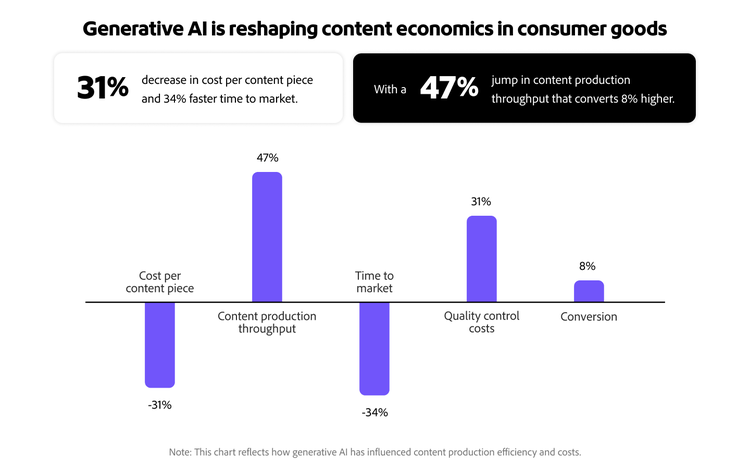
Generative AI is already delivering material efficiency gains across the industry. The survey shows a 31% reduction in cost per content piece, a 34% faster time to market, a 47% increase in content output and an 8% lift in conversion.
As output scales, brands are deploying automation across governance and quality control functions to ensure accuracy, compliance and brand integrity, while expanding personalisation across product portfolios and regions.
Agentic AI adoption is promising but nascent.
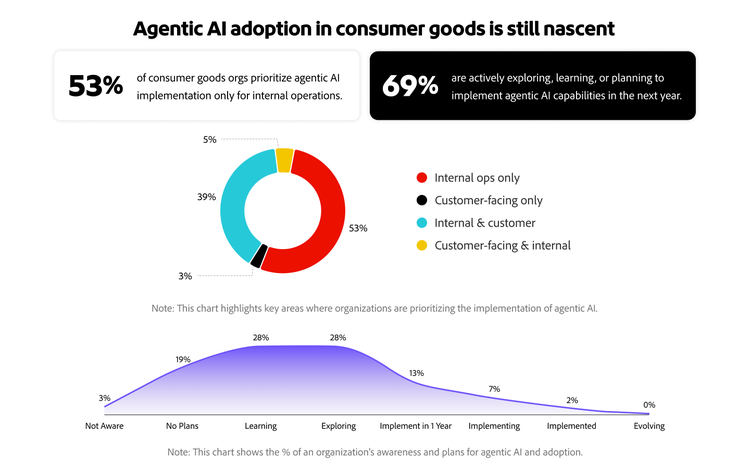
Interest in agentic AI is accelerating, but most consumer goods organisations remain cautious. Among the respondents, 69% are exploring or planning to implement agentic AI, yet 53% currently prioritise it only for internal operations rather than customer- or consumer-facing use cases.
This highlights the industry’s need for stronger governance, better data quality and higher operational readiness before scaling autonomous decision-making beyond the enterprise.
Building AI-ready consumer goods experiences.
To move from experimentation to sustained advantage, leaders in the consumer goods space should focus on three priorities:
- Unify and activate data. Break down silos across retail, ecommerce and direct-to-consumer ecosystems to enable real-time personalisation and predictive insights.
- Modernise the marketing model. Adopt journey-centric structures, AI-ready martech stacks and decision engines that turn insights into action across B2B and B2C engagements.
- Scale AI responsibly. Use generative and agentic AI to accelerate content, discovery and engagement, while embedding governance, compliance and quality controls that protect trust.
The future of the consumer goods industry will be shaped by how effectively brands connect data, operations and engagement across increasingly complex distribution networks.
Read the full report to see how leaders in the consumer goods space are transforming customer experience in an AI-driven world.
Bruce Richards joined Adobe in 2018 and today leads Global Industry Strategy for Consumer Goods with a bold, future-forward vision. With more than 25 years of executive experience in the retail and consumer goods sectors, Bruce is a driving force behind Adobe’s industry direction — helping brands innovate, adapt and succeed in an environment where consumer expectations evolve by the minute.
A specialist in customer experience, digital transformation and modern marketing, Bruce partners closely with Adobe’s clients to craft standout strategies and build the solution ecosystems that bring them to life. His career spans leadership roles in marketing, consulting and customer advisory, where he led client services teams supporting some of the world’s most iconic brands, including Macy’s, Estée Lauder, Bloomingdale’s, Beiersdorf, CVS/pharmacy and Hanesbrands.