Brands will spend over $200 billion on programmatic advertising this year, producing trillions of impressions. Every one of those impressions generates rich behavioural signal: what was watched, on which screen, at what time, against which creative. Yet almost none of that signal makes it home. The campaign ends, the logs are archived and the brand effectively forgets who it just paid to reach.
This is not a new problem and while progress has been made, persistent structural challenges have prevented brands from fully closing the loop between investment and insight.
Paid media and owned channels still live in different systems, run by different teams, reporting to different leaders. Cookies, mobile ad IDs and the third-party data ecosystem built on top of them are all narrowing under privacy regulation and platform changes. Brands that try to solve this in-house hire data engineering teams to build data pipelines and spend 6-12 months in structured query language (SQL) just to answer basic questions.
All of this is expensive, operationally fragile and delayed. By the time insights are available, the campaign and the consumer have moved on and untapped opportunity is left on the table.
But today, Adobe and The Trade Desk are partnering to remove these barriers at once.
Adobe Real-Time Customer Data Platform, Adobe Real-Time Customer Data Platform Collaboration and The Trade Desk together offer a turnkey path from paid media exposure data directly to event and profile data in Real-Time CDP — ready for personalisation, journey orchestration and measurement. No clean-room builds. No dedicated engineering team. No six-month wait. With The Trade Desk’s leadership in relevant, transparent advertising and Adobe’s world-class customer data management, brands can finally, fully act on insights — focusing on customer value while delivering efficiency across the funnel.
“For years, brands have been sitting on a goldmine of paid media signal with no practical way to act on it,” said Ali Nazer, senior director of product management, Real-Time CDP and Real-Time CDP Collaboration at Adobe. “With this integration between Real-Time CDP, Real-Time CDP Collaboration and The Trade Desk, we've fundamentally changed that equation. Marketers no longer have to choose between reach and intelligence — every impression now has the potential to make their first-party profiles richer, their audiences smarter and their owned channel experiences more relevant. This is what it looks like when paid and owned finally work as one.”
Greater reach and actionable insights at your fingertips
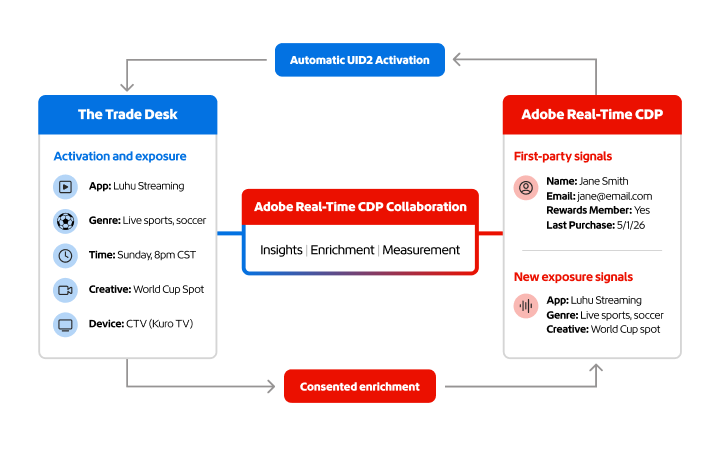
At the centre of this integration is a new pattern enabled by Real-Time CDP Collaboration. The Trade Desk's Raw Event Data Stream (REDS) captures impression-level data across display, video, connected TV (CTV), audio and native. Real-Time CDP Collaboration processes that data at scale and resolves the identifiers back to first-party profiles through an identity pedestrian crossing that can power both measurement and customer profile enrichment.
The result is not just a report — it’s a richer profile. Marketers get campaign attribution and a detailed view of which customers were exposed to paid media, on which channels, how frequently and against which creative. That signal is then immediately available to suppress converted customers from prospecting, enable lookalike expansion off enriched audiences and use content exposure signals for journey personalisation, incrementality measurement against a real cohort and more.
The same integration supports audience activation to The Trade Desk based on its Unified ID 2.0 (UID2) framework. At the point of activation, Real-Time CDP automatically converts first-party audiences into UID2 and delivers audiences to supply-side and demand-side platforms — no customised integration or SQL needed. The Trade Desk can then report all impression delivery back against the originating UID2, giving brands a far more complete picture of reach and frequency across channels.
Now, every dollar a brand spends on paid media makes its owned channels smarter. Audiences get richer every day. Targeting gets sharper. Measurement becomes more honest and actionable. Brands stop renting audience depth and start building it — producing a compounding advantage that third-party signals alone cannot deliver.
“Advertisers are increasingly looking for ways to connect media performance with deeper customer intelligence in a privacy-conscious way,” said Natalie Kansteiner, senior director of data partnerships at The Trade Desk. “By expanding our integrations with Adobe Real-Time CDP and Real-Time CDP Collaboration, we’re helping marketers more easily activate and measure first-party data across the open Internet. Together, Adobe and The Trade Desk are enabling brands to create more relevant advertising experiences while improving transparency, interoperability and actionable insights across paid and owned channels.”
With this integration, brands can easily tap into powerful new capabilities, including:
- Automatic translation to UID2 from Real-Time CDP. At activation time, Adobe automatically translates first-party audiences in Real-Time CDP to UID2, enabling privacy-preserving delivery to The Trade Desk and consolidated, reliable impression reporting against the originating identifier.
- Audience overlap and discovery in Real-Time CDP Collaboration. Using instance overlap insights and index scores, marketers can explore The Trade Desk exposure signals against their first-party audiences and glean new exposure and affinity signals such as platform, time of day and creative.
- Outcomes-based measurement of The Trade Desk campaigns. Turnkey reporting with intuitive workflows and dashboards allows marketers to overlay first-party conversions against The Trade Desk impressions for actionable campaign attribution that can inform in-flight and ongoing spend.
- Profile enrichment. Simple, click-based workflows enrich consented first-party audiences with behavioural attributes like last exposure date, channel mix, exposure count and content affinity for segmentation and activation in Real-Time CDP.
- Richer owned channel activation. The integration gives marketers the ability to use enriched profiles in owned channels such as email, web and mobile, as well as paid channels like social — directly from Real-Time CDP.
- Identity resolution across known and pseudonymous identifiers. Resolution of UID2 against hashed email, Adobe’s third-party cookie Demdex and mobile ad IDs maximise match rates to power prospecting and re-engagement campaigns.
Partnership in action
To better understand how the integration works, consider the example of Meridian Foods, a fictitious CPG brand running a CTV and display campaign through The Trade Desk. Today, Meridian’s media team can report on impressions served through The Trade Desk's aggregated reports — but they want deeper measurement and the ability to act on exposure signals across other channels like email and paid social.
Thanks to the new partnership with Adobe, Meridian connects its Trade Desk account to Real-Time CDP Collaboration and onboards audience and conversion datasets from Real-Time CDP in a few clicks. Adobe processes Meridian's REDS feed and resolves impression-level identity signals against Meridian's first-party data. Within the Real-Time CDP Collaboration interface, Meridian's marketers view overlap insights and attribution reports for their most recent campaign. Based on these insights, they select the most relevant attributes and send them back to Real-Time CDP to enrich their first-party audiences.
Now, Meridian can build audiences like “Exposed to CTV 3+ times” or “Football affinity” and activate them to owned channels or walled-garden Customised Audiences for lookalike optimisation — all driven by the paid media signals its existing budget was already generating.
The ability to connect paid media signals to first-party profiles has been a gap in the marketing technology stack for years — not because the data didn't exist, but because the identity resolution and pipeline infrastructure to act on it at scale wasn’t built into the platforms brands already use for segmentation and activation.
The integration between Adobe Real-Time CDP, Real-Time CDP Collaboration and The Trade Desk fills that gap. Brands can now treat their paid media spend as a source of first-party intelligence, reducing dependence on inaccurate, waning third-party signals and improving overall outcomes.
Learn more about Real-Time CDP Collaboration and how Adobe's data collaboration capabilities can help you to activate the full value of your paid media investment.
Lory Mishra is a principal product marketer for Adobe Real-Time CDP. She launched and currently leads the go-to-market for Adobe Real-Time CDP Collaboration, a neutral and radically simple data collaboration application. Prior to her role in product marketing, Lory led account teams for Adobe's largest enterprise customers and drove performance marketing initiatives at digital agencies across industries.
Anshuman Nangia is product manager for Adobe Real-Time Customer Data Platform and Adobe Real-Time CDP Collaboration. He leads activation products covering tags, event forwarding and destinations and manages strategic ecosystem integrations with identity and data partners.