


117% lift in homepage engagement


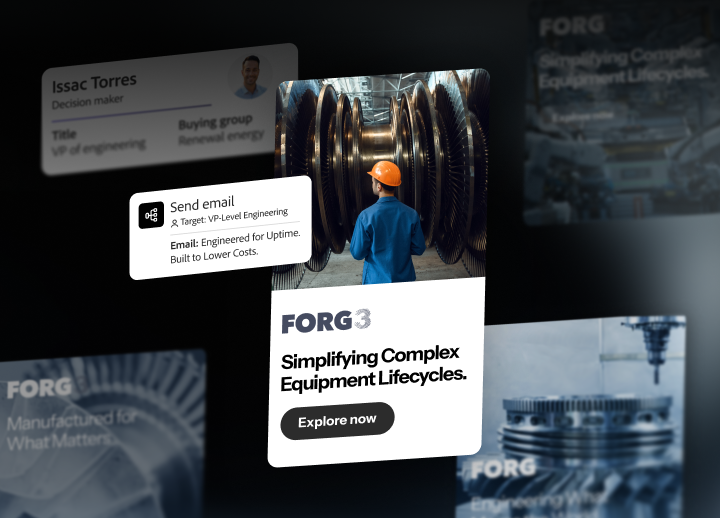

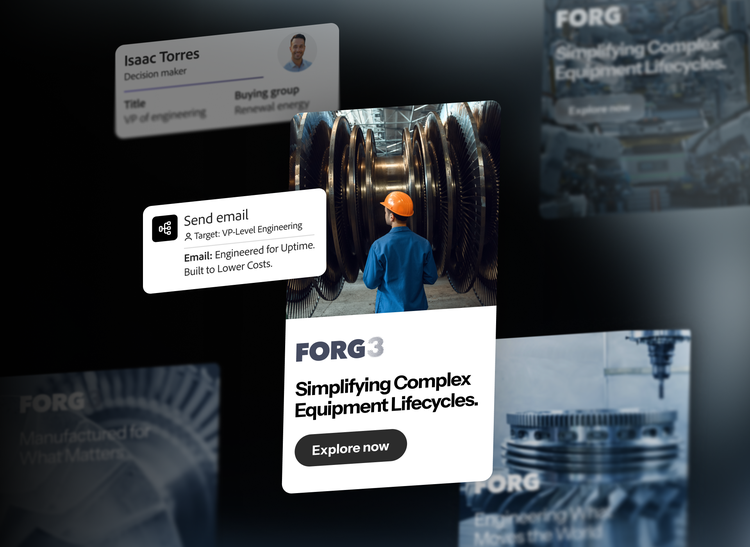






From complex product configuration to distributor enablement and aftermarket service, Adobe helps manufacturers simplify decision‑making, support partners and deliver seamless experiences from initial research through long‑term ownership.
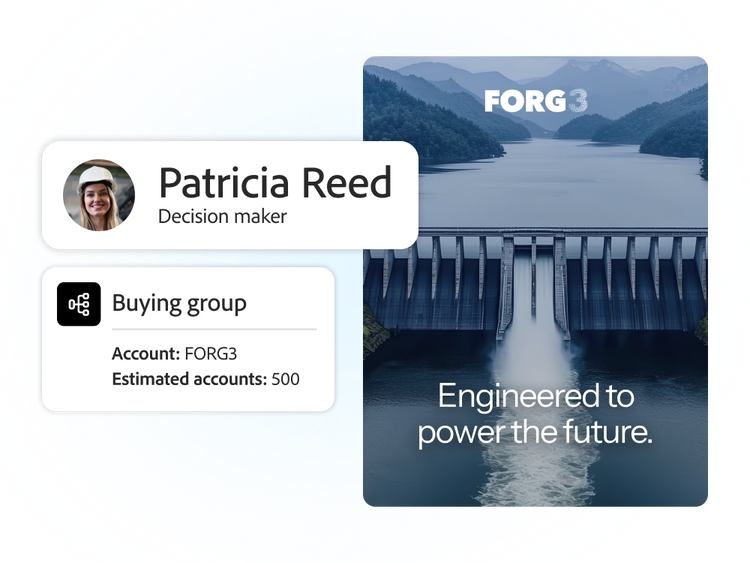
Bring clarity and co-ordination to complex industrial buyer journeys with deeper insights and more timely, relevant engagement.
The data needed for industrial buying decisions often sits in many silos — from engineering systems and service records to distributor portals and digital channels. Adobe unites this fragmented data to:
Industrial buying groups can include a broad mix of roles across engineering, procurement and operations — each with different needs and timelines. Adobe can align your sales, marketing and service with shared account views and real‑time signals, so teams can:
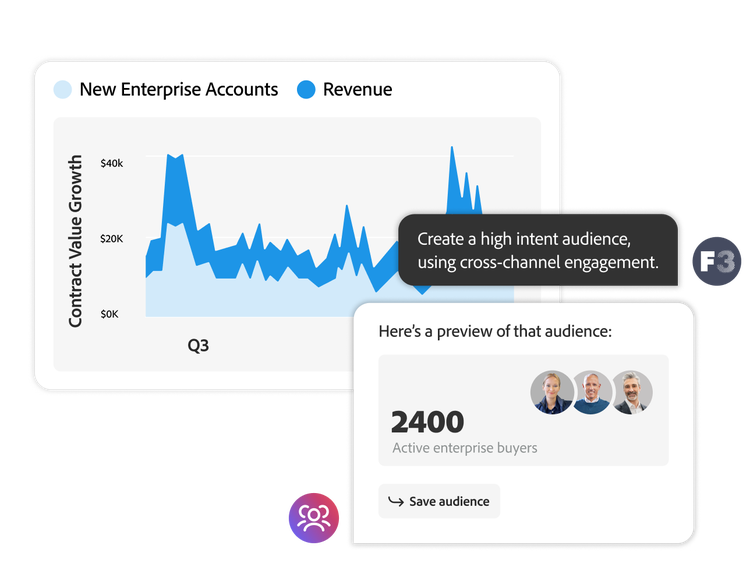
Give industrial buyers faster and more intuitive digital paths from research to purchase with AI‑ready discovery, greater product visibility and more connected data, content and commerce.
Legacy portals and manual quoting workflows can significantly slow the efforts of engineers, procurement teams and plant leaders. Adobe modernises these experiences with intuitive, scalable commerce capabilities, enabling teams to:
Industrial manufacturing product content is often stored in scattered systems and inconsistent formats, which limits discoverability and reduces site performance. Adobe unifies and structures content operations across brands and regions, enabling teams to:
Industrial manufacturing buyers increasingly rely on search engines and AI‑powered research tools that work best with properly structured product information that’s clear and accurate. Adobe enhances brand discoverability by optimising and governing your content using AI agents, enabling your teams to:
Quickly deliver high‑quality, personalised content at scale by simplifying workflows, centralising assets and accelerating content creation.
Traditional processes can’t keep pace with the tailored content that manufacturing teams need across products, regions and buyer roles. Adobe accelerates creation with generative AI across the full lifecycle, enabling teams to:
Manufacturing teams manage large libraries of product images, technical documents, training materials and marketing assets — often spread across siloed systems. Adobe centralises these assets in one governed environment, enabling teams to:
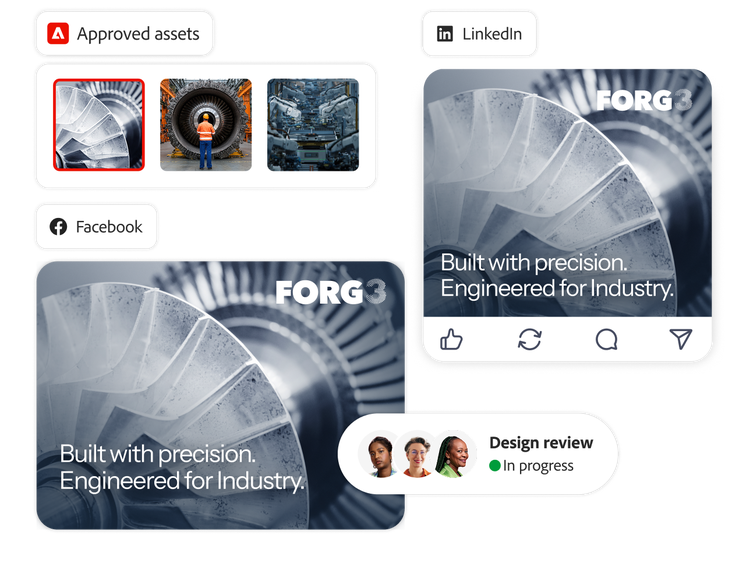
Slow, disconnected review cycles create bottlenecks for engineering, legal and compliance teams across manufacturing organisations. Adobe unifies work, feedback and approvals in a single governed workflow, enabling teams to:
117% lift in homepage engagement

3X faster to create a new marketing programme

55% Increase in net merchandised value with faster, more relevant content for customers

25% More unique visitors and page views in one year

Connected 10 teams through process alignment

15% increase in website traffic by optimising content and delivering more relevant customer experiences

“It’s rewarding to deliver qualified leads to sales that they agree are valuable. Digital marketing has earned greater respect up to the executive suite.”
In the era of Industry 4.0, industrial manufacturing is undergoing a rapid transformation as companies respond to rising costs, global disruptions and increasing operational complexity. This shift is fundamentally changing traditionalB2B sales models in several key ways:
Breakdown of traditional Go-to-Market (GTM) models
Traditional GTM models, which relied heavily on field representatives, trade shows and in-person demonstrations, are currently breaking down. Modern B2B buyers now expect seamless engagement across both digital and human channels, requiring manufacturers to move away from disconnected outreach toward orchestrated, data-driven engagement.
Shift to digital-first self-service
Manufacturers are transitioning from relationship-driven sales to digital-first engagement. Buyers increasingly choose to research, configure and purchase online, creating a need for self-service portals that can handle complex catalogues, negotiated pricing and multi-step approvals. This shift empowers customers with instant access to the information they need, reducing the friction associated with fragmented, manual sales processes.
Alignment through unified data
Traditional sales models were often hindered by siloed data across systems, business units and geographies. Industry 4.0 necessitates a single source of truth that unifies data from engineering, supply chain and service portals. This alignment allows sales and marketing teams to prioritise high-value accounts and co-ordinate their efforts to reach the right stakeholders at the right time during long, complex sales cycles.
Adoption of AI-powered sales automation
The integration of AI and agentic solutions is revolutionising how manufacturers engage with buying groups. AI agents are now being used to automate brand activation and improve product discoverability on digital surfaces, which shortens buying cycles and reduces the reliance on manual sales interactions. Furthermore, intelligent conversational experiences guide buyers through complex configurations, making the purchase journey simpler and more efficient.
Personalisation at scale
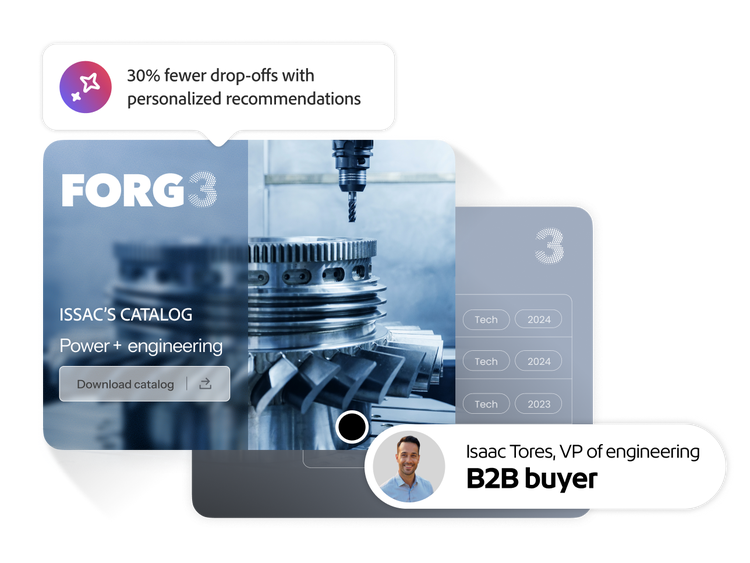
A defining challenge of Industry 4.0 is balancing personalisation at scale with operational efficiency. Manufacturers are moving toward 360-degree, profile-driven experiences that use AI-powered analysis to predict buyer interest. By delivering tailored, role-based shop fronts for specific personas—such as engineers or procurement managers— companies can differentiate themselves and build long-term loyalty in a volatile market.
Sales cycles in the industrial manufacturing sector are exceptionally long and complex, with data scattered across distributor conversations, field rep visits and service portals, making it difficult to track where a deal stands. Adobe unifies data from engineering, supply chain and service channels into 360-degree profiles that use AI-powered analysis to predict buyer interest across buying groups.
This allows sales and marketing teams to align around a "single source of truth," allowing them to prioritise high-value accounts and ensure consistent messaging for engineers, plant managers and procurement teams alike.
In industrial manufacturing, AI agents improve the discoverability of complex SKUs through a strategy known as Agentic Brand Activation. This approach ensures that highly technical products—such as those with numerous variations in Automation & Control or specialised Industrial Machinery—are easily located and understood by buyers. AI agents improve discoverability through the following mechanisms:
Many manufacturers still rely on manual quoting and relationship-driven sales, but they lack the unified data foundation to meet modern buyer expectations for digital self-service.
Adobe transforms outdated ERP-driven portals into modern commerce experiences with role-based shop fronts that support complex SKU assemblies, multi-tier approvals and customised configurations. As a result, manufacturers empower customers to research, configure and purchase on their own terms; for instance, a national HVAC system distributor achieved over $1B in annual online revenue through this flexibility.
Adobe’s AI tools reduce the cost to sell by streamlining the Lead-to-Cash process and transitioning traditional, high-touch manual sales models into scalable, digital-first operations. By leveraging Adobe for Business, industrial manufacturers can turn operational complexity into a competitive advantage through the following mechanisms:
Automating lead management and account orchestration
Adobe uses AI-powered analysis of individual and buying group data to predict buyer interest and target audiences with greater precision.
Reducing reliance on manual sales interactions
A core strategy for lowering costs is the shift toward self-service and agentic automation.
AI Agents: Adobe’s agentic brand activation uses AI agents to automatically optimise and govern content. This shortens buying cycles and reduces the need for manual sales interactions as buyers increasingly rely on AI-driven search and research.
Optimising the content supply chain
Manufacturers face heavy demands for technical and marketing materials that typically require manual effort. Adobe solves this via an AI-powered content supply chain.
AI personalisation simplifies complex industrial product configuration by transforming traditional, high-touch manual processes into intelligent, self-service digital experiences. Within the Industry 4.0 framework, this is achieved through several specific mechanisms:
Role-based shop fronts and tailored catalogues
Instead of forcing every user through the same dense product manual, Adobe’s AI -ready web experiences provide role-based shop fronts. This means the digital interface automatically adjusts its product catalogues, content and pricing to suit the specific needs of different stakeholders, such as engineers, plant managers or procurement teams.
By tailoring the visibility of complex SKU assortments and variations to the user’s intent and persona, the system reduces the cognitive load required to navigate large product assemblies.
Intelligent conversational buying
Adobe simplifies the discovery and selection of complex parts through intelligent conversational buying experiences.
Content support via generative AI
A major hurdle in product configuration is the sheer volume of technical content required to support every possible variation. Adobe’s generative AI tools (such as Adobe GenStudio) help scale this content by:
Modernising ERP-driven portals
Adobe transforms outdated ERP-driven portals and manual quote workflows into modern commerce experiences. By integrating digital shop fronts with back-office systems, the AI can surface real-time data regarding stock availability, customised configurations and tiered pricing. This enables customers to "research, configure and purchase on their own terms," which significantly reduces the friction and errors associated with manual data entry and off-line communication.
Agentic brand activation
As buyers increasingly rely on AI-driven search, Adobe uses AI agents to automatically optimise and govern product content. This ensures that when a buyer is researching a complex industrial system, they are presented with accurate, structured and structured content that makes the configuration options clear and trustworthy, thereby shortening the buying cycle.
In summary, by unifying data from engineering and supply chains, Adobe allows manufacturers to deliver a 360-degree profile-driven experience that predicts buyer interest and simplifies the "Lead-to-Cash" journey for even the most complex industrial assemblies.
Adobe’s agentic brand activation solution uses AI agents to automate the optimisation, activation and governance of digital product content, ensuring that a brand is found, understood and trusted as buyers increasingly rely on AI-driven search and self-service research.
These AI agents automate these processes through the following specific methods:
By utilising these AI agents, industrial manufacturers can scale their operations efficiently, providing the structure and accurate content necessary to satisfy complex industrial buying groups while driving more efficient, scalable growth.